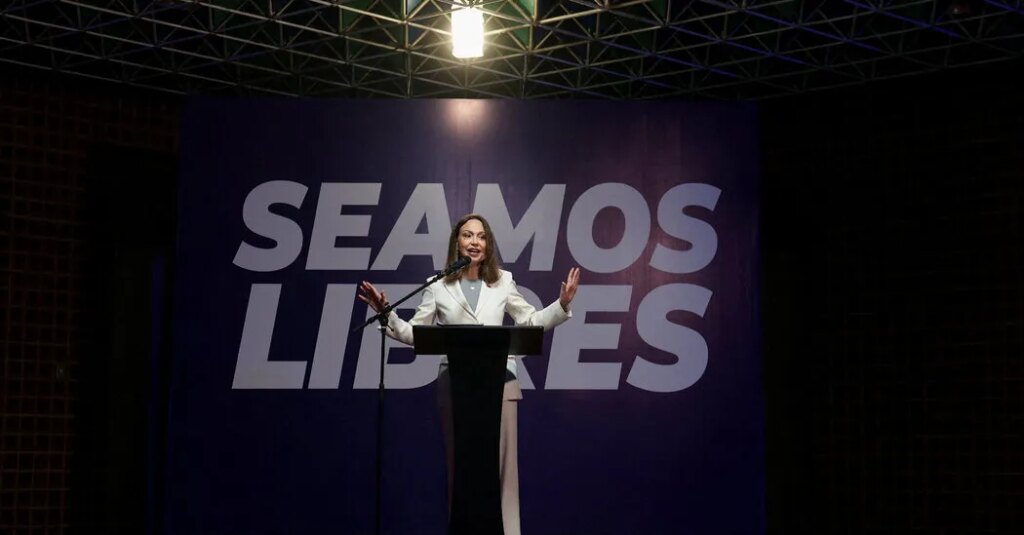
The popular opposition leader María Corina Machado appeared before reporters in Venezuela’s capital on Thursday and thanked the Trump administration for removing her country’s autocrat — while also signaling independence from Washington and calling for an election in 2027.
Ms. Machado made her long-awaited return to Venezuela on Sunday, after months in which she said she had been blocked from the country. On at least one occasion the United States had discouraged her return.
The relationship between Ms. Machado, long a darling of the Washington establishment, and the Trump administration had been strained in recent months. She has objected to President Trump’s decision to keep the authoritarian government in power in Venezuela, even after he sent U.S. forces there on Jan. 3 to seize President Nicolás Maduro.
On Thursday, Ms. Machado expressed gratitude to Mr. Trump and his Secretary of State, Marco Rubio, saying that “thanks to their vision, their courage, and their action on Jan. 3, the door to freedom has been opened” in Venezuela.
But she also doubled down on her criticism of a businessman who has become the Trump administration’s top business partner in the country, Alejandro Betancourt, saying that a significant oil deal between Mr. Betancourt and the U.S. lacked the transparency the Venezuelan people want.
“This person in particular,” she said of Mr. Betancourt, has been “investigated in connection with cases and very serious crimes in various countries around the world.”
Mr. Betancourt has never been charged with a crime.
Responding to Ms. Machado’s statements, a spokesman for Mr. Betancourt’s company said: “We look forward to sharing more with the public about the work we are doing under existing agreements, made under all applicable laws,” adding that the company had delivered on all past contracts and “has never once been charged with any violation.”
In a text message, Mr. Betancourt added that his company’s “main focus is on growing production, adding jobs to the Venezuelan oil industry and growing the US-Venezuelan ties.”
Ms. Machado’s statements could aggravate tensions with U.S. officials, and reflect a balance she is trying to strike between pleasing Washington and appealing to everyday Venezuelans, who have demonstrated a desire for change.
Ms. Machado has led Venezuela’s opposition for the last three years, and organized the campaign to oust Mr. Maduro in the 2024 election. But the regime manipulated the vote and falsified the results, according to independent observers, stealing an election won by the opposition. Mr. Maduro stayed in power.
After American forces captured him and took him to the United States to face criminal charges, the Trump administration installed his vice president, Delcy Rodríguez, as the country’s leader. Since then, Mr. Trump has lauded Ms. Rodríguez, who has made concessions he demanded, including U.S. control of a large share of Venezuela’s oil output.
Ms. Machado left the country late last year to receive the Nobel Peace Prize. In recent months she has been blocked from entering Venezuela by forces she has declined to name.
On Sunday she entered Venezuela through neighboring Colombia, according to two government officials.
On Thursday Ms. Machado, a former legislator, said that her return to Venezuela “was something strictly autonomous, organized by our teams,” and not by governments. She declined to share more details.
Her conversation with the press was held in an auditorium at the Andrés Bello Catholic University in Caracas. Outside, hundreds of supporters gathered to greet her, singing the national anthem, cellphones held aloft.
Ms. Machado’s appearance in public, calling for a change of government, would have been unthinkable just two years ago. She was living in hiding inside the country and the ruling party was lashing out at her supporters in one of the most repressive campaigns in its more than two decades in power.
The U.S. removal of Mr. Maduro and its oversight of finances and political dialogue have opened space in the country for dissent, though it is still far from free, with more than 300 political prisoners behind bars and repressive laws on the books.
The post Venezuelan Opposition Leader Thanks Trump but Marks Distance From Him appeared first on New York Times.