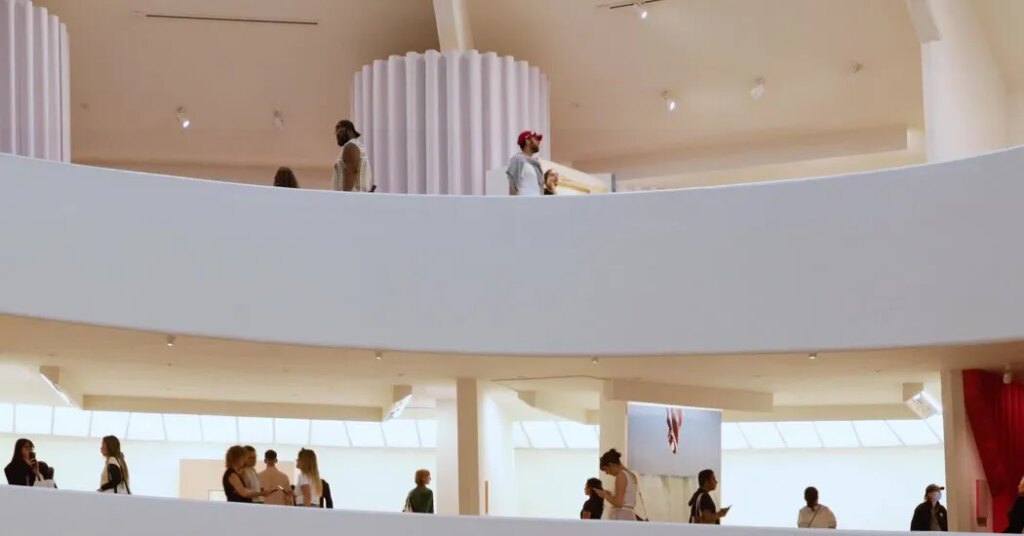
Quality takes time to surface; quantity is easier to see. For the New York-based artist Taryn Simon, the challenge of making a photography exhibition has regularly been expressed in metrics: this many years of research, this many miles traveled, this many images, this many texts. The numbers always spiral upward, as does her current show at the Solomon R. Guggenheim Museum — which, true to form, arrived in September with quantitative honors. The first photographer given a solo show in the museum’s spiraling galleries. The largest debut of new artwork ever staged at the Guggenheim.
Count how many photos: over 1,700, plus the videos and sculptures too. Clock how many years: almost 10. When this show opened, Vogue praised Simon’s bespoke outfits in equally numerical terms: She has “dozens, maybe hundreds” of the same practical skirt with suspenders. The Wall Street Journal, a statistics-loving newspaper, counted how much she walks: “Sometimes I’ll hit 30,000 steps before 11 or 12.”
What is the function of this quantitative shock and awe? Do numbers have powers that a picture does not? (And most pictures, these days, are made of numbers: ones and zeros, computed billions of times into cyan, magenta, yellow and black.) Since her earliest days, when she photographed exonerated convicts for her series “The Innocents” (2000-03), Simon has tried to visualize murky currents of power with an unrelenting work ethic, not to mention hefty budgets. The force of her pictures lay not just in what they depicted, but in the diligence and effort required to capture them. She is the hardest-working woman in the darkroom, and she wants you to know it.
I’m not convinced all this hard work pays off, certainly not in the case of “Father Country I Do Love You,” now filling the Guggenheim. It is the second most solipsistic exhibition I have ever seen at this museum (last year’s Rashid Johnson exhibition is still the vainest), and tragic besides, because Simon really can be an impressive photographer when she uses her powers of persuasion and technical skill more precisely. This show has pictures of real strength and surprise, but they’re submerged in a mock-paranoid mapping of recent American history riddled with banalities, affectations, off-key jokes and literal toys. She cannot get out of her own way, and no one at the Guggenheim — which commissioned the work, and has now acquired it for its permanent collection — seems to have helped her.
Here’s the conceit of “Father Country I Do Love You”: In 2017, Simon had lunch with an agent at the Federal Bureau of Investigation. She does not tell us his name, offering instead the James Ellroy-esque detail that they met “at Los Portales, a Mexican restaurant off an airport service road in Maryland.” Artist and agent hit it off, and over the coming decade he tells her about his career. At least as he narrates it, it intersected with almost every major episode of political upheaval from the end of the Cold War to the first election of President Trump, when the agent retired. (A frame narrative at the show’s start and end invokes Simon’s father, who also worked for the U.S. government in a shadowy role; more on that in a spoiler-laden postscript.)
From these conversations, Simon produced 42 sequences of artworks, mostly color-coded photographs: count them, forty-two. The agent describes wiretapping a small-time cocaine dealer in Washington in the early 1990s; here now is the drug dealer, photographed from the back. The agent let Jodie Foster shadow him at Quantico in preparation for “The Silence of the Lambs,” and here now is Jodie Foster, 35 years older, her fingers inked with proper F.B.I. technique.
Simon travels to Kenya to photograph 36 blinded survivors of the 1998 bombings at the American embassy in Nairobi, where the agent was stationed; each picture has excessive headroom and plain lighting, and hangs in a uniform tiled display. She heaps McDonald’s French fries against a backdrop of Communist Party red: not just any McDonald’s fries, but fries purchased at the specific Pennsylvania McDonald’s where Mr. Trump staged an election photo op at the drive-through.
We know the artist schlepped to that particular McDonald’s because the French-fry photos come, as do most images here, with extended captions. These not only specify that the F.B.I. agent enjoyed eating McDonald’s at the Beijing Olympics, but offer extraneous details about earlier McDonald’s sponsorships, about limited-edition hamburgers only available in Beijing, and about Mr. Trump’s stated desires to serve McDonald’s to Xi Jinping, the Chinese president.
You will have noticed the tone: connecting the dots, unmasking the truth. These photographs, the show wants us to believe, are not just images, but evidence — shot in the cool style of courtroom exhibits, or stock photography. These extended wall labels are not just texts, but disclosures — and at the Guggenheim I saw visitors training their camera phones on the labels, rather than the photographs, as if that were where the real work lay. (It takes hours on your feet here to read them all.)
Hanging over this exhibition-as-evidence-locker is Simon’s deep-state Zelig, popping up at terrorist attacks, political conventions, at a Capitol shooting. Yet behind the patina of disclosure, Simon behaves like someone who wants her own cover blown. . Numerous biographical details in the interviews Simon conducted appear to match the life of Jeffrey Bedford, who served in the F.B.I. from 1989 to 2016, rising to the rank of unit chief. My repeated efforts to contact him at work and through relatives were unsuccessful, but Bedford was born in Exeter, N.H., as was Simon’s agent. He attended Phillips Exeter, Amherst College and Golden Gate University School of Law before joining the police force in Manchester, N.H.; Simon’s agent, she lets him tell us, did all that too.
She does not redact the names of her agent’s parents — also the names of Bedford’s parents — when she interviews them in a nursing home. Nor does she redact the name of her agent’s partner, killed in the line of duty, when she photographs the chaplain who led her funeral; Bedford has publicly discussed his partner’s killing on a podcast.
By the show’s end she even lets Simon’s retired agent disclose that he left the bureau to work in campus security at a “pretty hoity-toity, all girls” school, whose alumnae include Jackie Kennedy. No secret, then, what school that was: the Holton-Arms School, in Bethesda, Md. In 2020, one Jeffrey Bedford published an article on his campus safety work at Holton-Arms, complete with smiling headshot.
These are not secret details; I found them with two minutes’ searching on my phone at the Guggenheim’s coffee bar. They are so unclassified that Bedford’s own LinkedIn profile mentions “overseas assignments” in Kenya and Saudi Arabia, which Simon’s agent also undertook, “as well as 9/11 at the Pentagon.”
In other words, Simon’s cloak of privacy over her agent is a MacGuffin of the most classic Hitchcockian vintage — a performance of protective anonymity, to invest each photograph with the frisson of a political thriller. She even winks at this in the show’s one truly great gag: five portraits of Valerie Plame, outed as a covert C.I.A. agent in 2003, posing for Simon in the disguises of a cowgirl, a Hollywood star, a Starbucks-sipping corporate lackey.
So the question becomes: Why has Simon propped up this giant show with a secret that is not a secret? Asked for comment, the Guggenheim would not confirm his identity either: “It was an artistic decision not to reveal the identity of the agent. Simon kept him unnamed because she wanted him to represent the ‘everyman.’”
Yet this is exactly the trouble: the distraction of an undisclosed narrator suggests she doesn’t trust her photographs alone. The agent’s pseudo-anonymity is functioning just like the large grids, the long captions and the neutral backgrounds: it sheathes her pictures with a veneer of objectivity. The supposed disclosures assign to the pictures an assumption of credibility that has been draining away from photography for well over a century, and that is now, with the arrival of computational imagery from artificial intelligence, very close to death. But if all the pictures here are true — corroborated through the extended texts — then we don’t have to ask if any one picture is good.
That isn’t how truth in photography works, and someone as smart as Simon already knows this. Whether the agent really did meet Jodie Foster is totally irrelevant for whether Simon has made a good photograph of Jodie Foster (and she really has). Whether he ate McDonald’s in Beijing cannot make a still life of Pennsylvania-terroir French fries any less heavy-handed (which it really is).
Any truth in photography inheres in the image, not in the caption. The sensation I felt at the Guggenheim was uncannily similar to what I feel reading the A.I. summaries that now appear above web search results, which declare (with total confidence and putative neutrality) that such-and-such really happened, but are as likely to be wrong as right.
“Truths are illusions which we have forgotten are illusions,” Nietzsche insisted, and his skepticism of a rigid truth/fiction binary would animate so much art and philosophy of the 20th century: Truth is only a social convention, the malleable product of institutions and discourses, and no “outside” reality exists to evaluate a claim. The truth has had a rough ride in America lately. Nietzsche had an answer, though: In art, at least, we still have one last place where the true dimensions of the world can be grasped. Art happens through allusions, metaphors, stylizations. Art admits its constructedness openly, and it is honest about what it cannot know. And through that craft, it keeps our larger will to know alive.
But Simon plays hide-and-seek in one other way at the end of this show: a video of her father, whose memories of his own government activities have been lost to Alzheimer’s. This should be the moment of metaphor: the agent merges with the parent, America into Lethe. And yet she can’t help herself — dad, yet another text recounts, manufactured arcade games after his government service, and so Simon has embedded the video of her father into a giant marble run, with a chute spanning half the museum. As Guggenheim attendants encouraged families to send the balls sliding down the ramp, like the seabirds in “Mr. Popper’s Penguins,” I watched in disbelief. After all this work, the truth was only a game.
Taryn Simon: Father Country I Do Love You Through March 14, 2027, Solomon R. Guggenheim Museum, 1071 Fifth Avenue, Manhattan, 212-423-3500; guggenheim.org.
The post Her Detective Story Is All Clues and Little Mystery appeared first on New York Times.