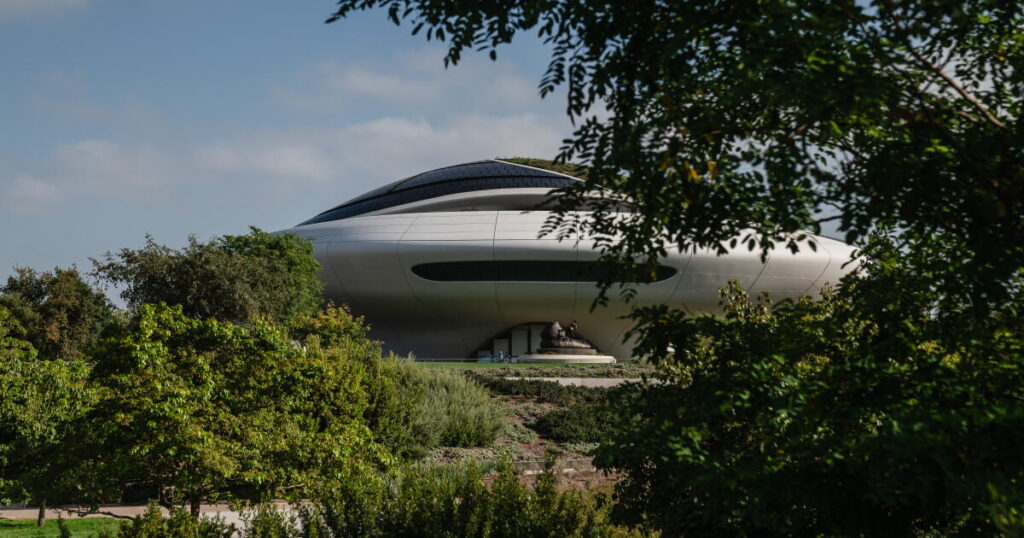
Cris Sarabia clutched his binoculars, craned his neck and envisioned a brighter future than what he saw at street level. Atop the new Lucas Museum of Narrative Art sits a rooftop garden not accessible to the public. As Sarabia, a native plant advocate, stared at it, he imagined a waystation for monarchs on their commutes across Los Angeles.
“What a perfect spot,” he said. “That’s an easy part to start to flip to support our native species.”
When the Lucas Museum of Narrative Art opened in September, it touted its 11 acres of park space and greenery from the ground to its undulating roof as a celebration of California’s landscape.
The Lucas gardens in Expo Park are an undeniable improvement on the asphalt parking lot they replaced, but they are a missed opportunity to create the habitat Los Angeles desperately needs. Museum officials, firm leaders and local stakeholders have continually communicated that the gardens would feature “indigenous” or “native” plants. At a museum preview event, Mia Lehrer, president of Studio-MLA, the landscape architect firm behind the gardens, described looking to California’s mountains, meadows, foothills and valleys for inspiration. “The landscape will foster habitat for birds, bees and butterflies,” she said.
One element that makes California’s mountains, meadows, foothills and valleys so special are their native plants, which have long provided habitat for native species. While there are some native plants and many drought-tolerant plants across the Lucas grounds, there are also surprising gaps. While Angelenos are using water rebates to replace turf with native grasses, expansive non-native lawns blanket the Lucas. Sustainability may have been a focus for the Lucas gardens — the museum’s website trumpets solar panels on the roof and a rainwater irrigation system — but its planting choices have room for improvement.
A native Angeleno, Sarabia is the longtime conservation director for the Palos Verdes Peninsula Land Conservancy. He has spent decades advocating for the reincorporation of native plants into our built ecosystems for the benefit of animals, insects and humans. In two visits to the museum during its first weeks of operation, he noticed an absence of bees and birds, key indicators of habitat.
The involved parties seem to grasp the value of promoting the garden as a haven for the creatures that have called our region home for centuries. But the museum has not yet fostered an ideal environment for them. To supply sufficient habitat, the conservation-focused National Wildlife Federation recommends a minimum goal of 70% native plants. Locally, the Theodore Payne Foundation requires gardens to incorporate at least 50% native plants to be considered for its annual native garden tour.
The Lucas Museum declined to reveal its percentage of native plants, but native plant experts estimate it doesn’t clear either threshold. One way to measure is calculating biomass, which refers to plant life by weight but is complicated to do. Charles Miller, a native plant expert and chair of the Los Angeles chapter of Al Gore’s Climate Reality Project, which empowers climate activists, guessed on the high end that the gardens’ biomass might consist of 35% native plants, including plants native to Northern California. Shrubs and ground covers measure far less than that, but trees boost the number.
“We would love to work with the Lucas Museum on ways to replace some of the non-native plants here with very easy to care for native plants, that have evolved in the Los Angeles area, that are biodiversity powerhouses that support a lot of wildlife,” said Amina Sharma, the California Native Plant Society’s communications manager. “You know: butterflies, moths, caterpillars, birds. That would do a lot to make this landscape come alive.”
I told the Lucas Museum and Studio-MLA about the experts’ critiques and offers of assistance. They issued a joint statement, asserting that the museum never set a specific target for native plants, but did not respond to the proposition.
Earlier this month, one candidate for City Council District 9, which includes Expo Park, highlighted the institution’s dedication to plants “natural to California” at a sustainability candidate forum. “And I helped make sure they dictated that,” said Jose Ugarte, a former aide to the district’s incumbent councilmember, Curren Price. A Lucas Museum spokesperson said “Mr. Ugarte’s description of the project is not accurate.” Ugarte’s campaign office didn’t respond to a request for comment.
“The landscape replaced an asphalt parking lot and is built on top of an underground parking structure, which limits soil depth, weight and drainage and shaped which plants could thrive there,” a museum spokesperson said. “It now provides shade and a free public green space in South Los Angeles, a part of the city with very little park space.”
Hundreds of native plants thrive in containers smaller than the soil assembled atop the Lucas parking structure. And no one disputes that a free green space is an improvement on an asphalt lot. Rather, the native plant experts took issue with the possibilities squandered, small and large.
Between a paved path and the floor-to-ceiling windows at the museum’s southern end sits a small, warped segment of grass that is already struggling. Sarabia saw it as a “simple missed opportunity,” a place for specimen plants to draw museum visitors outside. “Nobody’s gonna picnic right here,” he said.
“The thing that drives me the most crazy is when somebody uses a non-native tree or shrub or plant when we have a native version that is very similar aesthetically,” Miller said. “Why do we need to use the other one at all?”
The gardens feature several such instances. Rather than plant Pacific madrone (Arbutus menziesii), a locally native species known to be in decline, designers opted for strawberry tree (Arbutus unedo), a species native to the Mediterranean.
“Madrone is very similar and is a host species for varied larvae species,” Miller said, “which strawberry tree will never be.”
Although beautiful, drought-tolerant, native options are available, the vast lawns are made up of non-native grasses. Across the garden, designers drew inspiration from Asia, Africa, Europe, Oceania and South America, ignoring, among others, the Ceanothus and California buckwheats (Eriogonum fasciculatum) that grow all around them. Lehrer told the New York Times that jacarandas and bougainvilleas, native to South America and favorites of George Lucas, had to be included in the gardens.
“There is no need to bring plants in from all over the world when you have every native plant here that can meet the same needs,” Sharma said. “Now that they’re here, it’s not a matter of taking out this non-native tree, but thinking how can we augment the space around it now to support life.”
Sharma and Sarabia said even a handful of local additions could make a difference.
“It’s as simple as starting to replace some plants or adding native plants in here, and that difference can be made pretty quickly,” Sarabia said. “We’ve seen it in so many instances: If you build it, they will come. You plant a milkweed, monarchs show up the very next season.”
Miller’s mindset is more aggressive. While many native plant advocates promote a blended approach to lower the barrier of entry to this kind of landscaping, he believes Los Angeles should require most new garden projects, including this one, to be 100% native. That’s what’s necessary, he said, to approach, city-wide, the 70% threshold the wildlife federation recommends.
“We just have too much data that says that we really, really critically need this, and the city of Los Angeles has failed really awfully over the last century-plus,” Miller said. “We’re just bringing a chunk of another ecosystem and patting ourselves on the back for it, saying we’re somehow adapting to the damage that we’ve done to the planet.”
As ecologist Doug Tallamy has chronicled, over 90% of herbivorous insects specialize on one or a few native plant lineages.
“Thus, ecosystems dominated by nonnative plants are characterized by reduced insect diversity, abundance, and biomass,” Tallamy and two co-authors wrote in a 2018 study. “Given that the majority of terrestrial birds rely on insects as a primary food source for reproduction and survival, the persistence of insectivorous bird populations is inextricably linked to insect conservation.”
To find a better example of a garden with a true focus on native plants, curious visitors need not travel far. At the nearby Natural History Museum, California fuchsia (Epilobium canum) abounds, in bloom through October, alongside an array of plants native to Southern California.
“Just cross the street,” Sarabia said. “You see this beautiful native plant garden as soon as you do, providing so much habitat value.”
Studio-MLA also worked on that museum’s gardens, as did Carol Bornstein, the woman who co-wrote one of the most influential books about California native plants. On the studio’s website, it notes the native nature of the plantings, writing that a former parking lot is “now home to over 400 new plants — 70% of them native to the area — which provide habitat for insects, birds and mammals.”
That could have been true at the Lucas, too, on a far grander scale. It’s a shame it’s not.
The post Lucas Museum’s ‘habitat’ garden woefully misses the mark on native plants appeared first on Los Angeles Times.