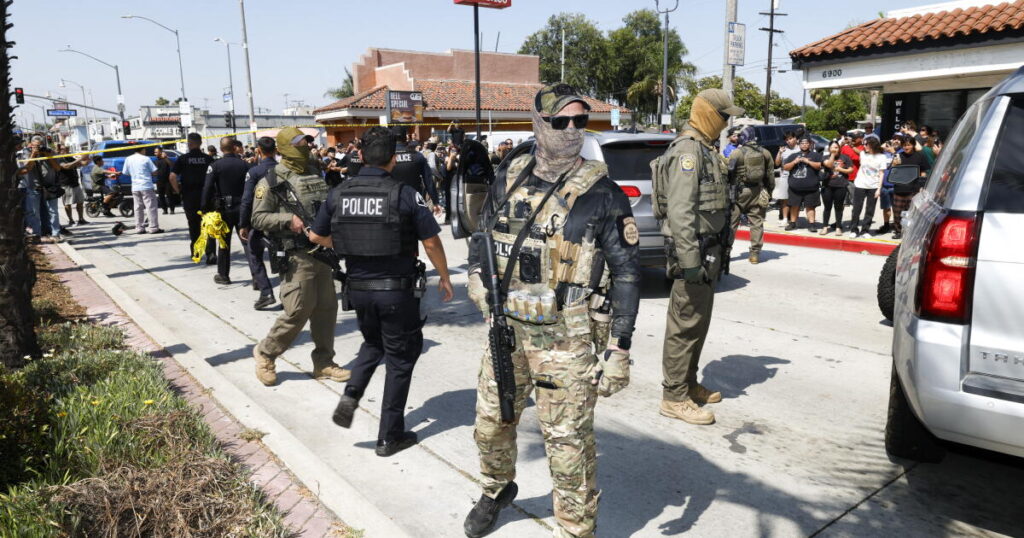
A federal judge has barred immigration agents in Southern California from stopping people simply because they appear Latino or Latino and working class, finding evidence of an unwritten, “officially sanctioned” policy of racial profiling.
In her order granting a preliminary injunction, U.S. District Judge Maame Ewusi-Mensah Frimpong cited “a mountain of evidence” provided by the plaintiffs, including body camera footage and text messages that captured immigration agents referring to Latinos using slurs such as “tonk” and “wet.”
“The Government’s showing that it trains agents to follow the law cannot defeat the mountain of evidence that, in practice, agents do not follow the law,” Frimpong wrote.
The injunction requires agents to establish individualized reasonable suspicion before detaining someone for immigration enforcement, rather than relying on racial stereotypes. Simply appearing Latino and working class is insufficient, Frimpong wrote, even if a person shares those characteristics with an identified target. The order exempts stops at ports of entry, checkpoints and other functional equivalents of the border.
Frimpong emphasized that her ruling was not a final determination that the government maintained an unlawful policy. The Trump administration filed a notice of appeal Wednesday, seeking review by the U.S. 9th Circuit Court of Appeals.
The Department of Homeland Security did not immediately respond to a request for comment.
Based on the evidence, Frimpong said, plaintiffs “have shown that they will likely be able to prove the Government does have a policy in the Los Angeles area of stopping people for immigration purposes just because they look Latino or because they look Latino and working class.”
Frimpong’s order applies in the Central District of California, which encompasses Los Angeles and the surrounding areas, including Orange, Riverside, San Bernardino, Ventura, Santa Barbara and San Luis Obispo counties.
The newly disclosed evidence had not yet been turned over by the government when the Supreme Court last year stayed the judge’s earlier order barring stops based solely on race or ethnicity, language, location or employment, either alone or in combination.
In a 10-page concurring opinion, Justice Brett M. Kavanaugh said the plaintiffs had no good basis to believe law enforcement would unlawfully stop them in the future based on the prohibited factors. He also wrote that apparent ethnicity can be a relevant factor in immigration stops when considered alongside other salient factors and that reasonable suspicion permits brief stops for questioning.
But Frimpong wrote that the new request differed from the earlier one in its evidence, legal theories and proposed relief. The Supreme Court had not explained its reasons for granting the stay, she noted, and Kavanaugh’s concurrence was not binding precedent.
“This Court cannot be faulted for failing to follow guidance that was never given,” Frimpong wrote.
The Department of Homeland Security has repeatedly denied allegations of racial profiling and touted Kavanaugh’s opinion as having “vindicated” agency practices. During a September hearing on the motion, Daniel Mummolo, with the Department of Justice, called the state of the record “the same” as what the Supreme Court originally considered.
But in their July motion for a preliminary injunction, plaintiffs’ lawyers argued that new evidence proves they are threatened by the future application of the government’s policy and practice, that race is the predominant characteristic driving immigration stops and that ongoing stops — including of U.S. citizens — are neither brief nor unintrusive.
The ACLU of Southern California, Public Counsel and other groups and private attorneys filed the lawsuit last year calling for an end to unlawful stops and arrests and for the protection of due process and access to counsel rights for people in immigration detention. The legal action came amid a sweeping immigration crackdown across the state.
Over the past year, the government began turning over discovery to the plaintiffs.
“That has yielded a damning record,” Annie Lai, director of the Immigrant and Racial Justice Solidarity Clinic at the UC Irvine School of Law argued during the September hearing. “Race is a central factor for all these arrests.”
The discovery documented random, rather than targeted, stops, a casual use of racial slurs and apparent frustration among a few officers who feared they were being asked to break the law.
After a June 2025 raid at a Home Depot in Hollywood, body camera footage captured an agent saying: “There was a guy, I’m pretty sure he’s wet. He was just sitting in that minivan.” A text chain revealed an agent referring to “tonks everywhere selling food” — using a word reportedly derived from the sound an agent’s utility flashlight makes when hitting a migrant’s head. In a video, an agent said, “Yeah, just plug us in wherever you see some tonks and we’ll jump out.”
For years, including during President Trump’s first term, Immigration and Customs Enforcement compiled target lists that would include the daily routines of the people they sought to detain. Those operations focused on individualized investigations of specific people.
That changed last year, attorneys said in the motion, citing an email from ICE headquarters in late May 2025 instructing field offices to begin arresting “collaterals,” or nontargets, en masse. Soon after, plaintiffs allege, agents “embarked on a coordinated campaign of suspicionless stops based on demographic profiling.”
Attorneys allege that one way the government executes its “policy of race-based profiling” is through “roving patrols,” in which they drive around without searching for a particular target. In text chains detailed in the motion, agents discussed “soft counts” of “possibles” based on location drive-bys and “roaming.”
After Frimpong issued a temporary restraining order last year, the government “represented to this Court and the Supreme Court that these operations were based on “intelligence,” the motion states.
“But discovery revealed that Defendants’ paltry ‘intelligence’ was manufactured to justify operations at public access locations Defendants were already intent on raiding,” according to the motion. The attorneys cited a deposition from a veteran ICE agent who was assigned to participate on the operations and said they were not “designed in good faith” to arrest the identified targets.
According to the motion, the government sent intelligence-gathering teams to Home Depots and car washes where “they ran checks until they identified an arbitrary number — typically a small number — of possibly unlawfully present individuals.”
“Defendants then selected a day to raid the location, without regard to whether the previously identified ‘targets’ were present,” the motion states. “Unsurprisingly, Defendants frequently did not arrest their supposed ‘targets,’ even as they arrested numerous others.”
The post Federal judge blocks ICE from making racially discriminatory stops in Southern California appeared first on Los Angeles Times.