Sandra Bullock has posed for dozens of magazine covers over the course of her Hollywood career. But a cover shoot this year felt different. For this one, there was no wind machine, no slinky, backless number.
Instead, styled in a modest plaid dress, Bullock was invited to step into an olive-green diorama and handed a broom.
Behind the camera for the unusual shoot for Interview magazine was Szilveszter Makó, a Hungarian photographer whose painterly portraits inspired by his home country’s folklore have lately become inescapable in the fashion world and on social media.
On Instagram last week, Jo Ellison, the editor of How to Spend It, The Financial Times’s glossy style magazine, posted a collage of Makó’s covers of Bullock, Emma Corrin, Gigi Hadid, Hunter Schafer and Daisy Edgar-Jones. Those came out in just the last few months. “How many more covers is Szilveszter Makó doing this season?” she wrote.
A few days later, American Vogue unveiled its November cover star: Jenna Ortega, photographed by Makó. Then came Alicia Keys for Vogue Italia.
The attention is “kind of unbelievable,” Makó, who is based in Milan, said during a visit to New York City in September. “I never imagined that there actually will be this much interest.”
His magazine covers and brand campaigns are quickly recognizable for a collection of motifs: painted fish, flames, utensils and a dark cabin, to name a few. The images are muted and surreal: Elle Fanning in a voluminous dress, served on a giant dinner plate; Rama Duwaji standing in exaggeratedly pointy pumps beside an illustrated cat and chair that look as if they’ve leaped out of “Goodnight Moon.”
“You step into Szilveszter’s brain when you step onto his set,” Bullock wrote in an email. “And that world was painted and constructed long before I showed up.”
The images have broken through as some people have grown tired of seeing flawless celebrity faces against seamless backdrops. More and more, people crave texture, personality and signs of slight imperfection — even if these, too, have been painstakingly and deliberately created. This explains why Makó, 35, with his idiosyncratic tastes, is seemingly as booked and busy as Juergen Teller or Annie Leibovitz.
“There’s an interest in flatness and painting and drawing in his work, which is in some ways not photographic,” said Emily Keegin, a photo editor and creative consultant who has directed magazine cover shoots featuring Ariana Grande and SZA. “And I think that aligns with where we are as a reaction to A.I. and a distaste for anything that’s hyperdigital.”
Makó has become so well known for what Keegin calls his “heavy fingerprint” that last month he opened “Bauhaus Ballet,” an immersive experience in downtown Manhattan. The temporary exhibition, akin to the sort dedicated to van Gogh and Klimt, invited fans to step inside his sets.
As celebrities, actors and members of the fashion world began to file in for the opening reception, they were offered glasses of Champagne by a row of hands protruding from behind curtains.
Further inside, Makó was still making tweaks, pacing one of the galleries with a plastic bag of Kentucky bluegrass seed, which he sprinkled along the base of rustic plantings meant to evoke the Hungarian countryside.
Makó, who tends to avoid interviews unless they are conducted as written exchanges, hesitated at first to speak with a New York Times reporter in person. But a couple days after the opening reception, he was back in the gallery space ready for a conversation.
When it comes to creating images, “we are fighting always for perfection,” Makó said. “Everything needs to be the best possible. But there are limitations.”
As an audio recording of the actress Gwendoline Christie reading a translation of a 19th-century Hungarian poem played on a loop, a line stretched down the block to get into the exhibition, which was produced with the Cultivist, an organization for art enthusiasts, and Capital One.
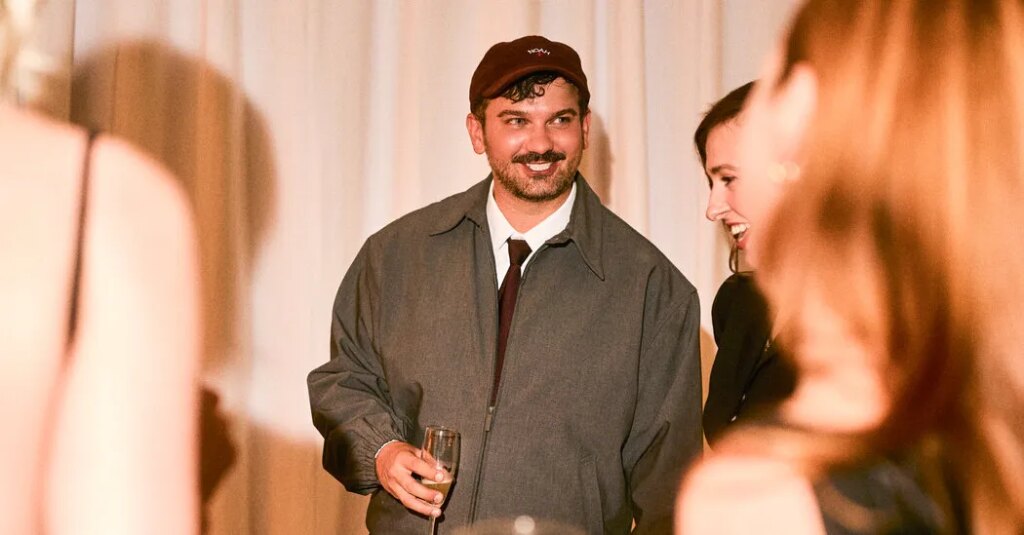
Some visitors who filtered in recognized Makó, who on this day had a neat beard and wore a maroon baseball cap, and lingered nearby to eavesdrop.
Growing up in Lillafured, Hungary, Makó spent two years attending a Waldorf school, where he learned to sew his own clothes and tend to plants and animals. Versions of his childhood home, a cabin of wattle and daub painted a dark brown, appear in some of his portraits as a statement headpiece.
Early on, Makó said, he thought he might become a painter. But he had a formative experience while spending time in his mother’s hair salon, where he learned how to do edgy, “emo” cuts that he then photographed and posted on Myspace.
Rather than photograph his subjects in the salon, Makó remembered telling them: “‘Your hair was iconic. Let’s go to the cemetery or the railway.’”
“That was what we had,” he added. “The chicken coop.”
That background touched off a yen for experimental images. He began booking shoots with fashion models who were just starting out, first in Hungary, then in Berlin and Milan, where he settled in 2013.
“It’s very easy to shoot beautiful models,” Makó said. But he was more drawn to distinctive faces from smaller modeling agencies. As a college student, he studied photography but also took psychology courses.
Makó said his “first big break” came three years ago, when GQ Italia asked him to photograph the actor Willem Dafoe for the magazine’s December 2023 “Men of the Year” issue. He put Dafoe in one of his house headpieces and posed the actor stooping in a box with a pillow and a spoon.
Makó prefers to work with tangible objects as opposed to relying on computer-generated effects. He has come to realize that lots of other people like that, too.
“I learned in the last few years that people do appreciate the materialism,” he said, “the fact that, actually, these things are existing.” (Makó said he used digital photo-editing tools but wouldn’t generate imagery from nothing.)
In an email, Anya Taylor-Joy, who did a cover shoot with Makó in May, said she liked how the “2-D becomes tactile” in his images.
There have been some creative differences. When Makó photographed the performance artist Marina Abramović last year, she came away frustrated. “He only wanted to do his ideas and vision that he prepared beforehand,” she said. “He didn’t realize that I am an artist, and I don’t want to be directed with no possibility for collaboration of my own.” When reached later for comment, Makó described himself as a longtime admirer of her work.
“He was upset I didn’t want to put my head in a box as everyone else had done,” Abramović added.
It’s rare for Makó’s subject to be a visual artist, too, with a competing aesthetic vision. But Abramović also touched on a criticism of Makó’s work that has grown louder as his photography has become more ubiquitous.
Last week, after Ortega’s Vogue cover hit social media, some figures in the art and fashion worlds bristled at the familiarity of the image. Egregious to some was also that, in other photos, Ortega appeared in the same turquoise feathered dress that Hadid had worn in a spread for WSJ Magazine. “I need to collaborate with my stylists,” Makó said later by email. “If they like a piece, I will shoot it.”
There is something paradoxical about the criticism, according to Elizabeth Goodspeed, an art director and a designer. “Makó is being commissioned precisely because his photographs look the way they do; expecting each new job to suddenly look different is like commissioning Yayoi Kusama to paint stripes,” she wrote in a recent essay. “It’s fine to let Makó be Makó!”
Ellison, the How to Spend It editor, reflected on this, too, in an essay titled “The Curse of Overexposure.”
Makó, who still feels new to the spotlight, said the harsh comments on social media were “heartless.”
“I have, yes, a very distinctly particular way of how I take the pictures,” he said. “But for me, they don’t look the same.”
Makó insists that he has not yet fully established his visual language, and that his style will continue to evolve. “They just need to be a little bit patient with me,” he added, “and give me some time.”
There is rarely a stretch when Makó is not working or traveling, sometimes staying up all night, he said, to meet deadlines. A day off in Milan would probably find him at home in bed with his 9-year-old cat, Needle, shutters closed, rewatching “Harry Potter” movies or “The Queen’s Gambit.”
“I want something that’s taking over my brain, and I don’t need to think,” Makó said.
But, never one to be satisfied, he said he dreamed of photographing Tilda Swinton. He doubts, though, that he’ll ever feel the validation he craves: from his relatives, from former grade-school classmates, he said. This is partly because the world that his megawatt-star subjects inhabit doesn’t easily translate to life back home. It’s also because Makó is a vicious critic of himself.
“The things that I really want, I will never have,” he said. “So it’s already a lost cause. Like being beautiful. I always wanted that.”
The post He’s Photographed Every Magazine Cover You’ve Seen Lately appeared first on New York Times.