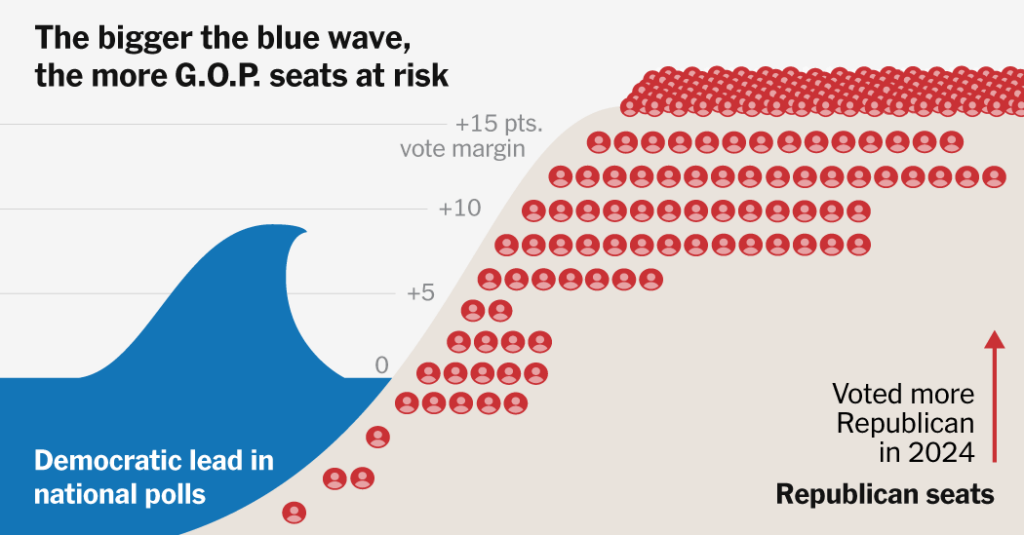
There’s no formal definition of a “wave” election, but by some measures a blue wave appears all but inevitable.
Whether a big wave translates into a large Democratic House majority and Democratic control of the Senate is a very different question. Republicans have major structural advantages that give them a chance to avoid major losses, even if a big blue wave comes ashore. Under some scenarios, Republicans might even feel like the winners.
If the Democratic Party’s strength can be thought of as a growing blue wave, the Republican Party’s advantage is that its House members and especially its senators are already far uphill. The big question isn’t whether a big wave is forming, but whether it will be large enough to overwhelm those Republicans standing on high ground.
The Republicans are well prepared. They have seen this possibility coming for a long time. Historically, midterm elections tend to go poorly for the president’s party and, this cycle, President Trump’s approval ratings are among the lowest on record.
To try to preserve their majority, Republicans redrew the House map so that more of them would be in safer districts — to continue with this metaphor, they tried to evacuate away from the shoreline. They have also spent billions trying to shore up red states and districts — the equivalent of Elon Musk and other donors spending billions on sand bags and life jackets.
Nonetheless, these extraordinary preparations probably won’t be enough to keep the House under Republican control. The wave appears big enough that Democrats seem likely to take the chamber under almost any scenario short of a polling error larger than in 2016 or 2020. The big question is whether they can win a large majority.
The Senate is a very different story. There the Democratic challenge is much greater: They will need to flip at least two seats in states that Mr. Trump won by double digits in 2024. Not even the largest waves in memory would make the Democrats plainly favored to win such reliably Republican states. That might take a tsunami.
Here are four scenarios for how the election might unfold.
Scenario 1: Senate Republicans stay dry
Wave size: D+5 to D+7 popular vote (similar to 2010 or 2014).
Polling error: Democratic strength substantially overestimated (similar to 2016 or 2020).
Outcome: Republicans hold the Senate fairly easily. Democrats win only a narrow-to-modest House majority. That House victory may not be called for days or even a week, as Democrats wait for states like California to count their mail-in ballots.
How it happens: Imagine you’re standing alongside Republicans in districts that voted for Mr. Trump by eight to 12 percentage points, when an enormous blue wave crashes ashore.
Fortunately, you are on high ground — and well prepared.
In this first scenario, the wave sweeps away the Republicans along the beach, like the Republican Senate seat in North Carolina, but by the time the water reaches you uphill, it gently sloshes over your feet like a peaceful day on the beach. The blue wave is big, but it doesn’t reach beyond what Republicans are prepared to withstand.
It’s not implausible to imagine how Republicans hold the Senate and keep the House close. To do it, Republicans merely need Republican-leaning voters to show up for them on Election Day, despite these voters’ reservations about Mr. Trump’s job performance. In today’s polarized era, Republicans voting Republican is never a far-fetched possibility.
It’s even easier to imagine when you consider just how far Republicans are positioned uphill. If Democrats win only the seats where Mr. Trump won by 8.5 points or less, they would win a modest 223 seats (just five more than needed for a majority), and they would fall two seats short of taking the Senate.
And the polls have underestimated Republicans before. If the polls are off by as much as they were in 2016 or 2020, the current Democratic polling lead — around nine points nationwide — might only yield a Democratic victory of five to seven points. That would be comparable to the size of some prior wave elections (like Republican victories in 1994, 2010 and 2014), but it would not necessarily yield a large Democratic House majority or Democratic control of the Senate.
It may count as a blue wave in terms of the national vote, but it would feel like a ripple in Congress.
Scenario 2: Senate Republicans hold on to high ground, but just barely
Wave size: D+7 to D+9 (similar to 2006 or 2018).
Polling error: The polls are generally accurate, but Republicans are modestly underestimated — either nationally or in crucial red states. (Similar to 2018 or 2024.)
Outcome: A big blue wave that nonetheless leaves Republicans breathing a sigh of relief — and Democrats disappointed. The Senate only narrowly remains Republican, even though Democrats fare better in safely Republican states than either party has fared on opposing turf in decades. Democrats make significant gains in the House.
How it happens: This is a big wave. It’s as large or larger than any midterm in decades. In this scenario, the wave doesn’t slosh up against the feet of the Republicans on high ground; it surges over the sand bags and washes them away. Republicans are fighting for political survival.
On a national scale, it would mean a seat-by-seat battle for control of the Senate, while Democrats cruise to a large majority in the House. The polls aren’t far off in this scenario: Democrats are winning big nationwide and are highly competitive in Republican states and districts. In Scenario 1, states like Kansas and Iowa might not even be close. This time, the core Senate battlegrounds in red states remain too close to call late into the night.
But in this scenario, Republicans hold on in just enough of the key Senate battlegrounds. The life vests do their job. Democrats have their best night in decades in red states like Texas, South Carolina and Kansas, but they fall short. Or maybe Susan Collins, the renowned political surfer who has thrived in wave elections before, manages to stay on her surfboard in Maine yet again.
How could this happen? To hold the Senate, Republicans merely need enough support and turnout from Republican-leaning voters to prevent Democrats from taking states that Mr. Trump won by 13 points. No party has flipped a Senate seat that leans so heavily toward the other party in a regularly scheduled election since Republicans won in Illinois in 2010.
Over the last three blue waves — 2006, 2008 and 2018 — Democrats flipped Republican-leaning Senate seats facing that kind of double-digit deficit only three times: Montana in 2006, North Carolina in 2008 and Alaska in 2008 (which required the Republican senator Ted Stevens to be convicted of a felony just one week before the election).
This scenario does not require a major polling error. Today, the polls show Democrats up by a couple of points in states like Ohio, Texas, Maine and Alaska. It would be pretty typical for the polls to be off by a few points in a few states, and it’s particularly common in states that typically lean heavily toward one side or the other. Historically, polls tend to underestimate Republicans in red states (and underestimate Democrats in blue states).
Scenario 3: Democrats surge just enough to win the Senate
Wave size: D+8 to D+10 (similar to 2006 or 2018).
Polling error: Reasonably accurate, including in the key Senate battlegrounds. (Similar to 2006 or 2022.)
The outcome: Democrats win control of the Senate. They win an even larger House majority than they did in 2018.
How it happens: This is mostly like Scenario 2. The wave is just as high. The Republicans are swept off their feet. Except this time, the Republicans can’t hold on. Democrats win the double-digit Trump states they need to flip the Senate. Maybe even Ms. Collins is flipped off her surfboard.
The difference between Scenarios 2 and 3 might be only tens of thousand votes in a few key states. From the standpoint of polling, public opinion or wave height, it’s barely a difference. Politically, it’s everything: the difference between Democratic or Republican control of the Senate.
Whether Scenario 2 or Scenario 3 unfolds on election night comes down to a crucial sliver of Republican-leaning voters who disapprove of the president. These are not the voters who usually decide the outcome of American elections. They’re usually safely in the Republican camp, including in prior blue waves. But the polls suggest that these voters are so dissatisfied with Mr. Trump that enough of them will either stay home or vote Democratic.
The 2006 midterm election makes for a nice comparison. Democrats needed to win at least three Senate seats that President George W. Bush had won by eight points or more. In the end, they won the seats they needed, but by a razor-thin margin: Two of the three were decided by less than one point.
Scenario 4: Tsunami
Wave size: D+10 and higher (similar to 2008 or larger than any modern electoral victory).
Polling error: Democrats outperform the polls in the most closely watched states or nationwide. (Similar to 2012, 2022 or 2025.)
Outcome: A large Democratic majority in the House (maybe 250 seats), a comfortable one in the Senate (53 or more), and the beginning of a new chapter of American politics.
How it happens: In this scenario, the G.O.P.’s structural advantages are swept away. Maybe Democrats win the key Senate races with room to spare, with the party’s candidates winning reliably red states like Ohio, Alaska, Texas or even Kansas by a modest but comfortable margins. The wave is just that high.
The consequences of this kind of Democratic victory would reverberate for years. The closest Senate races — which in this scenario might be Iowa, Kansas or even Mississippi and South Carolina — might not decide control of the Senate in 2026, but could determine which side has the advantage heading into 2028. Farther down the ballot, Democrats would have a once-in-a-generation chance to break the Republican grip on solidly red-state legislatures. Texas wouldn’t just go blue in the Senate race but in the governor’s one as well.
In today’s polarized era, it can be hard to believe that any party could win in this kind of tsunami. The last time a party won by more than 10 points in the national vote was 2008, when House Democrats outran Barack Obama while benefiting from the giant turnout on his behalf.
But this scenario is consistent with the latest polls and the president’s approval rating, which is lower than any president’s heading into a midterm since Harry Truman. It’s nearly 10 points lower than it was in 2018, when Republicans lost the popular vote by almost nine points but held the red-state Senate races.
Back then, Republicans held those states by rallying Mr. Trump’s supporters. A majority of voters approved of his performance in the key red states, like Texas, Tennessee, Indiana, North Dakota and Missouri. This time, winning just the voters who approve of Mr. Trump won’t be anywhere near enough. It wouldn’t even be enough in a state like South Carolina, let alone the top-tier Senate battlegrounds.
With Republican-leaning voters outright disapproving of Mr. Trump, this time they really do stay home or even cast a ballot for the other party. If that happens, Democrats could win by a larger margin than we’ve seen in recent memory.
As I’ve said on The Daily, this election will mark the moment when we begin to turn the page and look toward a new chapter of American politics. No matter what, the next chapter is going to be different. There will be new issues like artificial intelligence, new candidates trying to capitalize on deep dissatisfaction with the parties, and a presidential primary — without Mr. Trump. If the midterm is a tsunami, the end of the Trump era might start to feel as if it’s in sight.
Of course, it’s just as easy to imagine — maybe even easier to imagine — that Republican-leaning voters will ultimately decide to show up and vote for Republicans, as they usually do. We will find out on election night.
The post Four Scenarios for How the Midterms Could Go appeared first on New York Times.