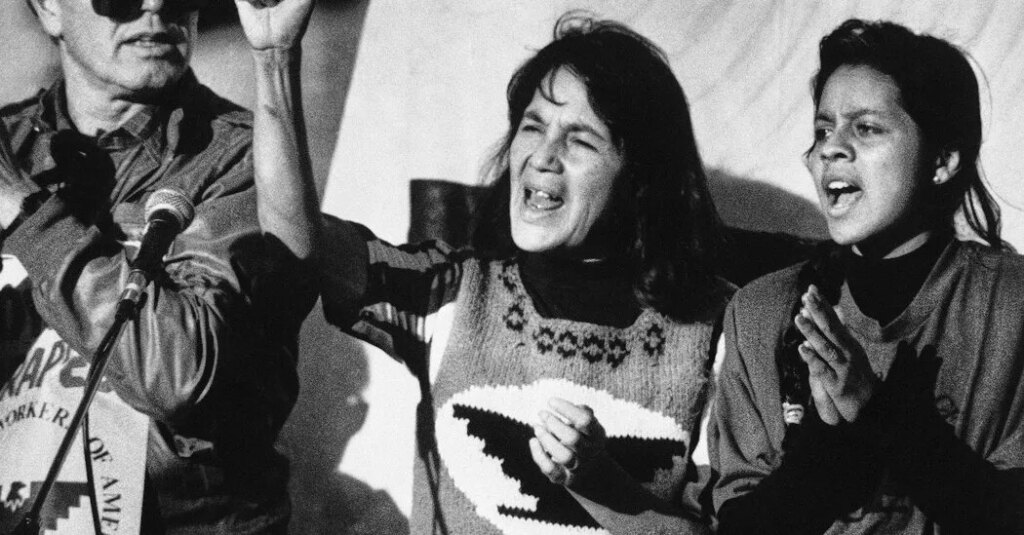
California leaders on Wednesday remembered Dolores Huerta, the labor leader who died at age 96, as a transformative figure who empowered Latinos, immigrant farm workers and women during a much less diverse era in the state.
Ms. Huerta, they said, would be recognized for cofounding the United Farm Workers with Cesar Chavez and laying the groundwork for the breadth of Latino leaders in political office today. Her death came a mere six days before voters could elect California’s first Latino governor in the modern era.
Those parts of her legacy are clear. And in her final months, Ms. Huerta was lauded for bravery in revealing that she had been raped by Mr. Chavez, in a New York Times investigation that also found he had groomed and sexually abused girls. That prompted governments to swiftly remove his name from an annual holiday, buildings and other commemorations.
For some, however, Ms. Huerta’s remembrance may be complicated by lingering questions about whether Ms. Huerta had protected men and the movement instead of the victims. In June, The Times reported that some women who were involved with the union had accused her of dismissing their own complaints of sexual assault and harassment from men they had worked with.
Ms. Huerta said in interviews that she was unaware that Mr. Chavez had abused underage girls and that she was battling a past “culture of misogyny” in the organization when complaints were raised. While some have asked whether she could have stopped Mr. Chavez’s behavior by revealing decades ago that she had been raped, it often can take years or decades for assault victims to come forward.
Such are the tangled threads that the public and historians will be contending with, said Oliver Rosales, a history professor at Bakersfield College who studies labor movements. There is the Ms. Huerta who is an icon of Mexican American history, and there is the woman accused of rebuffing the complaints of other women in her union, he said.
“It’s hard to separate those two,” said Mr. Rosales, who grew up in Bakersfield, where Ms. Huerta lived for decades. He said he hoped her death would allow a more full accounting of her entire life.
“I do think in the end that her life transcends the farmworker movement and what might’ve happened in the ’50s, ’60s and ’70s,” he added.
In California, Ms. Huerta became something of a living legend, still vibrant in her 90s and a major figure in state Democratic politics. President Barack Obama awarded her the Presidential Medal of Freedom, America’s highest civilian honor, in 2012. She was inducted into the California Hall of Fame a year later.
She was revered for her role as the vice president of the United Farm Workers for nearly four decades and for being Mr. Chavez’s second-in-command. She is widely believed to have coined the phrase “Sí se puede,” meaning “Yes, we can,” a chant that regularly echoes through Democratic campaign rallies and marches.
In March, The Times revealed extensive evidence that Mr. Chavez had groomed and sexually abused girls who worked in the farm workers’ movement. It included allegations from Ms. Huerta, who said that Mr. Chavez had raped her inside a vehicle in a secluded California grape field in 1966. She decided not to report the assault to the police because she felt they were hostile toward the movement, she told The Times, and because she feared that no one in the union would believe her.
She said that two of her children were the products of sexual encounters with Mr. Chavez, including the rape — baby girls who, by her arrangement, were raised by others.
“Unfortunately, he used some of his great leadership to abuse women and children,” she said in an interview.
The Times later revealed that Ms. Huerta had faced sexism within the U.F.W., with men taking credit for her work or using offensive slurs against her.
But women also accused Ms. Huerta of dismissing their claims of sexual harassment. They said she responded by accusing some of the women of being manipulators, informants or sexual agents intent on disrupting the movement.
Liz Sullivan told The Times that when she was a U.F.W. organizer in 1977, two men took turns raping her after a meeting in the Coachella Valley. She and other women tried to form a women’s safety group, but she quit the U.F.W. after union leaders accused her of counterorganizing. Nearly two decades later, Ms. Huerta met with Ms. Sullivan but told her that rape was “just something men do to women,” Ms. Sullivan said.
Ms. Huerta said she did not recall the meeting or having said anything that was dismissive about rape.
“It is right to reflect on the life of Dolores Huerta, now that she has passed,” Ms. Sullivan wrote in a statement on Wednesday. “But instead of turning her into a mythic figure, let us see her as a human being, in all her beauty and with all her faults, just like the rest of us — if only we also would have the courage to confront injustice.”
Ms. Huerta, in an interview this year, said there were numerous instances in which she had acted on sexual harassment complaints and promoted women to leadership roles.
“I have to say that in my own good conscience, from Day 1 when I was in the organization, I always advocated for women,” Ms. Huerta said.
On Wednesday, some Latino leaders mourned her while they considered where this year’s revelations fit into her personal history.
Julián Castro, a former Obama official and former mayor of San Antonio, said that Ms. Huerta had always served as a moral compass, and that she had helped reshape American history.
“Any time you’re in public life, there are going to be a million different opinions about you,” Mr. Castro said. “But the record is very clear that she did a lot of good, and she helped a lot of people, and I’m convinced that’s what people will remember about her.”
Hilda Solis, a Los Angeles County supervisor who was a close friend of Ms. Huerta’s, traveled to Bakersfield on Tuesday to sit by Ms. Huerta’s bedside in her final days. Ms. Huerta was too weak to speak, but Ms. Solis said she prayed beside her and whispered to her stories of their time together.
Ms. Solis said that the allegations against Mr. Chavez were a “sad part of history,” but commended Ms. Huerta for saying that she had been raped by him as well.
“She was always fighting for women’s rights, for women who were violated,” she said. “She shouldered a lot.”
Robert Rivas, the speaker of the California State Assembly, said that his career and that of other Latino leaders was made possible by Ms. Huerta.
Latinos went from almost nonexistent in the Legislature to becoming “a force to be reckoned with,” he said.
“She was proof that our voices matter, that our work matters, that we belong in the rooms where these decisions are made,” he said. “She didn’t just say, ‘Sí se puede.’ She spent her life showing us how to do that.”
He said the revelations about Mr. Chavez had been shocking, and he applauded Ms. Huerta’s courage for speaking out when she did. “I understand the complexity and the challenges with that, but certainly she did the right thing in speaking out against those abuses,” he said.
On Wednesday, Gov. Gavin Newsom ordered the flags lowered to half-staff to honor Ms. Huerta and said that she “represented the best of us.”
After the Times investigation in March, some immediately suggested that California rename Cesar Chavez Day after Ms. Huerta, a recognition of how significant her contributions were to the labor movement and an acknowledgment of the struggles she faced. The Legislature, with mere days to consider a switch, opted for Farmworkers Day instead.
That was disappointing to those who had championed Ms. Huerta. But some California leaders suggested that the lesson learned from revelations about Mr. Chavez was to be cautious with hagiographic treatment of past leaders.
There may still be efforts to honor Ms. Huerta in new ways. Miriam Pawel, an author and journalist who has written extensively about Mr. Chavez and the U.F.W. movement, said she would like to see the sweep of Ms. Huerta’s history taken into account. Decades ago, Ms. Huerta had already been considered a polarizing figure by some within the union for her role in enforcing Mr. Chavez’s most aggressive measures, such as purging members.
“I hope that she is viewed as the sort of complex, and sometimes contradictory, figure that history suggests she was, and not lionized as a one-dimensional or two-dimensional figure the way for many years Cesar Chavez was,” Ms. Pawel said.
Sarah Hurtes and Manny Fernandez contributed reporting.
The post Huerta Is Remembered as a Labor Champion With a Multidimensional Legacy appeared first on New York Times.