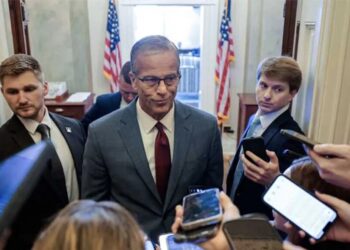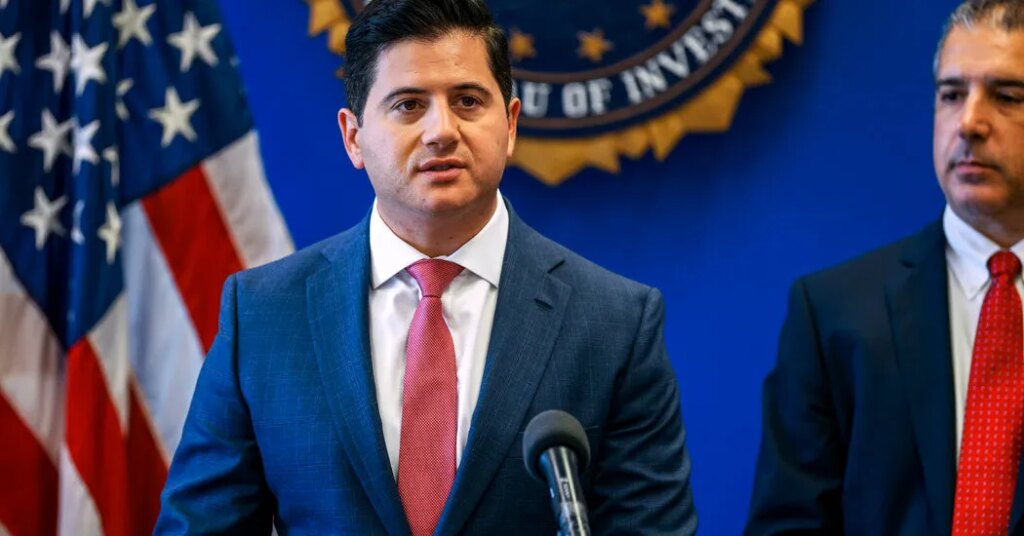
President Trump’s success in demolishing the traditional wall between the White House and the Justice Department is apparent at the helm of the agency, now led by his former personal lawyer, Todd Blanche.
Mr. Trump’s reach can also be seen in the network of U.S. attorneys across the country who are flexing their power to pursue the president’s political agenda.
At least eight current U.S. attorneys have played prominent roles in pushing Mr. Trump’s grievances, often citing thin evidence that has subsequently led many of their cases to collapse. Three of those are running their offices without Senate confirmation.
Two have taken up investigations that the president explicitly told them to pursue. In one previously unreported episode, Mr. Trump privately urged the U.S. attorney in Minnesota, Daniel Rosen, to prosecute Representative Ilhan Omar, who is now under investigation for potential immigration violations.
Taken together, the events and decisions have deepened what current and former officials describe as the stark politicization of a department that had long prided itself on operating with independence in prosecuting politically sensitive cases. The president and Mr. Blanche say they are ending Biden-era “weaponization” of the Justice Department against conservatives, while current and former department lawyers decry what they say is a reckless lowering of standards to pursue Democrats and other political targets.
The actions reflect a radically altered Justice Department, one in which longstanding rules about ethics, investigative procedure and legal standards are changing. The president has asserted sweeping authority to fire career prosecutors and investigators at will, despite years of court precedent meant to prevent such actions.
A Justice Department spokeswoman, Emily Covington, said U.S. attorneys have successfully driven down violent crime at a record rate, a key priority of the president, calling their work “a massive success story.”
“These attorneys and their offices are on the front lines every day crushing gangs, violent crime, drugs, human smugglers, illegal immigration and terrorism,” she said in a statement, praising them for “working productively and successfully with state and local law enforcement.”
The U.S. attorneys serving as Mr. Trump’s field commanders have taken up his grievance agenda principally on three fronts:
Pursuing investigations and prosecutions of Mr. Trump’s perceived enemies, from grudges that date to the 2016 presidential race to recent battles with the Federal Reserve.
Charging protesters of his immigration crackdown with violent crimes against federal agents. Many of those cases have fallen apart upon scrutiny from the courts.
Amplifying Mr. Trump’s false claims about widespread fraud in U.S. elections.
MINNESOTA
Daniel N. Rosen
Mr. Rosen has aggressively pursued cases against people in Minneapolis who protested the administration’s immigration policies and has helped oversee the investigation into Ms. Omar, a Minnesota Democrat whom Mr. Trump has vowed to deport.
In early January, Mr. Rosen, a longtime commercial litigator who had never been a prosecutor, stood with dozens of fellow U.S. attorneys at the White House to meet the president. Mr. Trump complained that as a group, they weren’t doing enough for him, according to people familiar with the private event.
“Where’s the U.S. attorney from Minnesota?” the president asked. When Mr. Rosen identified himself, Mr. Trump congratulated him for “prosecuting the fraud,” a reference to the multitude of cases of benefits fraud that the office has been pursuing there for several years.
The president then added: “And prosecute Ilhan Omar,” according to people familiar with the exchange. Some of those who heard the remark chuckled, taking it as something of a joke. A person familiar with the matter, speaking on condition of anonymity because they were not authorized to discuss it, said Mr. Rosen did not take the comment as an order and did not take any investigative step as a result of the president’s remark.
Lauren Bis, a White House spokeswoman, described the account as “false talking points” and noted that the Justice Department first opened an investigation into Ms. Omar years ago. She added that “any suggestion that this administration initiated it for political purposes is therefore demonstrably false and absurd.”
Federal authorities did begin scrutinizing the immigration history of Ms. Omar over a decade ago. And prosecutors in the Biden administration examined her finances and interactions with a foreign citizen, as The Times previously reported.
But that case appeared to have stalled. And in the months after Mr. Trump’s encounter with Mr. Rosen, federal investigators intensified an effort to identify whether Ms. Omar or members of her family may have lied on immigration forms.
A few weeks ago, federal immigration agents, as part of an investigation overseen by Mr. Rosen’s office, executed a search at Ms. Omar’s home in Washington.
Mr. Rosen has also focused his office on scrutinizing demonstrators who protested the administration’s immigration crackdown in Minneapolis.
After an ICE agent shot and killed a local woman, Renee Good, senior Justice Department officials pushed for a criminal investigation of her widow. That demand led to the departures of six prosecutors in the office, including Mr. Rosen’s top deputy, who had played a key role in leading anti-corruption prosecutions in the state. More resignations would follow, as Mr. Rosen sought to satisfy the administration’s demands while also keeping enough lawyers to keep the office functioning.
Judges handling the crush of cases grew increasingly frustrated with how often the prosecutors in Mr. Rosen’s office failed to adhere to court orders — nearly 100 times, by one judge’s count, and about the quality of the evidence in some of the criminal cases filed against protesters.
What happened in Minnesota’s federal court “created a grave threat to the rule of law,” Judge Patrick J. Schiltz later told The New York Times. The judge said most of the violations seemed to be due to incompetence and staffing shortages, but added that the Justice Department had not taken their corrosive effect seriously enough.
Mr. Rosen had to personally appear before judges to argue he should not be held in contempt for the way his office was handling — or not handling — pressing immigration cases.
Federal prosecutors were brought in from other jurisdictions to help ease some of the workload, and others were hired to fill the ranks, but the administration found new clashes with judges.
When a magistrate judge in Minnesota declined to approve criminal charges against the former CNN anchor Don Lemon for his presence at an anti-ICE protest in a church, Mr. Rosen immediately sought to get another judge to overrule the decision.
The Justice Department eventually succeeded in securing a grand jury indictment against Mr. Lemon, who covered the protest and has said he was there as a independent journalist.
Mr. Rosen’s staff also issued subpoenas to the offices of the governor and local officials, Democrats who had criticized the administration’s immigration policies. The subpoenas sought a wide range of records related to those offices’ policies on immigration enforcement.
Judge Schiltz quashed those subpoenas, finding their main purpose was improper — “to coerce Minnesota officials into assisting the federal government with enforcing civil immigration law and to harass and retaliate against them for failing to do so.”
Mr. Rosen’s office has taken no public actions to investigate the killings of Ms. Good and Alex Pretti, two U.S. citizens shot dead by federal immigration agents in Minneapolis. The local county prosecutor said the federal government continues to withhold key evidence she needs to make a charging decision in those cases.
Albany
John A. Sarcone III
John A. Sarcone III has led efforts to investigate New York’s attorney general, Letitia James, on the theory that she violated the civil rights of Mr. Trump by pursuing cases against him and his companies after he left office in 2021.
Mr. Sarcone, who leads the U.S. attorney office in Albany, N.Y., opened the James investigation last year, when his office issued a pair of subpoenas, the first related to a civil fraud case Ms. James had brought against Mr. Trump accusing him of exaggerating his net worth to defraud lenders. The second subpoena was focused on her long-running case against the National Rifle Association.
Ms. James challenged the subpoenas on the grounds that Mr. Sarcone was not lawfully serving as an acting U.S. attorney. The Trump administration has used a novel interpretation of federal rules for temporary federal officials to put Mr. Sarcone and others in charge of U.S. attorney offices without Senate confirmation. It first designated them as interim appointments, which have an expiration date, then declared them special attorneys.
The administration has used that method in some states with two Democratic senators, essentially working around the longstanding tradition in which home state senators have an important say in selecting the top prosecutor.
Judges have repeatedly ruled against the administration’s efforts to work around the federal law regarding vacancies in Senate-confirmed positions. In Mr. Sarcone’s case, a federal judge blocked him in January from overseeing the investigation into whether Mr. Trump’s civil rights were violated by Ms. James.
But Mr. Sarcone’s office has continued in its quest. Earlier this year, prosecutors in Louisiana, prompted by lawyers in the Albany office, filed charges against Ms. James’s hairdresser for identity theft and bank fraud, according to people familiar with the matter who spoke on condition of anonymity.
Since then, federal prosecutors from Albany, working with federal agents, have repeatedly tried to get her to provide evidence against Ms. James about financial transactions involving her campaign, according to people familiar with the matter who spoke on condition of anonymity. The hairdresser has pleaded not guilty and so far has not cooperated with prosecutors.
North Carolina
Dan Bishop
Dan Bishop has been tasked to pursue election integrity cases across the country as part of the administration’s hunt for evidence of mass voter fraud in the 2020 election.
Mr. Bishop had never worked as a prosecutor before becoming the U.S. attorney in Greensboro, N.C. As a member of Congress, he voted against certifying Joseph R. Biden Jr.’s 2020 presidential election victory.
In early 2026, the Justice Department gave Mr. Bishop authority to investigate election integrity issues across the country, a vast portfolio that could allow him to play a key role in the administration’s approach to the coming midterm elections.
Earlier this year, the Justice Department intensified its investigation into the 2020 vote in Fulton County, Ga. Shortly after Mr. Trump declared that “people will soon be prosecuted” for actions taken in that election, F.B.I. agents descended on election offices in Atlanta, seizing hundreds of boxes of ballots. The execution of the search warrant, which was approved by a federal judge, has set off a long-running legal fight over the justification for the search and possession of the six-year-old ballots.
Under Mr. Bishop’s direction, F.B.I. agents have also scrutinized past election results in Arizona, Texas, Ohio and Wisconsin. In some instances, the agents have been tasked with re-examining allegations that have already been disproved.
Los Angeles
Bill Essayli
Bill Essayli has pushed to charge cases against anti-Trump protesters, many of which fell apart in court. He also carried out a direct order from Mr. Trump to open an investigation of voting in the state.
“Do me a favor,” Mr. Trump said in early June when he called Mr. Essayli, the head of the U.S. attorney’s office in Los Angeles. The president wanted the federal prosecutor to open an investigation into California’s primary. “They are trying to steal that election,” Mr. Trump said, according to his own account of the conversation.
Mr. Essayli immediately opened an investigation. And he gave interviews suggesting voter fraud had occurred, even as votes were still being counted in the state, where tabulating mail ballots can take weeks.
The prosecutor predicted in an interview with the conservative radio host Glenn Beck that criminal charges would follow. “It will be election fraud charges,” he said.
Mr. Essayli’s public statements about his investigation represented a major departure from past Justice Department practice, particularly on the sensitive subject of investigating election issues while votes were still being counted.. In Mr. Trump’s first term, most department officials recoiled at the ways in which the president tried to direct law enforcement activity to promote and pursue his unfounded claims of mass voter fraud.
About two weeks before the midterm elections, after ballots had been mailed out to California voters, Mr. Essayli’s office announced criminal charges against 13 green-card holders he said had either voted or registered to vote illegally. The Justice Department has also sued the state of California, demanding they set aside, at least temporarily, any ballots from roughly 20,000 people in the state that the administration says it suspects are noncitizens.
In addition, Mr. Essayli has directed federal law enforcement resources at Mr. Trump’s critics. When the press office of Gov. Gavin Newsom of California wrote on social media that Kristi Noem, then the homeland security secretary, was going to “have a bad day today,” the U.S. attorney referred the governor to federal agents for a “threat assessment,” declaring he had “zero tolerance for direct or implicit threats against government officials.”
He has also pushed to prosecute protesters against administration policies, even in cases when his staff said the evidence did not support charges.
In one instance, according to people familiar with the matter, Mr. Essayli insisted on charging a man who had provided face shields to anti-ICE protesters, despite objections from some members of his staff. Mr. Essayli’s office eventually did file charges against the man over the masks, which were thrown out weeks later.
Miami
Jason A. Reding Quiñones
Jason A. Reding Quiñones has overseen a centerpiece of Mr. Trump’s retribution campaign, what the president’s allies have cast as a “grand conspiracy” by officials in the Biden and Obama administrations to pursue Mr. Trump. The case has been noteworthy not for bringing indictments, but for ending the prosecutorial careers of many of the lawyers assigned to it.
Mr. Reding Quiñones is at least the third U.S. attorney in the Trump administration tasked with investigating the “grand conspiracy” — a catchall term used by Trump loyalists to describe the effort to file criminal charges against former Obama administration officials, intelligence veterans and Democratic operatives for allegedly misusing their positions to harm Mr. Trump.
The first two U.S. attorneys were forced out, having displeased senior Trump administration officials by concluding criminal charges were not warranted against figures such as former F.B.I. director James B. Comey.
In Mr. Reding Quiñones, the Justice Department found a prosecutor willing to pursue the investigation further, with the help of a judge who had proven herself amenable to Mr. Trump’s legal arguments: Judge Aileen M. Cannon in Fort Pierce, Fla.
But the investigation has not fared much better. A career Justice Department official in Miami who oversaw the case concluded there was not sufficient evidence to support criminal charges against John O. Brennan, the former C.I.A. director, and was subsequently removed from the case.
The administration brought in an octogenarian former prosecutor, Joseph DiGenova, who proceeded to slowly retrace the previous investigations. Senior administration officials grew frustrated with what they viewed as the snail’s pace of Mr. DiGenova’s work, and he left under pressure in September.
In October, the Justice Department filed new charges in Washington — without a grand jury indictment or a judge’s signature — against Mr. Comey, alleging he directed a leak of classified information to a New York Times reporter in 2016. Mr. Comey has denied the accusation and is seeking to have the case dismissed.
District of Columbia
Jeanine Pirro
Jeanine Pirro has pursued indictments of the president’s critics and others invoking his ire, even when some of her prosecutors say the evidence does not support charges.
“This is a case,” Ms. Pirro declared in early July, “with tremendous evidence.” Speaking at a news conference, she announced the indictment of David Hearn, a former Olympic athlete, for felony destruction of property.
Ms. Pirro, the U.S. attorney for the District of Columbia, claimed Mr. Hearn ripped a piece of sealant from the bottom of the Lincoln Memorial Reflecting Pool by “forcefully and violently pulling up and removing” the liner.
Weeks later, Ms. Pirro abandoned her indictment of Mr. Hearn, acknowledging that there was substantial evidence showing the liner of the pool fell apart as a result of shoddy installation work. The embarrassing retreat, one which sharply undercut Mr. Trump’s claims that the only problem with his rushed pool renovation project was vandalism by leftists, led to a heated meeting in the Oval Office of Mr. Trump, Ms. Pirro and Interior Secretary Doug Burgum, whose agency she blamed for misleading her office.
In dropping the case, Ms. Pirro’s office claimed that Department of Interior officials withheld key details that would have changed prosecutors’ view of the evidence. However, she and her investigators knew even before they went into the grand jury that there was at least one significant evidentiary flaw in their case and barreled ahead anyway, according to court filings by Mr. Hearn’s lawyers.
At least a day before the grand jury presentation, Ms. Pirro’s office received a report from Interior Department officials that found there had been widespread damage to the pool liner more than a week before Mr. Hearn’s arrest, according to defense filings.
After Mr. Hearn was indicted, Ms. Pirro went to the pool herself and confronted a defense expert hired to inspect the liner.
During the awkward exchange, Ms. Pirro’s staff urged her not to question him about his inspection of the liner, yet she repeatedly pressured the expert to explain what he was doing, according to a complaint filed to the inspector general by one of Mr. Hearn’s lawyers.
Ms. Pirro also pushed forward with a series of cases meant to punish the president’s perceived enemies. Her office tried unsuccessfully to convince a grand jury to indict a half-dozen Democratic lawmakers who made a video reminding military officers of their duty not to follow unlawful orders. The grand jury rejected the case.
A federal judge also roundly rejected her efforts to subpoena Jerome H. Powell, the previous chairman of the Federal Reserve, over a construction project, saying Ms. Pirro’s office had offered “no evidence whatsoever” that he had “committed any crime other than displeasing the president.”
North Carolina
W. Ellis Boyle
W. Ellis Boyle has brought criminal charges against Mr. Comey, the former F.B.I. director, for posting a photo of seashells arranged to form the numbers “86 47.”
Of all the retribution-tinged indictments and investigations that have marked the second Trump term, none has more alarmed or angered longtime Justice Department officials than the one over the seashells photo.
Senior Trump administration officials tried and failed in mid-2025 to find a prosecutor willing to charge Mr. Comey with threatening the president, arguing that the “86” was mafia lingo that meant kill, and “47” was a reference to Mr. Trump, the 47th president. Mr. Comey has said that he understood “86” meant “eject,” from restaurant jargon for removing a dish from the menu.
Federal prosecutors in Virginia, as well as agents at the F.B.I. and the Secret Service, looked at the matter and quickly closed their investigation in 2025, despite intense pressure from senior Trump administration officials to pursue criminal charges, according to people familiar with the matter.
Mr. Trump was so keen to pursue the case against Mr. Comey that he insisted federal agents immediately send him a summary of their interview with Mr. Comey about the incident, according to court filings.
Mr. Boyle, the U.S. attorney in Raleigh, N.C., was willing to take the case. His investigators went so far as to interview Sammy Gravano, a famous mob turncoat known as the Bull, whose evidence helped convict his boss John Gotti.
Mr. Boyle eventually obtained an indictment against Mr. Comey over the photo of seashells, a case which is set to go to trial next year.
Mr. Boyle, a former Army captain who was sworn into his prosecutor job by his father, a federal judge in the same district, has denied he was pushed by anyone above him to bring the charges against Mr. Comey.
“In making the determination, I did not feel pressured, coerced or motivated in any way from any individual,” Mr. Boyle said in a court affidavit.
Chicago
Andrew S. Boutros
Andrew Boutros has overseen a tumultuous period at the U.S. attorney’s office in Chicago, one marked by the collapse of high-profile cases against people who clashed with immigration agents.
Operation Midway Blitz, an immigration crackdown begun by the Trump administration in Chicago in September 2025, spurred a series of confrontations between federal agents and local residents. Inside the government, Customs and Border Protection agents frequently pushed for prosecutors in Mr. Boutros’s office to file federal assault charges based on dubious claims of criminal wrongdoing, and sometimes before lawyers had a chance to review government videos of the incidents, according to current and former law enforcement officials.
As a profession, federal prosecutors pride themselves on rarely losing a case. When it comes to the assault cases related to Midway Blitz, the Chicago record has been extremely poor. Of more than 30 criminal cases filed against people for crimes like assaulting a federal agent or resisting a federal agent during the operation, more than two dozen have fallen apart, according to court records, current and former officials, and public reporting. One of the most aggressive efforts involved a case against participants in an anti-ICE protest who were charged with interfering with a federal agent. Mr. Boutros’s office tried and failed twice to get a grand jury to indict some of the protesters.
At the second failed presentation, one grand juror bluntly told prosecutors, “I heard this case like last week, and I thought it was a crock,” adding an expletive, according to the transcript. “And I still think it is.”
In a third attempt, Mr. Boutros addressed the grand jury himself. While he got an indictment, a federal judge eventually found the office had mishandled the case and dismissed the charges. The lead prosecutor, Sheri H. Mecklenburg, was reassigned, and she later accused Mr. Boutros of pushing her to seek an unwarranted felony charge.
“You sent an officewide email laying responsibility at my feet for a felony prosecution that you personally directed over my objection that the case was better suited to misdemeanor charges,” Ms. Mecklenburg wrote in a letter to Mr. Boutros when she retired, defending her conduct in the case. Justice Department officials have denied her account.
More than 100 former lawyers in the office signed a public letter denouncing Mr. Boutros’s leadership, saying he had “tarnished the reputation” of the office.
Mr. Boutros has dismissed such criticism as the product of predecessors who underperformed. He has said that the office was in “last place” among U.S. attorney offices in many key categories and that since his arrival, it has significantly increased productivity and the number of indictments. Officials have said the failure rate of Midway Blitz cases reflects the confusion and long hours of the initial days of the operation, which coincided with a federal government shutdown, and came before prosecutors realized they had to be more skeptical of the claims made by federal immigration agents. Once Mr. Boutros’s prosecutors changed their approach, the office rejected roughly 90 percent of the cases proposed by the agents.
Produced by Gray Beltran and Jenni Lee.
The post Here Are the U.S. Attorneys Who Are Carrying Out Trump’s Grievance Agenda appeared first on New York Times.