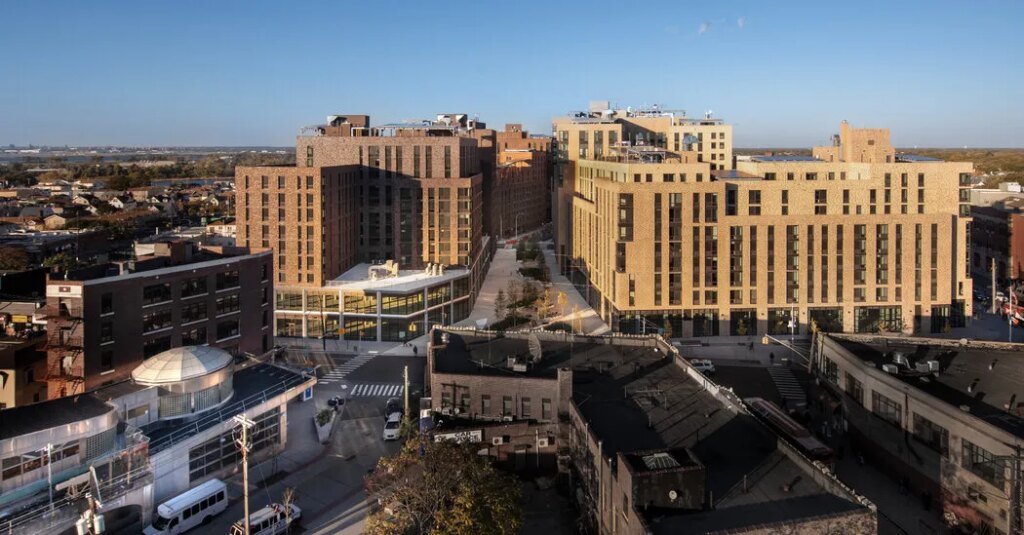
In a few years, 5,000 low-income New Yorkers will have found homes at Innovative Urban Village. A handsome and promising housing development, it is rising on the nearly 11-acre site of a megachurch parking lot in East New York, Brooklyn.
The $1 billion project is a massive mixed-use complex, with new tree-lined streets, shops, community services and a cultural center.
When finished, 10 buildings, between nine and 15 stories in height, will provide some 2,000 big and small apartments. PAU, the New York outfit behind the plan to redo Penn Station, is the architecture firm.
We’ll see how well it works when it’s done. But after a recent tour, I wanted to share what, so far, looked like a little good news on the housing front.
That’s because in countless ways and for decades, New York has been struggling, and largely failing, to grapple with the housing crisis.
One of the latest attempts came last year, when city voters passed a charter amendment called the Affordable Housing Fast Track, which kicks in this January. The amendment expedites, by a few months, the timeline to review proposals for development in a dozen districts that lagged farthest behind in affordable-housing production during the previous five years.
The fast-tracking works partly by stripping out the City Council’s veto power and handing final say over to the City Planning Commission, whose chair is appointed by the mayor. The Mamdani administration inherited the fast-track amendment when it moved into City Hall this year. It released the first naughty list of laggard districts this month.
All across the country, similar efforts to hasten housing construction have rolled back rules to speed up development. In California, environmental regulations have been loosened. In Austin, Tex., density and height limits have been changed. Minneapolis, among other cities, eliminated single-family zoning. The container ship of bureaucracy is, very slowly, turning around.
How well it is working depends where you look. Housing starts in California remain obstinately sluggish. Experts in that state blame rising construction costs and countless other obstacles.
In New York, fast-tracking followed legislation that mandated developments include affordable units, though the results are highly debatable, and also years of contentious rezoning, which has yielded thousands of new apartments in districts like Gowanus, Brooklyn, and thousands more in East New York, not counting the ones at Innovative Urban Village.
The rezoning efforts culminated in 2024 in the City of Yes, the Adams administration’s signature initiative. The City of Yes took the biggest swing yet at neighborhood NIMBYism, instituting reforms to encourage adding density everywhere.
But speed is relative when it comes to large-scale housing construction these days. During the 1970s, a less regulated age, New York built Starrett City: 5,881 subsidized apartments for 15,000 largely middle-income residents occupying 46 buildings on 153 acres of East New York, with two public schools, a shopping center and its own power and sewage treatment plants.
Co-op City, in the Bronx, from that same era, produced homes for some 50,000 mixed-income residents, eight public schools and three shopping centers on 320 acres. Its construction took seven years.
Today, it can take about as long to renovate some New York kitchens. As a result, the city now needs 700,000 more homes over the coming decade, according to a recent estimate by City Hall. Last year, nearly 39,000 residential units, affordable or otherwise, were built — the highest annual total since 1965, but nowhere close to the 70,000 per year required to meet the goal.
So what’s the holdup?
Half a century ago, the federal government basically got out of the business of building public housing, leaving its construction to private developers. The government relies on carrots like tax breaks, discounted land and streamlined approval processes, which is what reforms like fast-tracking aim to achieve.
At the same time, new rules and regulations continue to complicate the picture. A few years ago, progressive politicians in Albany allowed a longstanding tax incentive to lapse; developers had employed it to make subsidized projects pencil out. After a lengthy delay, state legislators replaced that measure with a less generous incentive.
So you may be excused for imagining that little gets built in the way of affordable housing.
But, as Innovative Urban Village underscores, that’s not true. The project is a joint venture by the Christian Cultural Center, which owns and shares the surface parking lot, and the local developers Gotham and Monadnock. I got a tour of the first two completed buildings.
They are hefty apartment blocks with old-school-style brick coursing and large, punched windows. The apartments are graciously laid out. There are landscaped terraces and generous amenity rooms. I’ve seen luxury developments that look shoddy by comparison. Monthly rents for studio apartments at Innovative Urban Village start at $561.
I also visited a large and equally ambitious all-affordable development called Rockaway Village in Far Rockaway, Queens. It’s an $855 million, 10-acre, two-million-square-foot development, also designed to house 5,000 low-income New Yorkers. It was completed in phases, starting in 2021. The final building is now taking in residents, and if you want some idea of just how bad the housing shortage is: 70,000 applicants entered the city’s lottery system for that building’s remaining 340 apartments.
As with Urban Innovation Village, Rockaway Village is urban minded. You can see it from the A train station. Its plaza has become the Far Rockaway town square.
The site used to be a strip mall. Phipps, the nonprofit housing developer, acquired it from the strip mall’s owner in exchange for storefront retail spaces along the village’s new main street, where apartment towers, designed by architects at the firm Marvel, rise over the whole district. The massing of the buildings and their brickwork varies thoughtfully to mitigate the project’s scale. There are sunny, attended lobbies and landscaped gardens for residents.
I saw empty storefronts and drug dealers in the plaza the other day. A city edict requires Phipps to pay for a work of public art; an initial proposal of theirs was met with community blowback and resulted in an example of random sculpture.
In that last apartment building, Phipps also agreed with city officials to house 46 formerly homeless residents, referred from the city shelter system, who have mental health issues. Managing an affordable property that mixes residents who have those needs with low-income families is Phipps’s longstanding expertise, but it increases costs for support staff and services.
Which is to say, deeply affordable housing in New York is always a complicated and fragile calculus. Residents I spoke with at Rockaway Village said they were ecstatic and grateful.
New York’s fast-tracking strategy is devised to encourage more of these sorts of affordable projects, but this will depend on whether developers see opportunity in the targeted areas. Some of the districts on the first naughty list, like Howard Beach and Staten Island, are threatened by sea-level rise. The Upper West and Upper East sides of Manhattan have almost no available land, save for a derelict church here and a few old tenements there. There’s nothing vaguely like a 11-acre surface parking lot in either of those neighborhoods, much less the amount of open land on which Starrett City and Co-op City were built. Sites like that now are only parks and public golf courses.
Maybe New York should take a page from Austin. During the 2010s, Austin’s rents skyrocketed. The city reacted by undoing all manner of housing codes and restrictions. Since the changes, Austin has added homes at three times the national rate of growth, according to a Pew study, and rents have fallen across the board. They are today below the national median, even while the city’s population continues to climb.
The message is that building much more housing of any kind improves affordability. Rockaway Village and Innovative Urban Village are hardly going to solve the housing shortage in the nation’s largest city.
But it’s no small victory that 10,000 more low-income New Yorkers will be going home.
The post Can We Make a Dent in the Housing Crisis? Two Projects Say Yes. appeared first on New York Times.