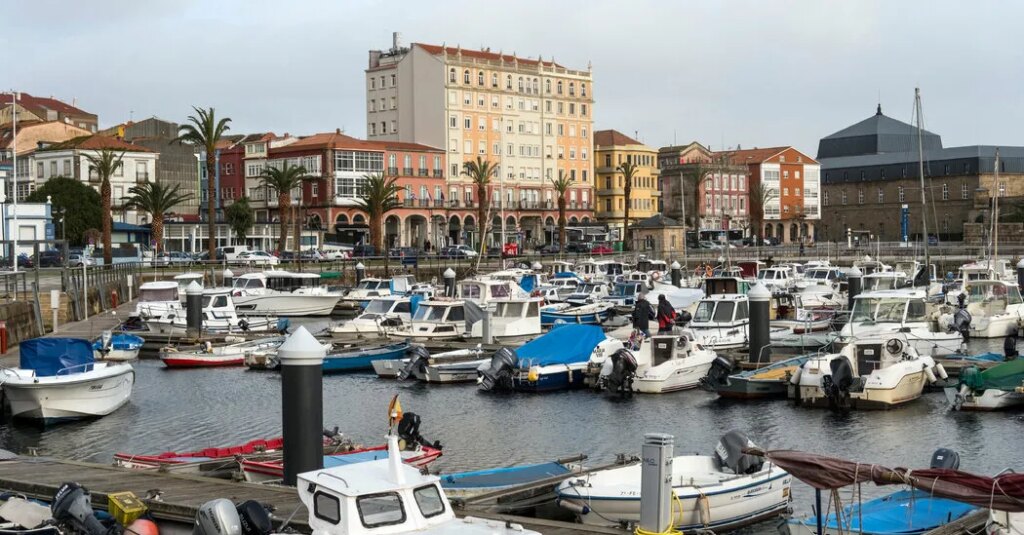
The port town of Ferrol has long been synonymous with Spanish national defense.
After the Spanish Navy built its arsenal and shipyards in Ferrol’s almost impregnable harbor in the 18th century, the city boomed. Naval engineers built elegant streets lined with glass balconies that became the envy of northwestern Spain, and more than a century later, Spain’s future dictator, Francisco Franco, the son of a naval officer, was born there.
Now the city, long since marred by industrial decay, unemployment and declining population, is becoming known for its warm welcome of Chinese industry into Spain and Western Europe.
In June SAIC Motor, one of China’s largest electronic vehicle manufacturers, chose a sleepy port just outside Ferrol as the site for a major plant. The project, which is expected to provide more than 1,000 jobs, has prompted widespread celebration across Ferrol.
That reflects a broader national consensus — even amid a rancorous election campaign in which politicians are sparring over other issues — over the need for Chinese investment.
The left-wing government of Pedro Sánchez is expected to sign off on the deal before the election on Nov. 29. If it doesn’t, a new conservative government is expected to. Either way, Ferrol will become the latest Spanish city to bet its economic future on hosting Chinese companies compatible with the country’s emphasis on green technology. Chinese battery makers, solar panel producers and other renewable energy companies are sprouting across Spain, where Chinese electric vehicle investments have grown faster over the past year than anywhere else in Europe.
The proposed plant in Ferrol embodies the trade-off between short-term economic opportunity and long-term risk that these Chinese investments present to Europe.
This summer, the Spanish news media reported that Spain’s security services were concerned that China might use the plant for espionage. The defense minister declined to comment on the reports, and the regional government quickly dismissed them as inaccurate.
What has lingered are deep questions about whether the increased Chinese presence, especially in one of Spain’s military heartlands, will eventually make Spain too reliant on Chinese supply chains, materials and technology, and make local Spanish firms more vulnerable to Chinese competition.
Those concerns have led leaders in other major European powers, like Germany, to make it harder for Chinese firms to set up shop on their soil.
“The question is,” said Rafael Dezcallar, until recently Spain’s ambassador to China, “what price are we willing to pay to have these advantageous relations with China?”
In Ferrol, a town of about 65,000, residents struggle to see a downside. They see the plant as a golden opportunity for rebirth after decades in which the Spanish Navy deployed some of its fleet further south, Asian competition eroded the shipbuilding industry, causing jobs to disappear and the population to crater.
“So, the plant is from China. What’s the difference?” said Rosi Vásquez, 68, as she carried groceries past one of the dozens of shuttered shops in town. “It would mean work for everyone.”
The investment promised “a radical shift regarding the nature of the city,” according to Alfredo Martín García, a historian at the University of León who has studied Ferrol, his hometown. “It changes the historical dynamic Ferrol has had over the last 300 years.”
Supporters also say the plant would give a lifeline to the Spanish car industry.
Spain doesn’t have its own competitive flagship brand, but it does produce gas-powered cars for other country’s automakers, traditionally those from Europe and America. That business accounts for 10 percent of the country’s G.D.P. — almost as much as tourism does — and Spain exports the most cars in Europe after Germany.
Facing the potential loss of that industry to electronic vehicles, Spanish officials are hoping the Chinese factories will provide Spanish workers with the technological know-how to become essential to the Continent’s new green production chains.
But some worry that China will keep key parts of the tech secret from the workers. That would extend a power disparity between China and Spain, which is already experiencing a historically high trade imbalance with China that has doubled over the last six years. Many fear Ferrol will be used merely as an assembly plant, or warehouse for cars, to get around high tariffs on Chinese imports to Europe.
Mr. Dezcallar said that when government officials have asked him about the SAIC plant in Ferrol, “I insist this has to involve a transfer of technology,” because Spain could not allow itself to just house Chinese assembly plants.
He argued that unlike Hungary, which has long been one of China’s preferred ports of call in Europe, Spain was in line with the goals and interests of the European Union, willing to call out its unfair trade imbalances and human rights violations. He also said that Spain was hardly an outlier given that muchof Europe was “fighting for the same thing,” an energy shot of Chinese investment.
While the Ferrol project enjoys support across the political spectrum, some have questioned if Mr. Sánchez has gotten too cozy with China.
The prime minister has gone to Beijing four times in four years and boasted in April that “we have raised political dialogue with China to its highest level in fifty-three years.”
Mr. Dezcallar, who has briefed Mr. Sánchez about China, said the prime minister — who has been a leading global critic of Mr. Trump’s strikes on Iran and his immigration policy — had not turned to Beijing as a replacement for Washington.
There was “for now,” Mr. Dezcallar said, no alternative to the United States, though “our fundamental values are being put into question by some American policies.”
But some deals have caused concern in Washington.
In 2025, the U.S. House and Senate intelligence committees called for a review of classified information-sharing agreements with Spain after Madrid contracted China’s telecom giant, Huawei, considered a security risk by Washington, to digitally classify and store communications intercepted by the police. The left-wing Spanish government has insisted that the system posed no risk of China scraping the information, which pertained to judicial, rather than counterintelligence investigations.
Not everyone is assured.
“Where on earth do you have China getting access to the tapes of important police records?” asked Fidel Sendagorta, a former senior foreign ministry official under Mr. Sánchez. He said the contract was “very symbolic of how much the Spanish government was willing to give to China to get something back. And what is this something back?” he asked.
In August, a leading left-of-center daily, El País, reported that the defense ministry had raised concerns that Chinese intelligence services might use the Ferrol plant to spy on Spanish naval bases that house ships containing American-made missile interception systems.
Alfonso Rueda, the conservative leader of the surrounding Galicia region, complained that the defense ministry surprised him with “these pronouncements” and his office later said in a statement that the defense ministry informed them that its report on the car factory “will be favorable.” The defense ministry and a representative for SAIC declined to comment.
Locals, including Ferrol’s mayor, suggested jealous neighboring port towns planted the story, and few expressed concern.
As Father Pedro Rodríguez Paz, 77, left the town’s main church near a docked battleship, he welcomed the plant as a chance to return to a “golden era” full of workers and “new buildings and more baptisms.”
Similarly optimistic messages reverberated around the city’s naval museums, its guarded arsenal, octopus restaurants and on the blighted streets around Franco’s birthplace.
“The important thing is the work and money. It’s a question of a rescue,” María José Valle Leivas, 43, said in her bookstore. “Everyone here wants it.”
The post A Chinese Port Could Be a Lifeline for Spain, but Also a Threat appeared first on New York Times.