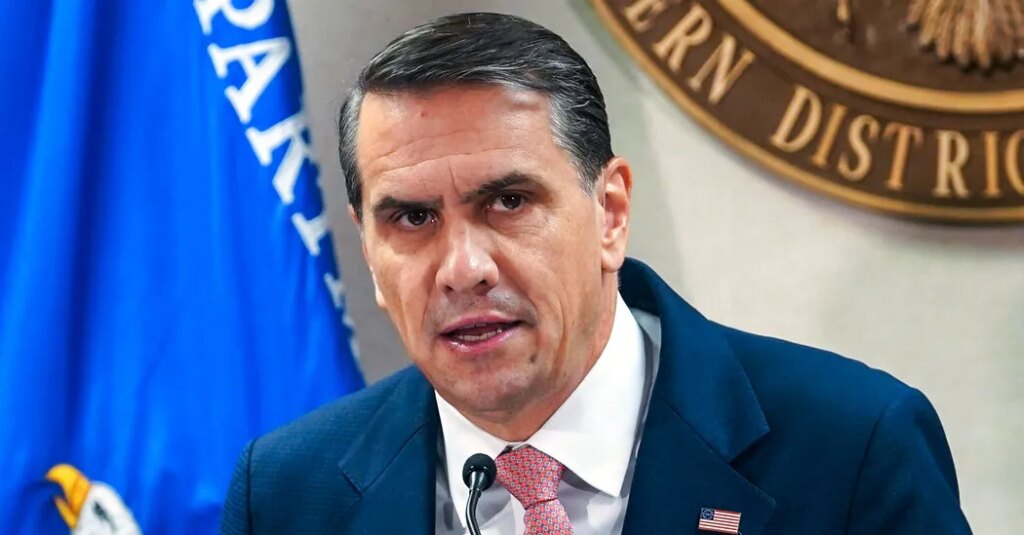
Attorney General Todd Blanche has delivered the same message time and again, at turns soothing and combative: The Justice Department is doing nothing out of the ordinary, and nothing remotely improper, in the lead-up to the midterm elections.
“We don’t do political paybacks,” Mr. Blanche declared last week, after he announced the indictment of a prominent Virginia Democrat on drug-trafficking charges.
“You got to stop it with that!” the usually measured Mr. Blanche said on Sunday, scolding Dana Bash of CNN for suggesting his effort to potentially block certification of Alaska’s Senate election to protect the Republican incumbent was undemocratic.
Yet it has become increasingly difficult to reconcile reassurances with reality, critics say.
In recent days Mr. Blanche and his team have announced, unsealed or initiated a succession of headline-grabbing actions certain to placate Mr. Trump’s demand for results, many targeting his longtime adversaries or promoting contested claims of election fraud.
That cadence seems to be quickening to a gallop.
On Monday, a federal judge in Washington unsealed new charges against James B. Comey, the third criminal case brought against the former F.B.I. director Mr. Trump openly reviles. If it is sustained in court, the charges open a new lane of criminal inquiry after the department’s indictment against Mr. Comey in April for sharing an image of seashells that Trump appointees say was a veiled assassination threat.
“This is a classic flood-the-zone strategy — run so many plays at once that the defense doesn’t know where to look,” said Greg Rosen, a former federal prosecutor who led the Justice Department section that investigated Trump supporters who ransacked the Capitol on Jan. 6, 2021.
Department officials declined to comment on ongoing investigations or matters before grand juries. But Emily Covington, the agency’s spokeswoman, said that all of the recent actions reported in the news media broadly reflected the normal progression of investigations and were in no way related to the election or partisan motives.
Mr. Comey’s team requested the charges be unsealed and a judge determined the timing of the release. The government did not object, Ms. Covington said.
“This department is following the facts and the law, not anyone’s political timetable,” she said in a statement.
Nonetheless, some paperwork filed in recent cases bear unmistakable signs of haste and exigency — typos, unorthodox tactics and the telltale signatures of the department’s senior political leadership in lieu of unit chiefs and career prosecutors.
The Comey case, for instance, was not based on a grand jury indictment, but rather an intermediate procedural benchmark known as an “information.” A letter federal prosecutors sent on Monday to officials in Washington State seeking help in protecting “the integrity” of the midterms referred to “voter roles” — misspelling voter rolls. The Justice Department’s lawsuit in Alaska last week omitted the key verb describing the action it wanted the court to take.
Two factors are driving the current spree, in the view of current and former officials. The first is Mr. Blanche’s decision to ignore the longstanding department policy of delaying nonessential activities involving public figures within 60 days of an election.
Ms. Covington said the Justice Manual, the department’s procedural guidebook, bars prosecutors from taking actions intended to sway an election, regardless of timing.
“The standard is purpose, not proximity to Election Day,” she said. “Department policy does not require the department to stop ongoing work during an election season.”
The second is Mr. Blanche’s belief that Article II of the Constitution gives Mr. Trump nearly unfettered executive authority — and his rejection of calls to resist direct presidential control or assert independence.
“No attorney general should ever pledge that,” he said in August.)
Almost all the actions have targeted Democrats and Trump critics.
They include the Comey indictment, based on an accusation that he authorized a leak of national security secrets a decade ago; intensification of an immigration investigation into Representative Ilhan Omar, a sharp critic of the White House; the indictment of L. Louise Lucas, a Virginia state lawmaker, accused of overseeing a criminal conspiracy to sell marijuana; and a criminal complaint filed last week against two former F.B.I. counterintelligence officials accusing them of lying to Congress about their roles in the bureau’s investigations of Hunter Biden.
(All have denied the charges, casting them as politically motivated.)
Both the Omar and F.B.I. cases are complicated, and even critics of the department concede that some of the leads being pursued might have merit. But there are no indications that either case involves a threat so urgent it cannot wait until after Nov. 3.
On Tuesday morning came another move involving a high-profile Democrat. F.B.I. agents searched the Beverly Hills residence of a political donor associated with former Representative Eric Swalwell in connection with an ongoing investigation into sexual misconduct allegations, according to two people with knowledge of the matter who requested anonymity to discuss details of the inquiry.
One investigation targets a Trump administration figure, Corey Lewandowski, and his role in approving contracts at the Department of Homeland Security.
The Comey indictment seemed to delight Mr. Trump’s base. Mike Davis, an influential activist, crowed that the department was “just getting warmed up.”
It is far less clear any of it will have the slightest impact on a electorate focused on rising gas prices, stagnant wages, self-dealing by administration officials and the Iran war.
Even so, more moves are on the horizon. There has been a surge in activity in the department’s investigation into Cassidy Hutchinson, a former White House aide from the first Trump term who testified before the committee investigating the attack on the Capitol, according to people familiar with the investigation.
Then there is the election itself. The department, on a parallel track, is intensifying efforts to directly influence the administration of elections, authority delegated to the state by the Constitution.
On Thursday, the department asked a federal court to block certification of the Alaska election if the incumbent, Senator Dan S. Sullivan, were to lose narrowly, claiming that the presence of another candidate with a nearly identical name tainted the election.
“I’m the one that said do it,” the president told reporters soon after.
A federal appellate court in California temporarily blocked a wider-ranging effort to impound 20,000 ballots, with two of three judges expressing skepticism of the government’s claims that many of the voters were undocumented immigrants. Similar actions in other states could come soon.
These moves come on top of unsuccessful department efforts to obtain sensitive voter data from the states, amid a daily drumbeat of charges against immigrants.
Ms. Covington said the Biden administration took comparable action in court before the 2024 election, suing Alabama and Virginia to stop them from removing possible noncitizens from their voter rolls — without drawing comparable criticism.
“When this department acts to keep noncitizens from voting, it’s called election interference,” she said. “That’s a double standard. Enforcing election law right before an election is exactly when it matters most.”
Both the Alaska and California suits bore the signatures of two top Blanche aides with connections to the White House, a departure from other recent election lawsuits brought by the department’s civil rights division.
In both cases, division officials raised questions about the legitimacy and viability of the suits, according to people familiar with the situation, speaking on the condition of anonymity to discuss internal deliberations.
The Comey case, brought in Federal District Court in the District of Columbia, was signed by five officials — none permanently assigned to the local U.S. attorney’s office or assigned to headquarters in units that investigate national security or public integrity crimes.
The first name listed was Mr. Blanche’s top deputy, Trent McCotter, who also filed the California voting suit. The second was Mr. McCotter’s deputy, Aakash Singh, who recently took over supervision of the flailing investigation based in the U.S. attorney’s office in Miami known as the “grand conspiracy” inquiry into Democratic officials.
The case emanated from the Florida inquiry, a senior law enforcement official said.
The others were lawyers temporarily detailed to the U.S. attorney’s office in Washington — one was a deputy counsel with the Department of Homeland Security, the two others were junior federal prosecutors from Texas and Florida.
The fate of the cases, like that of so many others brought under Mr. Blanche and his predecessor, Pam Bondi, is deeply uncertain, with juries and judges increasingly skeptical of the department’s motives.
The new charges against Mr. Comey are not an actual indictment, which involves convincing a grand jury there is probable cause to indict him, but a technical expedient intended to keep the statute of limitations from running out.
In a similar fashion, the charges against the two former F.B.I. officials — which include a more detailed account of potential wrongdoing — were filed as a criminal complaint, which can proceed with a judge’s approval, skipping the scrutiny of a grand jury.
Even more unusually, prosecutors added a new obstruction count to the case in a revised complaint filed near midnight on Monday without any judicial approval whatsoever. The magistrate judge overseeing the case, Zia M. Faruqui, said he was troubled that prosecutors had issued the new complaint without following the basic rules of criminal procedure and refused to accept it.
When one of the prosecutors, John Borchert, acknowledged it was a “novel” tactic to seek a criminal charge with neither the permission of a jurist or grand jury, Judge Faruqui said it was more than that.
“It’s not just novel, Mr. Borchert,” he said. “It’s never been done before.”
These days, prosecutors have good reason to avoid bringing their cases to grand juries — especially in Federal District Court in Washington, where both Mr. Comey’s case and the case against the former F.B.I. officials are playing out.
Over and over in recent months, grand juries in the courthouse have rejected the department’s efforts to bring charges against Mr. Trump’s perceived enemies and ordinary residents caught up in his immigration crackdown.
Obtaining a grand jury indictment “is no sure thing in the nation’s capital,” where hundreds of Trump supporters were convicted in the Jan. 6 attacks, said John P. Fishwick Jr., who served as U.S. attorney for the Western District of Virginia under President Barack Obama.
The post With ‘Flood-the-Zone Strategy,’ Justice Dept. Steps Up Moves as Midterms Near appeared first on New York Times.