After a roughly $1 billion investment in a new Washington Commanders stadium, $500 million for Capital One Arena and as a Nationals Park renovation is under review, another D.C. sports franchise is seeking hundreds of millions in taxpayer money for an arena upgrade.
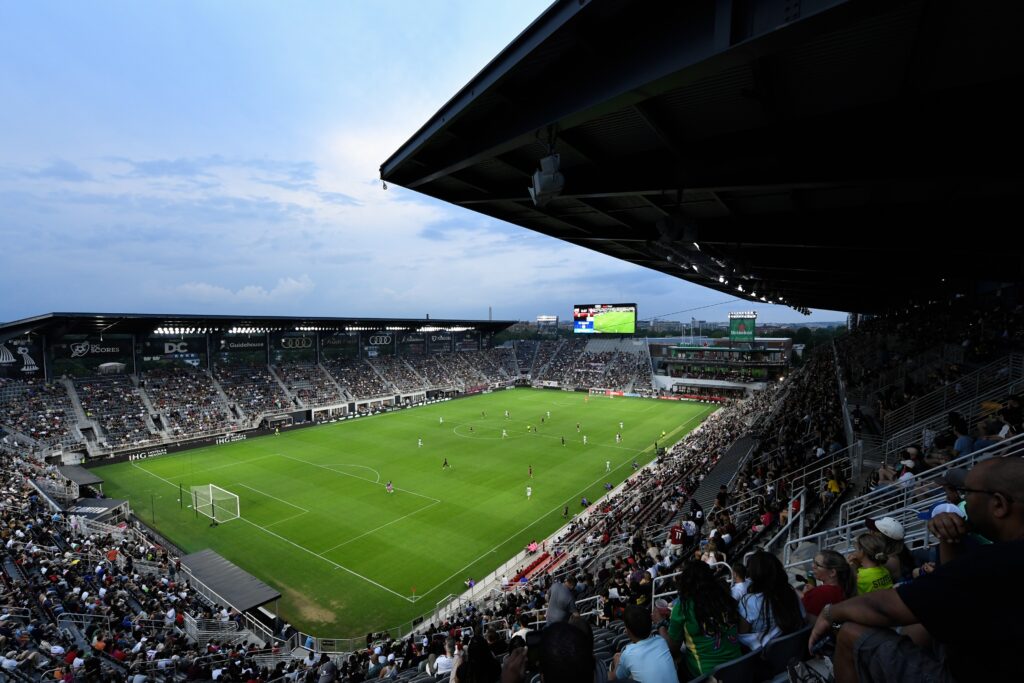
D.C. United execs made the case before D.C. Council members Friday for a $620 million renovation, including a roof, at Audi Field, where it and the Washington Spirit play to sold-out crowds.
A bill introduced in July by Chairman Phil Mendelson (D) would commit a minimum of $300 million in public investment for the soccer arena over five years, an upgrade the team says is necessary as Major League Soccer transitions to a winter-heavy schedule and the fan base grows. A renovated stadium also could host other sports and entertainment events, supporters say.
A major building trades union backing the development came armed with a project labor agreement already in place, excited by the prospect of creating hundreds of jobs. A major local developer, Monty Hoffman, urged passage of the bill, laying out plans to build housing nearby for seniors and retail.
But the team faces a hurdle: After the city has committed so much taxpayer money to other sports arenas, and as D.C. enters an increasingly challenging fiscal climate, is there a big enough public appetite to get the bill over the finish line?
“We have a little bit of stadium fatigue,” council member Christina Henderson (I-At Large) said in an interview. “When Phil introduced the bill, I was like, ‘Say what?’ It was a surprise.”
Outgoing Mayor Muriel E. Bowser (D), the city’s “sports capital” champion, threw cold water on the idea this summer, concerned that the upgraded Audi Field would compete with events at Capital One Arena — a concern Henderson shared.
The city previously invested $150 million toward Audi Field, which opened in 2018.
Mendelson said his hope was that additional revenue generated by expanded seating and the possibility of dozens more events at a roofed Audi Field would allow the District to recoup its investment.
Jason Levien, CEO of D.C. United, said in an interview he hoped lawmakers would consider the Audi Field project on its own merits. In addition to hosting more events in the winter months, he said the goal is to enhance the fan and team experience for the Washington Spirit, which is entering the last year on its lease at the stadium and looking for more commitments from D.C. United. “We want them to stay,” Levien said.
“Putting that all together,” Levien said, “I think there’s a big catalyst for economic growth, and the need for a stadium that can be climate controlled.”
The fate of the project could depend on the next mayoral administration. Bowser’s deputy mayor of economic development, Nina Albert, said Friday that while she thought the proposal to expand Audi had merits, the Bowser administration couldn’t support it without more rigorous analysis.
“The District’s investments in sports have historically required careful evaluation and justification of the public’s investment, and in this case I would argue we have a bit more work to do to justify it,” Albert said at the hearing.
The presumptive next mayor, council member Janeese Lewis George (D-Ward 4), has been reserved about whether she’ll back it. “I don’t have a comment on that at this time,” she said last week.
Levien said that while he was “disappointed” by Bowser’s stance, he said Lewis George encouraged him to lock down a project labor agreement early in their talks. That could avoid a situation as with the Commanders stadium deal in which a stronger labor agreement was negotiated late in the legislative process.
“Let’s build the right coalition to make this work. Let’s get labor involved from the outset,” Levien said of the approach.
Levien said the upcoming MLS schedule changewas the catalyst for the upgrade request. The season runs from late February to early December. Starting next year, it will run from July to May, with a midwinter hiatus. Other northern stadiums — not all of which will have roofs — are making adjustments as well. At the same time, as both the women’s and men’s teams regularly sell out the arena, execs say that they are outgrowing the existing 20,000-seat capacity.
“The demand is there. The league is evolving. This project makes sure Washington is ready for both,” said Charles Altchek, executive vice president of club performance and league growth at MLS.
With the looming schedule change, some superfans struggled to imagine keeping up with the teams without the roof.
“We’re definitely supportive of the stadium,” said Shirley Diaz, a nearby resident and regular at the games with her family. “There’s games we’re not able to go to when it’s raining or it’s simply too cold to take little kids to.”
Still, executives faced questions Friday about whether public financing is essential or whether some arena improvements would still move forward without it. Danita Johnson, president of D.C. United’s business operations, said that was under review.
Kim Stone, CEO of Washington Spirit, said while the team supports an expansion of Audi Field, it is “neutral” on Mendelson’s bill. Stone said the team is asking for a greater seat at the table to ensure the details of any deal also benefit the women’s team.
For example, Stone asked whether additional events at Audi Field could have a negative impact on the Spirit’s schedule.
“The details need to be refined in order to make sure we have enforceable protections that are good for everybody,” Stone said.
Under questioning by Mendelson, Levien committed to addressing Stone’s concerns.
Women’s sports proponents broadly backed the expansion, also seeing room to bring professional women’s volleyball under the roof. The DC Flight will play its first season at the Anthem next year.
“We should be the best place in the country for women’s sports,” said council member Brooke Pinto (D-Ward 2), arguing that the District could find room in its capital budget to continue to support sports and entertainment projects without forgoing other important public investments.
Still, Pinto said she realized that if the Spirit benefited from an expansion, that could raise questions about whether it was time to also fund an expansion for the Washington Mystics, which have the smallest arena in the WNBA and also want more space.
Council member Charles Allen (D-Ward 6), who represents the Southwest neighborhoods near Audi Field, was open to Mendelson’s proposal. But he said he was concerned that the bill set $300 million as the minimum public investment, and said he’s hearing some skepticism from the public about the idea.
“I hear from residents, small businesses and others that are like, where’s the investment for me?” Allen said. “The appetite to take on and throw a huge amount of money toward another stadium I think is thin among the public, and not just the public but our small businesses.”
Joey Davis, president of AFGE Local 1975, which represents government workers, said he couldn’t believe the council was discussing public financing for yet another stadium project when the city can’t afford cost-of-living raises for employees, which were left out of the most recent budget.
“How many stadiums must we finance before we can afford to adequately compensate the people who actually run this city?” Davis said, even as he recognized the capital investments come from a separate pot of money.
Others in the business community were hopeful a roofed arena in the winter could inject new energy — and revenue — into Southwest Waterfront restaurants and businesses in the colder months when Nationals Park goes dark. “This bill is about more than just a roof on a stadium,” said Hoffman, adding that a roofed Audi could “unlock” more economic vitality year-round, including at the adjacent land he is developing.
The legislation is unlikely to advance before the end of the year. The council has other sports stadium business to attend to this fall, namely legislation from Bowser authorizing bonds for $380 million to support the renovations at Nationals Park. The plan has been under discussion for years, and would be paid off through an existing revenue stream tied to the ballpark.
The post At risk of ‘stadium fatigue,’ D.C. Council weighs $300 million-plus for Audi Field appeared first on Washington Post.