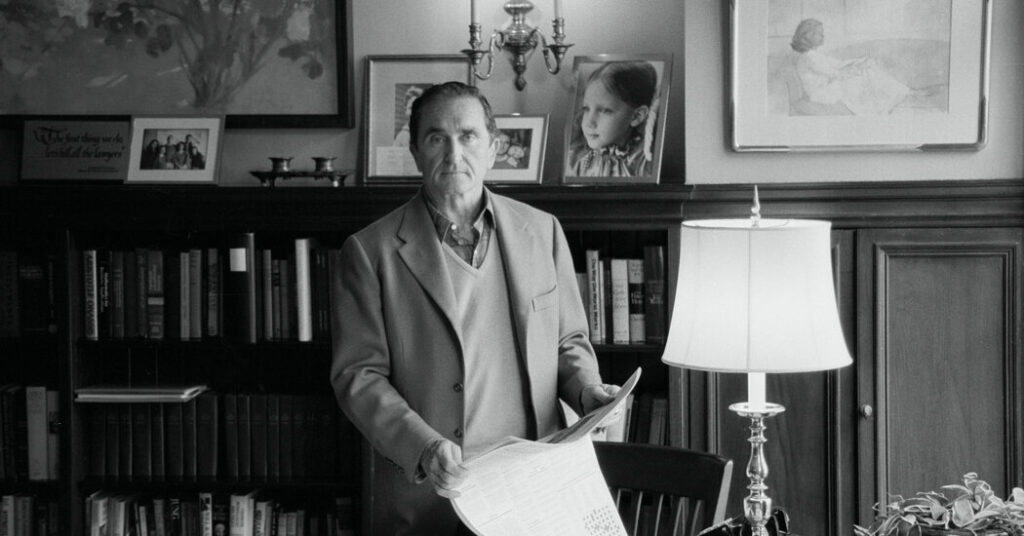
Arthur L. Carter, a Wall Street investment banker who became a newspaper and magazine publisher — most prominently founding the cheeky and salmon-colored New York Observer — and had an unlikely third act as a sculptor, died on Sunday in Manhattan. He was 93.
His death, in a hospital, was confirmed by his daughter Mary Dixie Carter.
In his youth, Mr. Carter had studied at Juilliard and entertained aspirations of becoming a concert pianist before he realized that classical music did not provide the stable income he needed as a newly married husband and father. His pivot to finance, however, proved wildly successful.
In the 1960s, Mr. Carter partnered with his next-door neighbor Sanford I. Weill, who later became head of Citigroup, and made a small fortune as a pioneer in the leveraged buyout — borrowing money to acquire a company using its own assets and cash flow as collateral. Mr. Carter later amassed hundreds of millions of dollars through his private-equity holding company.
Looking for other endeavors to occupy his restless interests, he entered publishing “to combine public service and build an economic asset at the same time,” he told The New York Times.
In 1981, he started The Litchfield County Times, a weekly newspaper covering northwestern Connecticut, where he owned a 1,400-acre dairy farm. He oversaw the paper for two decades as it grew in circulation to 15,000, won awards for general excellence for its size and gained a reputation for dogged reporting and stylish design. He later sold the paper and a few lifestyle publications he had acquired to the Journal Register Company, a Pennsylvania-based newspaper chain.
The Litchfield County Times’s real-estate listings were especially coveted in the 1980s and ’90s, attracting a readership of cultural elites looking for getaway weekend properties; they included William Styron, Arthur Miller, Meryl Streep and Jasper Johns. “People would see a house and they’d buy it on the phone,” Mr. Carter told The Hartford Courant. “Stephen Sondheim told me he bought his house over the phone.”
Seeking a broader media stage, Mr. Carter acquired a majority stake in The Nation in 1985 — he said the magazine had shaped his largely liberal outlook even on economic issues — and hoped his backing would help it amplify its venerable progressive voice during the Reagan administration.
In 1986, he wrote an opinion essay for The New York Times favoring a 1 percent annual tax on the accumulated capital of every family. He estimated that the tax could produce $100 billion annually — including $2 million from his own pocket — to reduce the national deficit and begin to redistribute the country’s wealth.
“Maybe, in time, the allure of money for money’s sake will dim,” he wrote, “and with it the attractions of such professions as investment banking, where fortunes are made for providing a service this country can probably do without.”
The Nation, with a reported circulation of 85,000, was losing $500,000 a year when Mr. Carter sold it in 1995, for a sum undisclosed at the time, to its editor, Victor S. Navasky. (Three years later, in an essay for The Atlantic, Mr. Navasky, who described Mr. Carter as “my friend, boss, and sometimes bane,” said he had paid $1 million for the magazine in installments.)
Mr. Carter added to his growing media holdings in 1987 by founding The New York Observer, an upscale Manhattan weekly whose distinctive salmon-hued newsprint was inspired by the look of The Financial Times. In a city brimming with established and upstart publications — among them, New York magazine, The Village Voice and Leonard Stern’s short-lived 7 Days — Mr. Carter saw his entry into the market as a sound business decision.
“I thought the demographics of Manhattan were very similar to those of Litchfield County,” he told The Times in 1987. “And there wasn’t any paper covering Manhattan exclusively. No one was saying they were going to focus on Manhattan — its businesses, its politics, its cultural affairs.”
The Observer was produced by a cadre of reporters and editors whom Mr. Carter prized for their insider tone and irreverence. “We don’t take ourselves too seriously,” he told The Courant. “Or we pretend we don’t.”
Among the staff members who passed through The Observer was Candace Bushnell, whose witty and candid Sex and the City column appeared in its pages. Its political writers included Joe Conason and Michael Tomasky, and Andrew Sarris contributed film criticism.
In 2006, the Times media reporter David Carr described The Observer, then with a circulation of about 45,000, as a “maypole of Manhattan gossip and intrigue” focusing on media players, real estate magnates and the political aristocracy.
“The vocabulary of contemporary journalism, saturated with gimlet-eyed social observation and a catty mistrust of convention, owes much to The Observer,” Mr. Carr wrote.
Terry Golway, an author and historian who wrote editorials for The Observer, said in an interview: “Arthur was absolutely fearless; he truly enjoyed it when reporters or columnists annoyed and even infuriated his friends and associates. I remember Mayor David Dinkins called to complain about a story I had written. Arthur told the mayor, ‘Dave, just be glad that story wasn’t in The Times.’”
Peter Stevenson, a former executive editor of The Observer and now a senior editor at the online newsletter Puck, said of Mr. Carter, “He was willing to lose millions because he loved journalism and couldn’t think of a better way to spend his money.”
Mr. Carter was losing about $2.5 million a year when he sold The Observer in 2006 for nearly $10 million to Jared Kushner, the 25-year-old son of a developer and a future son-in-law of Donald J. Trump. The Observer ceased print publication in 2016 amid big declines in print advertising industrywide, but it endured online.
Mr. Carter was droll about his experiences in the lucre-hemorrhaging world of publishing. “Everything,” he told The Times in 2006, “is a vanity press until it makes money.”
Arthur Lloyd Carter was born on Dec. 24, 1931, in Manhattan, a grandson of Jewish immigrants from Hungary, and grew up in Woodmere, N.Y., on Long Island. His father, Eugene, was a field agent for the Internal Revenue Service. His mother, Rosalind (Glaser) Carter, taught French.
After graduating from Woodmere High School, Arthur briefly attended the Juilliard School, where he studied under the concert pianist Rudolf Serkin.
He received a bachelor’s degree in French literature from Brown University in 1953, and then served in the Coast Guard, commanding a patrol ship based in New York.
After his discharge in 1956, Mr. Carter joined Lehman Brothers and commuted to Manhattan every morning from East Rockaway on Long Island with Mr. Weill.
On leave from Lehman, Mr. Carter earned a master’s degree in business administration from Dartmouth College in 1959. Rather than pursue a career teaching business, in 1960 he and another Lehman broker joined Mr. Weill in establishing what soon became Carter, Berlind & Weill, a small but scrappy investment banking and brokerage firm.
When Mr. Carter cashed out of the firm in 1970 to manage his own money instead of his clients’, he had become a multimillionaire. The firm later absorbed competitors and became, through mergers, Shearson Lehman Brothers.
Through his private-equity holding company, Utilities & Industries Corporation, Mr. Carter had stakes in scores of companies involved in printing, shipping, water utilities, shopping centers, real estate, banking, meat packing, music publishing and precision springs.
He was a major benefactor of New York University and the University of Connecticut, among other institutions. N.Y.U. renamed its journalism department in his honor.
His marriages to Linda Schweitzer, from 1957 to 1965, and to the actress Dixie Carter, from 1967 to 1977, ended in divorce. In 1980, he married Dr. Linda Kessler.
In addition to his daughter Mary, from his second marriage, he is survived by his wife; three children from his first marriage, Jon, Whendy and Ellen Carter; another daughter from his second marriage, Ginna; a stepdaughter, the actress Ali Marsh; a sister, Ellen Wiesenthal; 12 grandchildren; and two great-grandchildren.
Mr. Carter attributed his childhood interest in geometry to his lifelong interest in sketching, which evolved by his 60s into a new avocation, sculpture, crafting bronze, copper and stainless steel into angular three-dimensional art. He learned how to weld while serving in the Coast Guard, but he also employed craftsmen to assemble the work he sketched out, according to The Courant.
His work appeared in such venues as the General Motors building in Manhattan and at an entrance to Central Park.
In a book about his work, “The Geometry of Passion” (2016), Mr. Carter suggested that after a lifetime of searching for a profession to fit his skill set, he had found it not in numbers or words but in art. “Only squares and circles, lines and ellipses,” he wrote, “can elegantly explain and simplify the complex meaning of life.”
Sam Roberts is an obituaries reporter for The Times, writing mini-biographies about the lives of remarkable people.
The post Arthur L. Carter, 93, Dies; Investment Banker Founded a Cheeky Newspaper appeared first on New York Times.