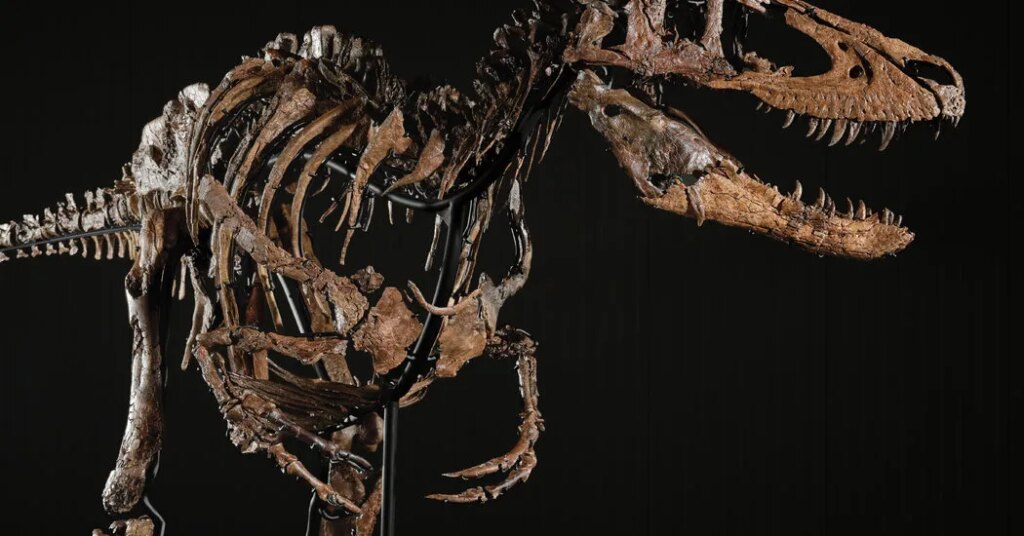
A skeleton belonging to a smaller relative of Tyrannosaurus rex was sold at auction on Tuesday for nearly $47.3 million, far beyond projections. It was the latest lucrative sale of a fossil coming out of the field of commercial paleontology.
The final price, $47,255,000, was higher than other recent auctions of larger dinosaur fossils, though below a $50.1 million sum for a T. rex specimen at Sotheby’s in June.
The fossil is nicknamed Jodi, after Jodi Pierson, the rancher who found the remains in 2019 on her land in Montana. It comes from the Hell Creek Formation, a layer of rocks known as a graveyard for fossil remains. Initially, Sotheby’s estimated the animal, from a group of dinosaur species called Nanotyrannus, would sell for $6 million to $9 million. The buyer and seller were not identified.
The Nanotyrannus was discovered miles away from the site of another significant paleontological find, in 2006 — the “dueling dinosaurs,” which appeared to be a Triceratops and a Tyrannosaurus locked in a death match. The process of excavating Jodi was documented in the Discovery Channel show “Dino Hunters” in 2020. Ms. Pierson’s cousin is Clayton Phipps, a commercial excavator who also discovered the “dueling dinosaurs.”
Jodi is 6.5 feet tall and 19.6 feet long. The group she is a part of has been at the center of a dispute that has animated the field of paleontology for almost a half century: Are Nanotyrannus just adolescent T. rexes, or an entirely different species of tyrannosaur?
A team from the Cleveland Museum of Natural History found a skull in 1942 then thought to be an adolescent Tyrannosaurus rex. In 1988, further study revealed the possibility that it may have actually been a cousin of T. rex — setting off decades of debate.
Differentiating between two similar species is challenging because of the limited fossil specimens available for comparison.
“Big top predators like T. rex were not abundant in an ecosystem, and big animals also typically leave more fragmentary remains,” Linda Ivany, a professor of evolutionary paleoecology at Syracuse University, said in an email.
She added that it was difficult to assess the age of a fossilized organism when it died.
“Hence the problem with Nanotyrannus,” she said. “Is it a juvenile T. rex, or a fully grown different species? The distinction is very difficult to establish.”
A study released last year in the journal Nature appeared to settle the question, based on the “dueling dinosaurs” discovery. Researchers marshaled sufficient evidence from the tyrannosaur in that pair of fossils, which ended up on display at a North Carolina museum, to show that it belonged to a distinct species, which scientists named Nanotyrannus lancensis. That meant that the “teen rex” theory had been overturned.
“Jodi” is also a member of Nanotyrannus lancensis, distinguishing her from another species, Nanotyrannus lethaeus. There is still some scientific debate as to whether there are two different species.
In July, Sotheby’s auctioned the Tyrannosaurus rex fossil known as Gus, for $50.1 million. That skeleton, almost 13 feet tall, is twice the size of Jodi, and was excavated from private land in South Dakota starting in 2021. It followed a Christie’s auction of another T. rex skeleton, nicknamed Stan, for $31.8 million — heating up the dinosaur fossil market. In 2024, Sotheby’s sold Apex — a stegosaurus — for $45 million, then a record. It was bought by the billionaire Kenneth C. Griffin, and is now on display at the American Museum of Natural History in New York.
Some scientists have criticized these auctions for potentially hiding away, in private hands, specimens that can unlock secrets about the fierce animals that once ruled the Earth.
“These amazing fossils should stay in the public sphere for scientists to study, for children to be awed and inspired, and for everyone to be able to marvel at worlds long past and what we can learn from them,” Ms. Ivany said.
The post Skeleton of ‘Jodi,’ T. Rex’s Littler Cousin, Is Auctioned for $47.3 Million appeared first on New York Times.