Broccoli is arguably among the first foods that come to mind when most people think about healthy eating, and rightly so. Rich in vitamins such as A, C and K, and minerals such as calcium, potassium and iron — not to mention a solid source of insoluble fiber and a potentially anticarcinogenic compound called sulforaphane — broccoli’s nutritious reputation is wholly warranted.
The rub is that how you cook the vegetable can affect whether all of those good-for-you nutrients make it to your plate. That’s particularly true for home cooks who favor methods such as boiling and roasting, two techniques that have characteristically high temperatures or roiling waters known to sap water-soluble vitamins and deactivate antioxidants found in broccoli and other cruciferous vegetables.
“If we care about how much nutrient is actually retained within the vegetable, we definitely want to think more carefully about the means of cooking,” said Leanne Le Zhu, a professor and director of the master of food science program at Cornell University.
We consulted food scientists to find out how different broccoli-cooking methods affect the vegetable’s beneficial chemicals and what you can do to keep them intact.
The compounds that make broccoli so healthy
The nutrients in broccoli, and their associated benefits, are wide-ranging. The vegetable contains almost as much vitamin C per serving as an orange. Its considerable quantities of blood-pressure-improving potassium, bone-nourishing calcium and brain-bolstering folate are just as noteworthy. It’s also full of fiber.
Some of these components are able to withstand different cooking methods without losing their potency, especially minerals such as calcium, which doesn’t seem to be compromised by heat, Zhu said. Others, such as fiber, will break down slightly but maintain their overarching structure with typical cooking strategies and times.
By contrast, the water-soluble and temperature-sensitive vitamins in broccoli, such as C and B6, often fare much worse: Boiling leaches them out into the surrounding cooking water, and hotter approaches such as roasting and stir-frying deactivate them entirely.
And then there’s sulforaphane, which actually isn’t present in broccoli from the jump. Instead, it forms when you chop or chew the vegetable, causing a chemical reaction between an enzyme called myrosinase and another compound called glucoraphanin, said Gabriel Keith Harris, a professor of food science in the department of food, bioprocessing and nutrition sciences at North Carolina State University.
Research has linked sulforaphane to possible anticarcinogenic, anti-inflammatory, antiaging and even neuroprotective effects, though most studies have been conducted on animals or in labs rather than in humans. Additionally, the amount of sulforaphane given to subjects in the few existing human studies was far greater than what’s found in a typical broccoli serving and would be next to impossible to re-create in real life, said Andrea J. Glenn, an assistant professor in the department of nutrition and food studies at New York University.
That doesn’t mean the compound does nothing. Its potential effects are promising, Harris said, but as of now, still mostly just that: potential.
Similarly to the water-soluble vitamins in broccoli, heat can mess with sulforaphane content because it can damage the compounds that create it. Think of an egg coagulating after being boiled, Zhu said. “If we have a high level of heat acting on any protein structure, at some point, the protein will stop behaving in its natural kind of state and start to change.”
When an egg is cooked, it no longer can emulsify into a sauce such as mayonnaise. The same goes for enzymes, which no longer will interact to form other compounds after such a transformation. In general, this change takes place after broccoli has cooked at 140 to 158 degrees Fahrenheit for five to 10 minutes.
How to cook broccoli to retain its nutrients
Boiling is the worst option for maintaining vitamins and glucoraphanin in broccoli, Glenn said. Water-soluble vitamins may be retained in the liquid — you can use it as the base of a soup or stew to get the most out of it — but anything that’s extremely sensitive to heat generally will be lost.
On the flip side, Glenn noted that the fiber in broccoli, which can be particularly hard to digest for folks with gastrointestinal conditions, may be better tolerated after an extended cooking method such as boiling.
But if you’re focused on making your broccoli dishes as nutrient-rich as possible, opt for one of these cooking methods instead.
Blanching: Blanching involves a short boiling process — usually no more than a minute or two — followed by rapid cooling by plunging the vegetable in an ice bath. Again, the high heat (even for a very brief time) can potentially reduce glucoraphanin, Harris said, but there’s a way to blanch and get your sulforaphane, too: All it requires is lowering the temperature of your water. Keep the heat below 204 degrees Fahrenheit — you might need a thermometer or digital kettle to monitor this — then cook for no more than one or two minutes, he suggested.
Blanching also has been shown to compromise temperature-sensitive and water-soluble vitamins such as C and folate. But it may still do a slightly better job of maintaining them than boiling, since the rapid cooking period doesn’t allow as much time for them to be leached into the water.
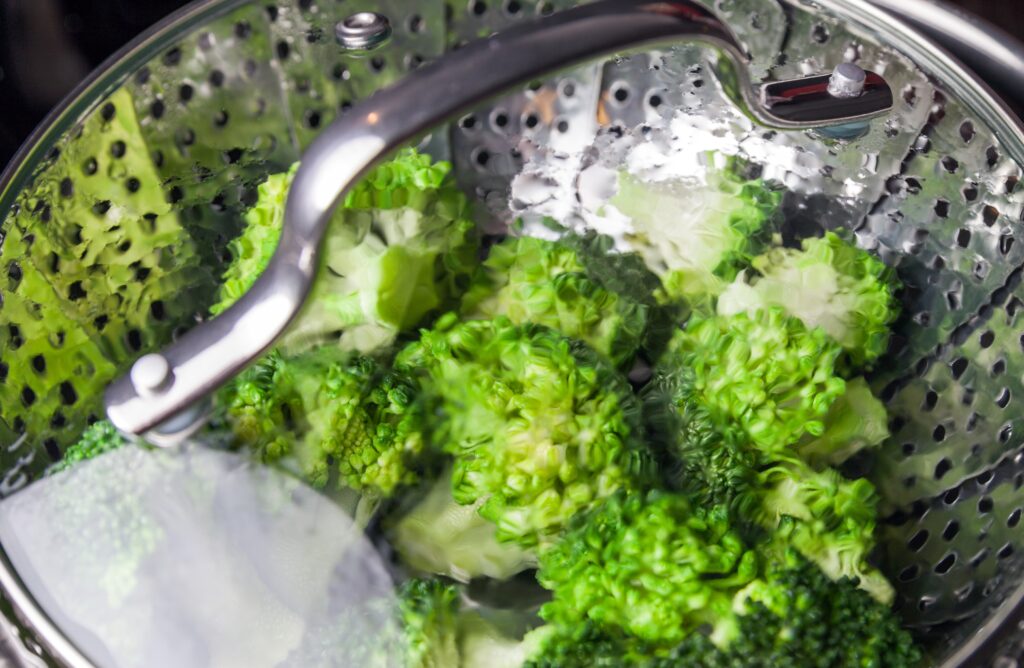
Steaming: Steaming is among the better broccoli-preparation styles because the indirect contact with heat prevents the vegetable interior from reaching temperatures that may destroy the enzymes within, Harris said. And while steaming has been shown to reduce the retention of compounds such as vitamin C in most vegetables, research suggests that broccoli may be the exception to this rule.
Roasting: There’s not much research focused on the effects of roasting, but since it uses high heat, it probably reduces some of the heat-sensitive nutrients in broccoli, such as the myrosinase required for sulforaphane, Glenn said, plus vitamin C and folate. It’s overall a better method than boiling, since there’s nothing for water-soluble vitamins to leach into. And not for nothing: It’s one of the tastier ways to prepare broccoli, so might be a good choice for pickier palates.
Microwaving: Using a microwave to cook broccoli may be among the better options for nutrient retention. Some studies even found that unlike other methods, it increased sulforaphane levels in the vegetable. Another found that it also had less impact on vitamin C content, preserving up to 90 percent of the nutrient.
Raw: The only way to guarantee your broccoli experiences no loss in nutrients is to eat it raw. Enjoy some fresh florets dunked in your favorite dip, or chop it up finely and add to other greens to give your salad some extra crunch. If you are completely put off by the idea of munching on uncooked broccoli, consider sneaking another cruciferous vegetable with a similar nutrient profile into a more palatable package, such as by blending kale into a smoothie, Glenn said.
At the end of the day, eating broccoli prepared any way is a win for your health compared with not eating this vegetable at all. So while the above can help guide you to maximize nutrient value, balance it with your taste buds. If there’s one cooking method that gets you to enjoy broccoli, then that’s the one worth doing, Zhu said.
The post The broccoli-cooking mistake that may reduce its health benefits appeared first on Washington Post.