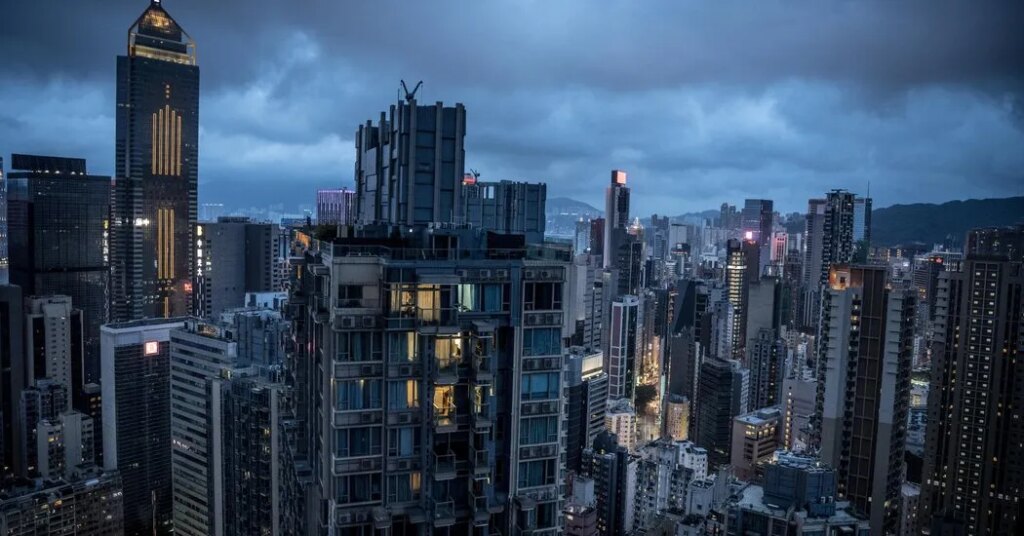
Hong Kong apartments can be terrifying. And it’s not just their price tag.
The city — where a parking spot can fetch more than half a million dollars and some people are forced to live in subdivided accommodation known as “coffin homes” — is one of the least affordable property markets on the planet. This tension has given rise to a subgenre of Hong Kong horror films in which high-density housing is a spooky backdrop for exploring superstition and socioeconomic anxieties.
“In Hong Kong, the ghosts and the spirits are trapped in the apartment with you,” said Roy Tan, a screenwriter and filmmaker in the city. “You can’t get out, and they can’t get out either.”
One “apartment horror” movie, “Coffin Homes” (Fruit Chan, 2021), is a splatter-filled satire that bites into the absurdities of capitalism and the Hong Kong property market. In the film, it is the ghosts who are displeased by the attempts of the living to share their space — a glimpse into a very Hong Kong superstition, where a suspiciously cheap apartment is a sign that it was most likely the site of a tragedy or grisly crime.
The films are steeped in Hong Kong folklore, in which “it is generally believed that the dead live among us all the time,” said Tobias Zuser, a lecturer at the Chinese University of Hong Kong and Hong Kong Baptist University whose courses include discussions on global horror cinema.
“It’s this wonderful contradiction between a hyper-modern city and the persistence of folk beliefs,” he said, adding that this means superstitions are more focused on trying to appease ghosts than denying their existence.
While there is no shortage of spirits in apartment horror films, the real dread often comes when people try to break into the Hong Kong property market — something that “Dream Home” (Pang Ho-cheung, 2010) makes explicit.
The film’s main character spends her whole life working multiple jobs to save up for an apartment, only for the owners to hike up the price at the last minute. That sends her on a prodigiously gory killing spree that, sure enough, ends up lowering the price of homes in the building. As the film says in its ominous opening screed: “In a crazy city, if one is to survive, he’s got to be more crazy.”
Yung-Hang Bruce Lai, a film critic, researcher and programmer from Hong Kong, said that horror films are an effective vector for this brand of social commentary because they illustrate the tension between what you want and what you can’t get, particularly in the city’s housing market. “Anxiety and desire are two sides of the same coin,” he said.
Gary Bettinson, a co-editor of the book “Hong Kong Horror Cinema,” said the source of horror in many films in this subgenre is the place the characters live in or move to.
“It’s not a monster — the monster is the property,” he said.
He added that frequent targets include the government’s struggle to cope with the housing situation, as well as “rapacious and unscrupulous landlords and property developers.”
Hong Kong’s topography gives its horror movies a distinct texture. With little space to build, developers look upward — ensuring a setting with spooky liminal spaces and dizzying verticality. In “Rigor Mortis” (Juno Mak, 2013), a phantasmagoric film with a cast of veteran Hong Kong horror stars, ghoulish apparitions stalk cramped corridors and bloody fights break out in small rooms.
Mr. Tan, the screenwriter, said that the city’s limited housing space is an inspiration for filmmakers. “Around the world, it’s life, death and taxes,” he said. “But in Hong Kong, taxes are so low that it’s life, death and square footage.”
This claustrophobic approach is markedly different from the sprawling haunted houses of many Western horror movies: less a fear of the unknown and more the intimate, immediate dread of what lurks beside you. Elevators are another terrifyingly tight space — used to great effect in “Out of the Dark” (Jeffrey Lau, 1995), a slapstick horror comedy involving attempts to exorcise a haunted apartment building.
And then there are rooftops, often a shared space in Hong Kong apartment buildings. They “become scenes of abjection and horror” when protagonists find themselves on the precipice, “hovering over this abyss and sometimes plunging into it,” said Mr. Bettinson, the “Hong Kong Horror Cinema” editor. Both “Out of the Dark” and “Home Sweet Home” (Soi Cheang, 2005) — in which a mother and son are terrorized in their new apartment by what appears to be a monster — have a climax set on rooftops.
At their most effective, apartment horror films turn the concept of a home on its head by subverting what is meant to be a safe and comfortable environment.
“The home turns against you; it’s a deep-seated fear,” Mr. Bettinson said.
Those fears are often made worse by the constant cacophony of the city. Air-conditioners drip and hum, traffic sounds echo and warp from far below, and the sheer density of living means there is no shortage of mundane things that go bump in the night. Or so we’d like to think.
“Hearing strange noises from time to time is something that every resident in Hong Kong will have to get used to at some point,” said Mr. Zuser, the university lecturer. “We are usually best off telling ourselves that this is either the piping, the neighbor or just the security guard.”
The post Hong Kong’s ‘Apartment Horror’ Films Skewer Its Ghastly Property Market appeared first on New York Times.