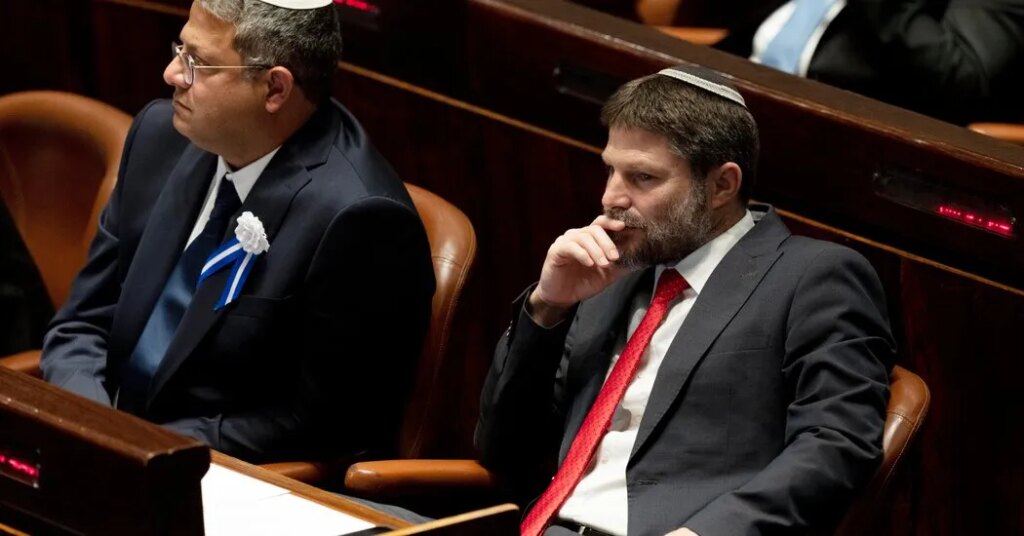
Prime Minister Benjamin Netanyahu of Israel has led the country’s most right-wing government in recent years, with two ultranationalist ministers in particular pushing policies and positions that have exacerbated friction with many of the nation’s traditional allies.
These politicians, Itamar Ben-Gvir, the national security minister, and Bezalel Smotrich, the finance minister, who is also responsible for the administration of the Israeli-occupied West Bank, are vocal about expanding Jewish settlements on land that much of the international community considers illegally occupied and designated for a Palestinian state.
But they are not in the same political party or always on the same page. In this election, they are not running on the same slate, unlike in the two previous votes.
Mr. Ben-Gvir leads Otzma Yehudit, or the Jewish Power party; and Mr. Smotrich heads the Religious Zionist party. Mr. Smotrich’s party is running this year on a list with the Zehut, or Identity party, led by Moshe Feiglin, a former member of Mr. Netanyahu’s Likud party.
Mr. Ben-Gvir has refused Mr. Netanyahu’s attempts to team him and Mr. Smotrich again in hopes of ensuring the parties clear the threshold of 3.25 percent of votes in Israel’s proportional parliamentary system so that the right-wing bloc does not lose any votes. Mr. Smotrich had expressed reservations, as well.
Polling shows Mr. Ben-Gvir is popular with young voters, and he is betting he can secure more parliamentary seats for his party and exercise more power in negotiations to form a right-wing government after the election. He told Time magazine on Thursday that he, nevertheless, supports Mr. Netanyahu and aims to push the next government further right.
Mr. Ben-Gvir is so virulently nationalist that he was not drafted for the Israeli military in his youth. His views were long considered fringe even by other right-wing politicians, like those in Mr. Smotrich’s party.
In recent years, both ministers have gained power domestically and have become known internationally for inflammatory stances and actions. After the Hamas-led attack on Israel on Oct. 7, 2023, which ignited a devastating war in Gaza, both called for Israel to adopt destructive policies to encourage the “voluntary emigration” of Palestinians.
Amid the war, violence by extremist Jewish settlers in the West Bank spiked drastically, and both ministers were accused of encouraging impunity. Last year, Britain, Australia, Canada, New Zealand and Norway imposed sanctions on Mr. Ben-Gvir and Mr. Smotrich for “repeated incitements of violence against Palestinian communities.”
Israel has in recent years undertaken an unbridled expansion of Jewish settlements while military operations in the West Bank have resulted in the biggest displacement of Palestinian civilians in the territory since the Arab-Israeli war of 1967. Both Mr. Smotrich and Mr. Ben Gvir want to accelerate these efforts.
Mr. Smotrich has pushed measures extending Israel’s footprint in the West Bank. This year, the security cabinet made it easier for Jews to buy land in parts of the West Bank, and Mr. Smotrich was explicit about his intent. “We are deepening our roots in all parts of the Land of Israel and burying the idea of a Palestinian state,” he said.
In the election, Mr. Netanyahu faces competition from former military general Ofer Winter, who formed a new right-wing party, People of Israel. Recent polling shows the party is drawing support from Likud even as the opposition presents a significant challenge.
And Gadi Eisenkot, a former Israeli military chief who lost a son and two nephews in the war in Gaza, is the leading candidate against Mr. Netanyahu.
Israelis don’t vote for a prime minister individually, but for a list of candidates presented by a party or parties. The premiership does not automatically go to the party with the most votes, and much more wrangling is needed before it becomes clear who the next leader will be.
Last year, Mr. Eisenkot formed the party Yashar! — Hebrew for “straight” or “honest” — and has said that he will not serve on a government with Mr. Netanyahu. He says he is running to “save Israel” from endless wars and policies dividing Israelis and destroying its international standing, as well as from Mr. Netanyahu. Polling in the days ahead of the election shows Mr. Eisenkot’s party with a slight lead over Likud, potentially securing more seats in the Knesset, or Parliament, than the prime minister’s party.
But the Israeli electoral system is complicated and no party has ever won a majority of seats in the Knesset, so there has been much debate and deal-making to build potential future governing coalitions ahead of the vote, and they will continue after the results are in.
The post Israel’s Most Vocal Far-Right Ministers Diverge in Election appeared first on New York Times.