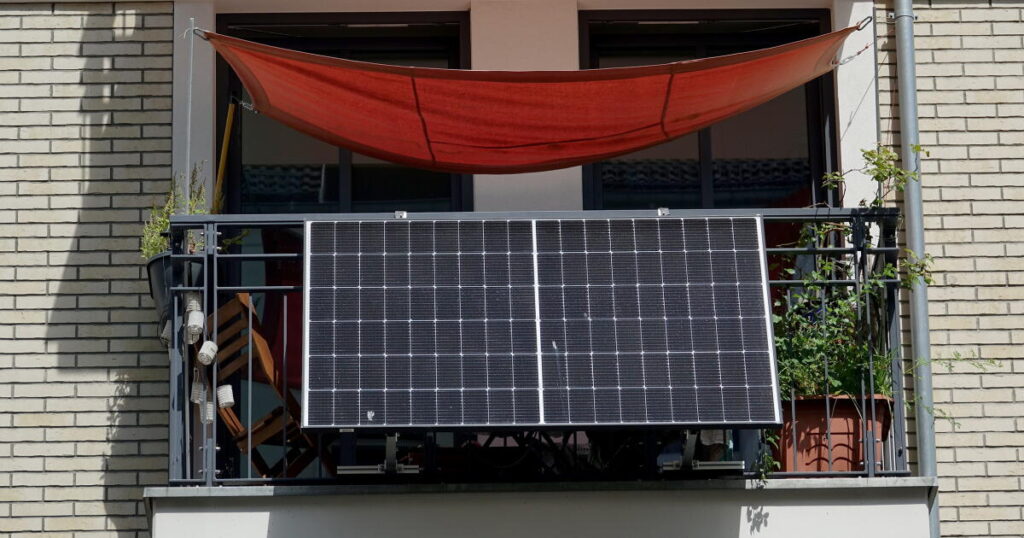
Ever since Gov. Gavin Newsom signed the Plug and Play Solar Act last month and opened the door for Californians to plug small solar panels directly into wall outlets without utility permissions, people have been asking: Can renters use this technology?
“It’s a bit of an open question,” said Joseph Kaatz, senior staff attorney at the Energy Policy Initiatives Center at the University of San Diego School of Law.
“Seems my lease and many others often prohibit actually putting solar on your balcony,” one commenter wrote in an online forum celebrating the new law.
Plug-in solar, also known as balcony solar, is often billed as solar for renters, since the panels don’t require access to the roof or costly installation and are lightweight and more portable than traditional solar systems. In Germany, they’re popular in apartment complexes, where people set them on their patios or hang them on balconies to save money on electric bills.
Under the California law that goes into effect in January, residents can buy certified panels under 1200 watts and set them up without getting utility approval, which can be onerous. But renters may have to navigate another layer of permissions: landlords. Currently it’s unclear whether tenants have the right to set up the panels if property owners don’t want them.
California has strong laws that prevent homeowner associations from blocking solar panels or imposing unreasonable restrictions on them, Kaatz said. The Solar Rights Act, established in the 1970s, was key to resolving conflicts between HOAs and their members and paving the way for solar installations as interest in rooftop panels surged in the 2000s.
But the law was designed to apply to homeowners, not renters. It mainly bars rules around property sales and transfers that would restrict solar.
“We’re in a new era of technology now that the Legislature never had to think about before,” Kaatz said. He thinks there’s a strong case to be made that the language in the Solar Rights Act applies to rental agreements, but it’s a matter of interpretation, he said, and it hasn’t come up yet since balcony solar is so new.
A few states with new balcony solar bills have included clauses that protect renters. New Jersey’s law, also passed this year, bars landlords from prohibiting balcony solar while requiring tenants to provide notice and adhere to “reasonable restrictions” on panel size and placement. Laws in Colorado, Virginia and Vermont include similar provisions, and a bill recently introduced in Congress would require states to protect renters’ rights to use the systems. But California’s law doesn’t address them.
Property owners say solar panels on balconies and fences could affect their insurance, while renters worry that landlords could set their insurance liability requirements so high it would make the panels cost prohibitive.
“If a tenant of mine wanted a panel, I would deny it,” one landlord wrote in the comments of a recent L.A. Times story. “I would not want a miscalculation on their part to damage my property. I am not so sure my insurance would go for it either.”
The Southern California Rental Housing Assn., which opposed the bill as it was moving through the Legislature on the grounds that it would allow tenants to connect devices without notifying landlords, said it is analyzing what it means for members. “The law doesn’t specifically address rental housing,” spokesperson Tanya Mannes Castaneda said.
Daniel Yukelson, executive director of the Apartment Assn. of Greater Los Angeles, said he reads the bill as allowing tenants to install balcony solar and his group may seek an amendment next year.
“There are literally no parameters in the law that we are aware of that would restrict the installation of these things,” Yukelson said. “Solar panels can be installed on the outside of a building, and wires can run everywhere, and those create trip hazards and panels can create fire hazards.”
Advocates are also ready to seek amendments if need be. California has special laws on the books protecting the rights of renters to hang their laundry outside to dry, said Bernadette Del Chiaro, a senior vice president at the nonprofit Environmental Working Group, which co-sponsored the California bill.
“If landlords start to restrict portable solar in California, we’ll simply have to go back to the Legislature and expand the state’s Solar Rights Act,” she said. “Since landlords don’t pay the utility bill for their tenants most of the time, it is unreasonable for them to place burdensome restrictions on their tenants.”
Balcony solar manufacturers say the “solar for renters” moniker may be a bit of a misnomer at the moment, since the vast majority of people who have purchased the small, lightweight systems in the U.S. are still homeowners.
“The reality of it is that it’s still very unbalanced,” Michael Scherer, co-founder of the Texas-based manufacturer Craftstrom, said, noting that 95% of its U.S. customers are homeowners. He said apartment dwellers, who may have space for only one 400-watt panel, may be less interested because they’ll save less than someone buying a larger system.
A 400-watt panel could power a normal-size refrigerator, or most of the other appliances running in an apartment apart from a refrigerator, such as laptops, lamps and a television, Scherer said. But it would hardly make a dent in the cost of air conditioning, for which he recommends at least a 3,000- to 4,000-watt kit. (A home cooled by a heat pump probably would require a smaller setup, but still more than 1,500 watts, he said.)
The energy nonprofit Bright Saver, which sells kits of two 180-watt panels for $414 with a $29 membership, has a calculator on its websitethat estimates savings for people by ZIP Code, taking into account their electrical utility. A 360-watt system would save someone in the Los Angeles Department of Water and Power’s East Hollywood territory between $113 and $142 in the first year, it estimates. That would cover the cost of a panel in three to four years and lead to $1,764 in savings over 10 years, assuming a 7% annual rate increase.
Cora Stryker, co-founder of Bright Saver, said the biggest problem for California renters is that the main certification for plug-in systems in the U.S. requires an electrician to rewire power outlets to allow for a special plug. The goal, she said, is to make sure that panels connect to a circuit that can support them, but typically renters don’t hire electricians.
Bright Saver is trying to get UL Solutions, the main certifier, to exempt solar kits under 360 watts, which many experts agree produce too little power to endanger the grid or overwhelm a home’s wiring.
The testing body said it’s concerned that systems under 400 watts can still overheat electrical components in a home and create a fire risk.
“Lower wattage alone does not eliminate those risks,” Colleen O’Brien, a principal engineer at UL Solutions, said in a statement.
For balcony solar systems to be allowed under California’s new law, they have to meet the standards of a certifying body such as UL Solutions. At the moment, none have received approval, although advocates expect at least one panel kit to be cleared by the end of the year.
The post Balcony solar is coming to California. Can renters actually use it? appeared first on Los Angeles Times.