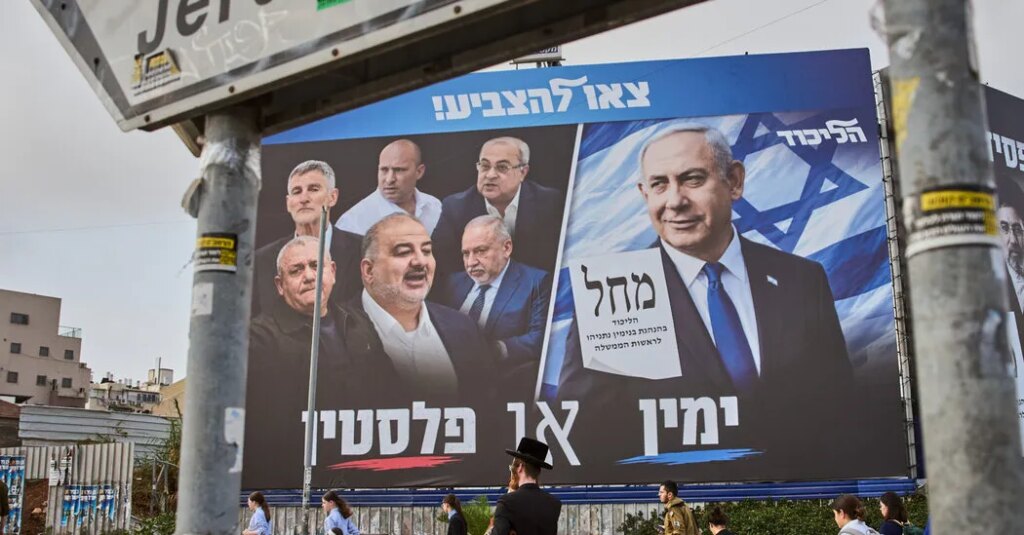
The first thing to say about Tuesday’s election in Israel is the one that tends to be mentioned the least: The country is having one. Competitive, lawful, on schedule and with a plausible expectation of unseating the powerful incumbent.
That’s more than can be said of the Palestinian Authority under the presidency of Mahmoud Abbas, who was elected to a four-year term of office in 2005 but has bypassed elections ever since. It’s more than can be said for Hamas, which won Palestinian legislative elections in 2006, went to war against its domestic political opponents and has ruled through fiat and fear ever since.
It’s also more than can be said for Egypt, whose president came to power in a 2013 coup and won an “election” the next year with nearly 97 percent of the vote; for Turkey, whose president stays in power by jailing popular political rivals and nettlesome independent journalists; for Jordan, a repressive dynastic monarchy; for Lebanon, whose parliamentary government cannot enforce its writ against Hezbollah and its masters in Tehran.
Yes, Israel is a flawed country that’s not above reproach. But it’s difficult to take Israel’s inveterate critics seriously when they demand a “Free Palestine” without registering the slightest audible objection to the tyrannies in Ramallah and Gaza; or when, in the name of freedom and equality, they seek to abolish the Middle East’s only functioning liberal democracy.
The second point is that, for an election widely billed as the most important in the country’s history, very little is likely to change, at least as far as the outside world is concerned.
This is not 1977, when the Likud’s Menachem Begin broke the Labor Party’s lock on power, later making peace with Egypt and going to war in Lebanon. It’s not 1992, when Israelis returned Yitzhak Rabin to office, leading to the Oslo peace process. It’s not 2001, when the election of Ariel Sharon in the midst of the second intifada signaled the end of Oslo and led to the full withdrawal of Israeli troops and settlers from Gaza.
This time around, all the leading contenders are on the political right. Not one of them wants a Palestinian state. Not one of them is going to remove Israelis from the West Bank or issue a blanket ban on settlement construction. Not one of them wants anything less than an assertive military posture toward Hamas, Hezbollah and Iran. And if, as polls suggest, no party emerges with a clear majority, then nobody is likely to have the votes to force the kinds of tectonic policy shifts achieved in those earlier elections, including the military conscription of the shirking ultra-Orthodox.
All this means that no plausible alternative to Benjamin Netanyahu as prime minister is going to shift the country’s course sufficiently to mollify its growing list of global detractors. But there’s a different kind of shift Israel desperately needs.
Hence the third point: What’s at stake in this election isn’t about policy. It’s about spirit. It’s about whether the Jewish state will honor the foundational Jewish idea, klal Yisrael, the whole of Israel, and the Jewish principle that all Israelis are responsible for one another.
Since returning to power in 2022, Netanyahu has repeatedly violated both.
He tore the country in half with a self-serving judicial “reform” that, whatever its notional merits, smacked of an attempt to neuter the only real institutional check the country had on pure majoritarianism and drove hundreds of thousands of Israelis to the streets in protest. He ignored repeated warnings from his security chiefs that political and social division was eroding Israel’s military readiness while creating a perception of weakness that Israel’s enemies were sure to exploit. He sought credit for every Israeli military success since Oct. 7 but persistently and pathetically disavowed personal responsibility for the colossal disaster itself. He resisted an independent state commission of inquiry into the catastrophe, breaking with decades of Israeli precedent out of fear of accountability and truth. And he allowed the cancer of Jewish terrorism to spread, chiefly because his political needs require him not to tangle with Itamar Ben-Gvir, the buffoonish far-right national security minister who is easily the most disreputable man ever to hold cabinet rank in Israel.
Against this, Netanyahu can also be credited with steeling Israel’s economy, now one of the best-performing in the developed world; forging strategic partnerships with the United Arab Emirates and other Arab states; eviscerating Hezbollah, which in turn sped the collapse of the Bashar al-Assad regime in Syria; and, with American help, setting back Iran’s nuclear program, possibly for many years. But none of it makes up for the sundering of klal Yisrael, the violation of the basic ethical compact that binds Israelis to one another, and to their leaders.
Finally: What’s at stake in this election isn’t Israel’s “standing.” Of the many intellectually flabby critiques of Israeli policy since Oct. 7, the idea that Israel should have traded its physical security for the sake of some added dollops of liberal pity is among the flabbiest. As I’ve written before, Israel doesn’t exist to showcase Jewish victimization. It exists to end it.
What is at stake is whether a people who have borne the burden of Hamas’s terror and Iran’s missiles and a nonstop state of emergency that would have broken weaker democracies and the unceasing chorus of global condemnation that is one part ignorance, two parts bigotry and three parts self-delusion should have a government worthy of their sacrifice, steadiness and courage. This week, a free and sovereign nation once again has the chance to elect one.
The Times is committed to publishing a diversity of letters to the editor. We’d like to hear what you think about this or any of our articles. Here are some tips. And here’s our email: [email protected].
Follow the New York Times Opinion section on Facebook, Instagram, TikTok, Bluesky, WhatsApp and Threads.
The post Four Thoughts About Israel’s Election appeared first on New York Times.