For more than 50 years, Ron Petersen has studied healthy aging, cognition and dementia.
Petersen’s research established the concept of mild cognitive impairment, which lies between healthy cognitive aging and dementia. This idea changed how doctors and scientists study cognitive health by emphasizing earlier detection and lifestyle changes. Petersen has co-written over 1,500 peer-reviewed articles and works full-time in clinical research as the director of the Mayo Clinic Study of Aging, where he also sees patients.
At age 80, Petersen said there are simple things we can all do for healthier cognitive aging.
“Aging need not be a passive process,” he said. “We can influence it. We can engage. And here’s where lifestyle comes into play.”
I wanted to know how Petersen’s extensive knowledge of dementia and aging informs his own daily routines and habits. So I caught up with him on the phone from Chicago, where he recently received a lifetime contribution award from the National Academy of Neuropsychology. (He had other trips to San Diego and then Fort Lauderdale, Florida, lined up the following week.)
Here’s what he recommends and does for healthy cognitive aging.
Exercising at least three times a week
“If somebody pushed me to the wall and said, ‘You got to do one thing. What would it be?’ ” Petersen said. His answer would be exercise.
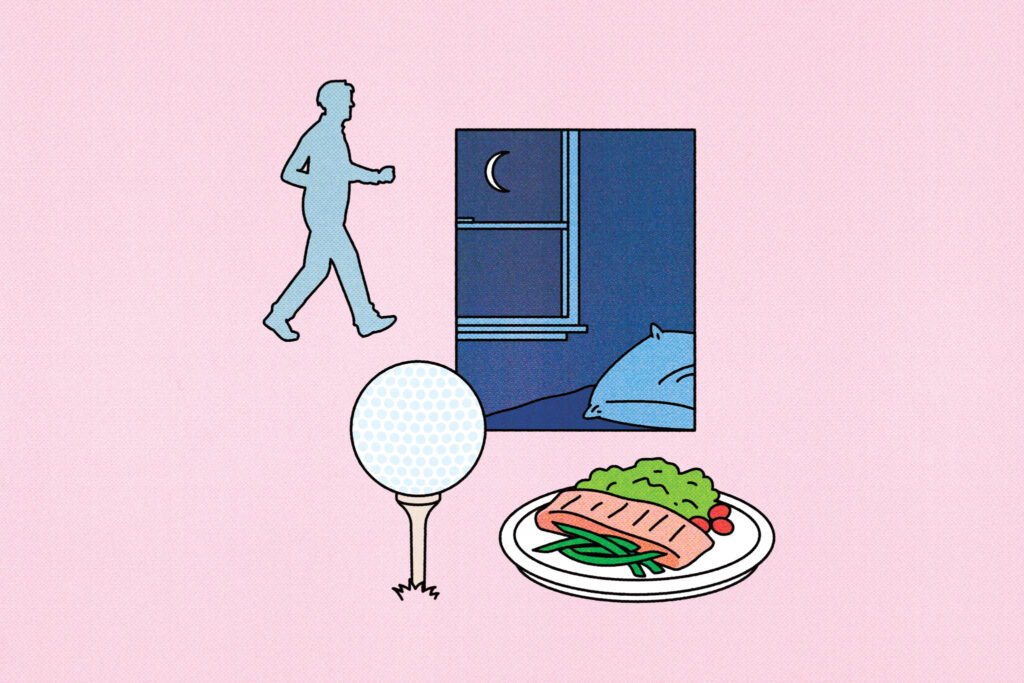
When he isn’t traveling, he exercises about three to four days a week, often with his wife at a health club. “I’ll do brisk walking. I sometimes do a treadmill up and down a little bit and change the velocity,” he said.
He also plays golf and does resistance training, such as leg presses and upper body presses, and flexibility exercises. These, he said, are the key to helping with balance and preventing falls — “a real bugaboo of aging.”
Petersen’s work and subsequent research have found that exercise can slow cognitive decline, reduce Alzheimer’s risk and promote better brain health.
Petersen recommends 150 minutes of aerobic exercise a week. Even a little bit, such as 10 minutes of super-slow jogging, helps, research shows. “Just doing more than you’re doing now is probably the single best item,” he said.
Staying intellectually active
Petersen stays busy with his work. So he tries to relax when he’s not working.
He isn’t one of those people who does Sudoku‚ crosswords or brain games, he said. He doesn’t watch a lot of TV, but when he does, it’s either the news or sports. (Being in Minnesota, he roots for the Vikings, the Twins, the Timberwolves, the Lynx and his grandkids’ teams. The night before we spoke, his oldest grandchild played a section playoff soccer game in 48-degree rain and wind. “They went into double overtime and won,” Petersen said.)
“I don’t read as much as I could, should and would like, but I like to read more nonfiction than fiction,” he said. “I’m reading a book right now called ‘The Gales of November,’ and it’s about the wreck of the Edmund Fitzgerald up on Lake Superior. It’s just fascinating.”
Staying mentally active — learning a language, listening to music, engaging in hobbies, using new technology — has both short- and long-term benefits for the brain, research finds.
He advises people that intellectual activities can help benefit your brain health — whether it’s reading the newspaper, going to lectures or just discussing things with others. But he recommends “to find one that’s fun, that you enjoy doing and look forward to doing each day.”
Eating a heart-healthy diet
It’s hard to know whether a particular diet is better than another for the brain, Petersen said, but eating a heart-healthy diet — such as the Mediterranean diet or MIND diet — is a good idea. Studies have shown that focusing on foods such as vegetables, nuts, beans, fruit and seafood may cut the risk of cognitive decline and dementia, particularly in people already at higher risk.
“What we should be doing for our heart health, I think is good for the brain as well,” he said.
For his part, Petersen is “an omnivore.” He often eats granola and yogurt with berries for breakfast. Lunch is “on-the-fly,” but he will sometimes have fruit, yogurt and granola as well. He doesn’t eat a lot of red meat — about once every two weeks. So for dinner, he prioritizes chicken and fish but admits he eats some junk food too, especially when he’s traveling.
In terms of alcohol, researchers have found a link between alcohol consumption — especially heavy amounts — and increased dementia risk. But Petersen does drink “a bit of alcohol” — usually on Fridays and Saturdays when out with family or friends. (He prefers beer, especially Wisconsin-based Leinenkugel’s Red Lager or Original.)
“There’s always an enjoyment aspect, too. You know, patients say, ‘Should I be drinking?’ I say, ’Well, if you don’t drink, I wouldn’t start drinking. But if you do drink and you enjoy the one cocktail in the afternoon or the one glass of wine with dinner, that’s probably okay.’”
Getting regular, quality sleep
Sleep becomes more difficult as we age. “Usually what happens is the quantity increases and the quality decreases,” Petersen said. “So we may spend more time in bed but we’re awakened [and] we can’t get back to sleep.”
Sleep is important for strengthening memories and clearing out waste from the brain. Disorders of sleep, including increased sleepiness or chronic insomnia, have been linked to higher risk of dementia and cognitive decline.
Petersen follows common advice: He avoids stimulants such as caffeine at night, goes to bed roughly at the same time (around 10:30 p.m.) and gets up roughly at the same time (6:30 a.m.) and has a cup of coffee. (Though he may sleep in a bit on weekends.)
He said it’s important to be mindful about sleep breathing disorders, such as sleep apnea, and that naps are generally considered fine, as long as they aren’t too long.
“Some people can go down for 10-15 minutes and — bingo — bounce right back in with the game and feel refreshed. And you know, I think that’s fine. I’m a little more concerned when you go down for an hour, two hours, something like that in the middle of the afternoon.”
That could be a sign of a sleep disorder and should be discussed with your health care provider.
Staying connected
Petersen has two children and six grandchildren who all live relatively nearby, and gets together with them weekly. Family, social connectedness, networking and being with friends are all important, he said. Studies have shown that feelings of loneliness can increase the risk for dementia; conversely, having strong social connections is key to cognitive health.
“It’s easy when you age to withdraw,” Petersen said. “‘Oh, I’m not going to go out. No, I don’t want to do this. Let’s stay home,’ that type of thing. And I think fighting that tendency is a worthwhile recommendation.”
Do you have a question about human behavior or neuroscience? Email [email protected] and we may answer it in a future column.
The post At 80, he’s a top dementia expert. Here’s how he keeps his brain healthy. appeared first on Washington Post.