On March 21, 1937, a crowd of hundreds gathered in the southern Puerto Rican town of Ponce on Palm Sunday afternoon, preparing to march. Their goals were twofold: commemorate the abolition of slavery in Puerto Rico, and protest the recent incarceration of Nationalist Party leader Pedro Albizu Campos by the occupying U.S. government.
As the march began, insular police under the command of the U.S.-appointed Gov. Blanton Winship opened fire unprovoked. Seventeen unarmed civilians, including a 12-year-old girl, were killed — and over 200 more were wounded in what became known as the Ponce Massacre. One of the victims, a man named Bolívar Márquez, used the last of his strength to write a message, with his own blood, on the same wall he died slumped against: “¡Viva la República, abajo los asesinos!” (“Long live the Republic, down with the Murderers!”)
On Oct. 15, Puerto Rican band Chuwi released their debut LP, titled “Libertad.” The title translates to “liberty,” while the cover art re-creates a well-known photo of the message Márquez wrote in 1937, but with the album’s title instead.
For the last two years, Chuwi’s name has been tied to “Weltita”: a sunny, joyous anthem about a beach day with your significant other, which the band performed alongside Bad Bunny on his Grammy-winning 2025 album, “Debí Tirar Más Fotos.”
That collaboration sent their profile skyrocketing, driving monthly streams from a few thousand to 6 million, securing them an NPR Tiny Desk concert, and a spot as openers for Bad Bunny’s world tour. For most people, that song was their introduction to Chuwi.
“We did our own shows in a few cities,” says Wester, who I meet along with the band on a balmy September afternoon, inside their studio in Aguadilla. “We managed to sell out almost all of them, and most of the people who went did so because of ‘Debí Tirar Más Fotos.’”
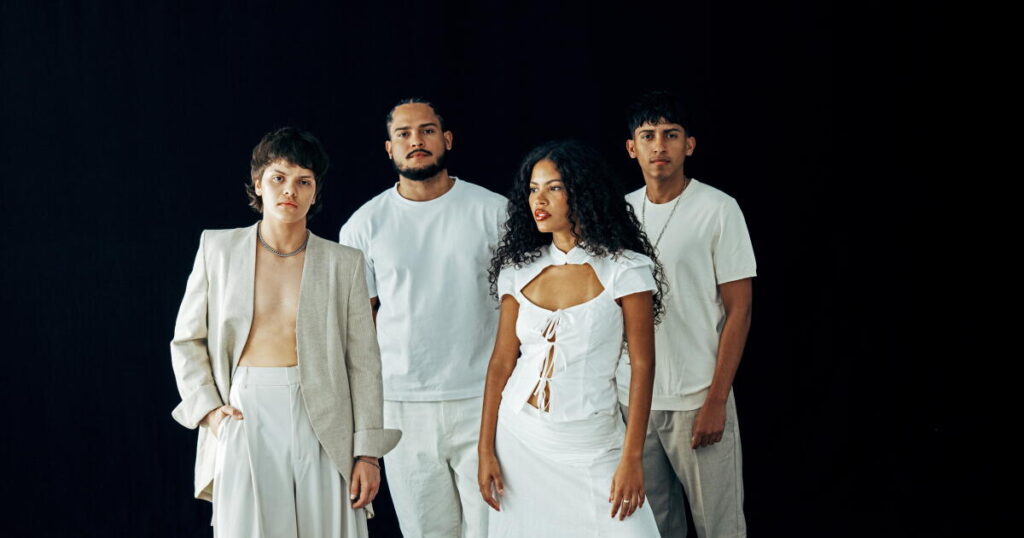
A quartet of three siblings (Lorén, Willy and Wester Aldarondo) and their best friend (Adrián López), Chuwi cares less about reproducing music within genre labels and more about making raucous, diverse and original Caribbean music with every project. Rather than rehashing traditional compositions, the group recognizes these sorely untapped sounds as living and malleable, creating new interpretations that bring them to our times without losing an ounce of their essence and verve.
But while “Weltita” is a wholesome hit, it’s not how the band got its start.
Driven by word-of-mouth acclaim, their first two EPs — 2022’s “Pan” and 2024’s “Tierra” — became fan favorites that stood out by smuggling Puerto Rican sociopolitical anxieties and activist language between catchy rhythms.
Songs like “Uwu,” “Tierra,” “Mundi” and “Guerra” touched on themes of displacement, colonialism and more — all years before Benito did the same on “DTMF.” He later noted that listening to Chuwi while living in Los Angeles was a small part of what spurred him to make that album — and invite the band for a feature.
“Libertad” completes a trilogy begun with those EPs, with all three titles forming the phrase “pan, tierra, libertad.” It’s the slogan for Puerto Rico’s Popular Democratic Party, the centrist party founded by its first democratically-elected governor, Luis Muñoz Marín, who promised to bring “bread, land, and liberty” to the people.
On the musical side, each project is influenced by the sound of a different Caribbean country. “Pan” includes folk music from Puerto Rico, while “Tierra” pivoted to the Dominican Republic — including tracks that took from bachata and traditional genres like palo.
For “Libertad,” the band looked toward Cuba, including a bevy of folk rhythms from the island such as reparto, punto, pilón, abakuá, timba, guaguancó and more.
“This is years in the making,” says Willy. “It was a process of research and learning, trying to understand these genres, talking to Cubans. We went looking for live performances and found tutorials where people explained how they were played, and that’s how it all came together.”
The album counts with the participation of guest artists Wampi and Daymé Arocena, two Cubans who have also seen their star rise over the past years. Wampi specializes in reparto, while Daymé dabbles more in jazz and soul stylings. Building the album around Cuban music was a challenge Chuwi embraced —and one that their invitees found “very curious” at first.
Chuwi famously doesn’t produce using live instruments, opting instead to build the music from the ground up with digital workstations and programs. As experienced as these players are, that became an endurance test for them with this album, as in the case of its lead single “Máquina.”
“I think the session for ‘Máquina’ has about 500 channels, and I’m not exaggerating,” says Willy. “When I open the project on my computer, it almost crashes. It’s inspired by timba, which is probably the most dynamic genre I can imagine. There’s something happening every second; basically, Cubans took all their genres, like salsa and son, and pushed them to their peak. You’ve got the keyboardist not just playing the moña — that “tin-ki-tin” riff — but tearing up the whole keyboard, and the bassist doing wild stuff. Trying to re-create that, editing it piece by piece on a computer … it wasn’t fun.”
Even Lorén’s voice got a workout on the title track “Libertad,” delivering her highest belts yet. “I wanna stand on business: that’s real, it wasn’t extended,” she insists. “Those are my lungs. Willy has the video!”
The majority of the album was already in the can by the time Bad Bunny invited them to participate in “DTMF.” Between those sessions, his subsequent San Juan residency last summer and his world tour, their release window got delayed.
Yet despite all those new experiences, the core vision for this album remained unchanged. In fact, the band “doubled down,” according to Wester.
“I think it was more about realizing: ‘Damn, the tide is shifting.’ Especially in the music industry. An album like ‘Debí Tirar Más Fotos’ comes out, and suddenly, [Bad Bunny] created a market for this album,” says Lorén.
As Willy observes, it also educated listeners about Puerto Rico with context they didn’t have beforehand, making an album like “Libertad” potentially more approachable. “It was a really cool alignment of things,” he says.
The band struggled to pin down the final track list, finalizing it barely a month ago. Their goal was for the album to tell a story of radicalization, following a protagonist who shifts from complacency to an awareness of injustice and institutional oppression, and ultimately resolves to act against it.
“We wanted ‘the hero’s journey.’ It starts from a place of safety, but then comes the rising action, the climax, the falling action — all of that,” says Wester.
The album also features a notable first for the band, as percussionist López debuts as a singer on “Aquí Lo Mío No Es Tuyo,” a bomba yubá track with a defiant pro-revolution message.
The song’s music was written years ago, pre-Chuwi. But the electoral outcomes of 2024 inspired him further. “After the last election, I was mourning, so I wrote those lyrics,” he says. “And it just so happened that they fit perfectly with what we were creating.”
The song uses samples from two different speeches: toward the end, from Pedro Albizu Campos, but ironically the opening voice belongs to Carlos Romero Barceló, a pro-statehood governor reviled in pro-independence circles on the island. López says he didn’t recognize the source of the recording at first, but decided to keep it because “I think he wouldn’t have liked this song … and that gives me peace.”
An even more daring swing is the closer, “P.T.L.” That song, which features cuatro guitarist José Santana, is a stylized cover of the “The Star-Spangled Banner.” Considering that the U.S. government functions as a background antagonist throughout the album, the group knew the track would be scrutinized. (“Do you think we’re f—?” asks Lorén, half-kidding.)
But the band has settled on an optimistic outlook.
“Hendrix made it more [aggressive]. We did a pretty version,” says Willy. “We were really thinking about the Puerto Rican danza; if you strip it down enough, you can perform a danza with just a güiro and a cuatro. And there was so much meaning there: a cuatro, Puerto Rico’s jíbaro instrument, playing the U.S. national anthem.”
However, Chuwi did not intend for it to sound like a parody or satire. “We aren’t trying to mock any country’s anthem,” adds Willy. “We’re trying to spark a conversation [about] the shared history we have with the United States.”
The band is aware of the whiplash many fans — new ones in particular — might suffer as they segue from the breezy feel of “Weltita” to the political heft of this album. Not just thematically, but sonically; when Bad Bunny first heard “Ay Mío” two years prior, he jokingly asked them if they did shrooms.
“Another thing we wanted to achieve with this album was for the music to feel free — because the album represents freedom,” says Willy. “So, it had to be more chaotic, more left-field, and weirder, yet balanced in a way that it remained accessible and enjoyable. We always keep in mind that, above all, we want to challenge ourselves. That involves risk. And who knows what will happen!”
Their lyrics also carry more righteous fire than before, with sharper lines that cut right to the indignation they feel. Whether it’s calling out federal surveillance tactics in “Cuco” (“If you get a call with static, it’s the Bogeyman”) or comparing backroom deals that favor the elite over citizens with pacts with the Devil in “Máquina” (“That room surely smells of sulphur”), they’re not biting their tongues.
As López croons between gritted teeth: “I carry a machete and a rage that clings to it.”
Chuwi have no fear about being tagged as a political band, and are ready to embrace it. “For us, the world and existence itself are political. Not everyone sees it that way, and using those words with someone who disagrees with you automatically slots you into their definition of the concept,” says Lorén.
“I feel it’s our most deliberately political album in the sense that, for example, the song ‘Tierra’ might be political, but the root of the sentiment is my own reality: that I don’t have a piece of land to live on. That you perceive it as political is a consequence of what we’re going through,” adds López.
When it comes to a song like “Ay Mío” — which directly calls out Puerto Rico’s recent ex-governors for its current woes — Lorén offers no apologies. “If you’re exploring where we are and how we got here … that has a first and last name,” she says.
Over the last two years Chuwi has traveled around the globe, and the foursome confirm that will influence their next project. “We already have an album title, and songs,” says Lorén. Yet for now with “DTMF” fading behind them, they’re focused on the present.
And for all the new followers they amassed, here’s their pitch: Meet the new Chuwi, same as the old Chuwi. But bolder, and more ready than ever to continue the fight for freedom.
The post Puerto Rican band Chuwi wooed Bad Bunny fans on his world tour. They go mask off in ‘Libertad’ appeared first on Los Angeles Times.