Foreign policy seldom has much impact on domestic politics. In 1992, President George H.W. Bush lost his reelection bid despite having presided over the end of the Cold War and the U.S. victory in the 1991 Gulf War. In 2004, his son George W. Bush won his reelection bid despite having mired the country in two unwinnable wars in Iraq and Afghanistan.
But this midterm election promises to be different. If, as now appears likely, this turns into a “blue wave” election, Republicans can pin a great deal of the blame on President Donald Trump’s foreign policy and trade agenda — and in particular on his foolhardy decisions to launch trade wars with many countries followed by a “forever war” with Iran.
Those unforced errors are a large part of the reason Trump approaches this midterm election with the lowest public-approval rating (34 percent) since Harry S. Truman in the 1946 midterms. (In case you’re wondering, Republicans picked up 55 seats in the House and 13 in the Senate in 1946 to take control of both houses of Congress.)
Then-Secretary of State James A. Baker III famously tried to sell the Gulf War to voters by arguing it was about “jobs, jobs, jobs.” The impact of Trump’s tariffs and his Iran war can be summed up as: inflation, inflation, inflation. The inflation rate in September ticked up to 3.7 percent on an annualized basis — up from 2.9 percent in 2024. Much as Trump would like to blame the rising prices on President Joe Biden, he has nobody but himself to blame.
Trump’s illogical and emotional devotion to tariffs led him to raise the effective tariff rate, according to the Penn Wharton Budget Model, from 2.3 percent in January 2025 to 7.1 percent in August following a Supreme Court decision invalidating some of his levies. The Yale Budget Lab estimates the current effective tariff rate is even higher — at 11 percent — and warns it will climb further still, to 11.8 percent, by the end of the year.
Trump claims foreigners pay the cost of tariffs, but a new study released by the Federal Reserve Bank of New York found that nearly 90 percent of the tariffs are passed along in higher consumer prices. The study concluded that “for every percentage point increase in average tariffs, consumer goods prices increase by about a quarter of a percent after one year.”
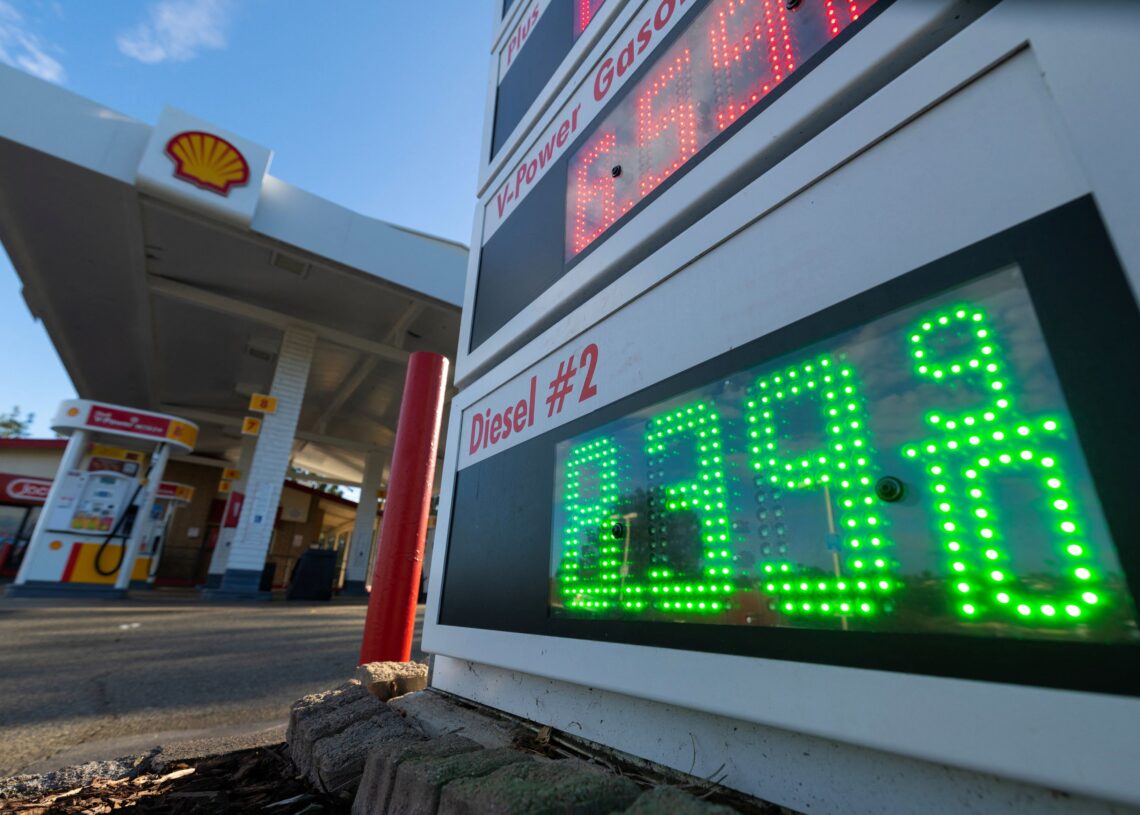
While the New York Fed study focused on “non-oil consumer goods,” gasoline and diesel prices have also been skyrocketing primarily because of Trump’s war of choice with Iran. It’s true that more oil is actually coming out of the Middle East now than before the conflict began, but the cost of getting that oil out has also increased because of continuing Iranian attacks.
On Friday, the benchmark Brent crude oil was over $116 a barrel — up more than 60 percent since the start of the war. The cost of diesel in the United States has risen even faster — up nearly 70 percent. Economist Mark Zandi reported earlier this month that the Iran war has cost every U.S. household nearly $1,100, and the Congressional Budget Office found that the war was responsible for more than a third of the increase in inflation this year.
In order to fight inflation, the Federal Reserve, much to Trump’s fury, has been forced to keep raising interest rates. The average interest rate on 30-year fixed mortgages has shot up from just under 6 percent before the Iran war began to 7.3 percent last week.
Hence the “affordability” crisis that Trump dismisses as a hoax but that voters feel in their pocketbooks. In the recent Washington Post-ABC News-Ipsos poll, 75 percent of respondents described economic conditions as “not so good” or “poor,” compared with only 34 percent who said so on the eve of Trump’s last midterm election in 2018, when Democrats picked up 40 House seats. By a margin of 40-33, voters today trust Democrats more than Republicans on the economy.
In a desperate bid to bring down oil prices before the election, Trump negotiated an agreement to buy diesel from Russia. That is unlikely to have any appreciable impact on prices, and it won’t help Trump’s slumping approval numbers, either. The more that Trump is seen as siding with Russia over Ukraine, the more he finds himself on the wrong side of U.S. public opinion. A recent Economist-YouGov poll found that 66 percent of registered voters sympathize with Ukraine compared with only 3 percent who sympathize with Russia.
YouGov also found that Volodymyr Zelensky is the most popular foreign leader in the United States; his 53 percent approval rating is far higher than Trump’s. So insulting Zelensky, as Trump does with distressing regularity, isn’t a smart strategy for reversing the president’s crumbling popularity.
Trump is right that the war with Iran hasn’t lasted as long, or caused as many U.S. casualties, as previous wars such as Vietnam. But, by shaking world energy markets, his Iran conflict has already caused more economic pain than previous conflicts such as those in Iraq and Afghanistan. Those disruptions are only exacerbated by his trade wars, and will further grow if, as Trump is signaling, he plans to renew attacks on Iran after the election.
Trump would be hard-put to engineer a more unpopular or more unsuccessful foreign policy if he tried. Republicans are likely to pay the price next week. Let us hope, for the sake of the entire world, that some of the Republicans who are left in office will be more willing to work with Democrats to rein in Trump’s terrible foreign-policy instincts.
The post Brace yourself, GOP. Trump’s Iran war and tariffs are going to sting. appeared first on Washington Post.