Longtime Serbian leader Aleksandar Vucic conceded defeat Sunday night in a historic election that could mean a new political era in the Balkan country after two years of pressure from a movement of university students.
The political power of the student faction grew out of protests that followed the collapse of a concrete canopy at a newly renovated train station in Novi Sad in November 2024.
Sixteen people, including three children, died in the incident. Protesters accused the government of gross negligence and widespread corruption and demanded accountability.
As the movement grew, its aims widened into a broader anti-corruption push: removing officials who cracked down on demonstrators, barring Vucic loyalists from leading public enterprises and ending political control of the media.
Vucic on Sunday night said that preliminary results suggested voters had overwhelmingly supported candidates backed the students, giving them a potential majority in the 250-seat parliament.
“On the basis of a sample … it is clear that we have lost these elections. The Student List has won; they will have between 135 and 140 seats, and we will have 105,” he told supporters at his party headquarters in Belgrade.
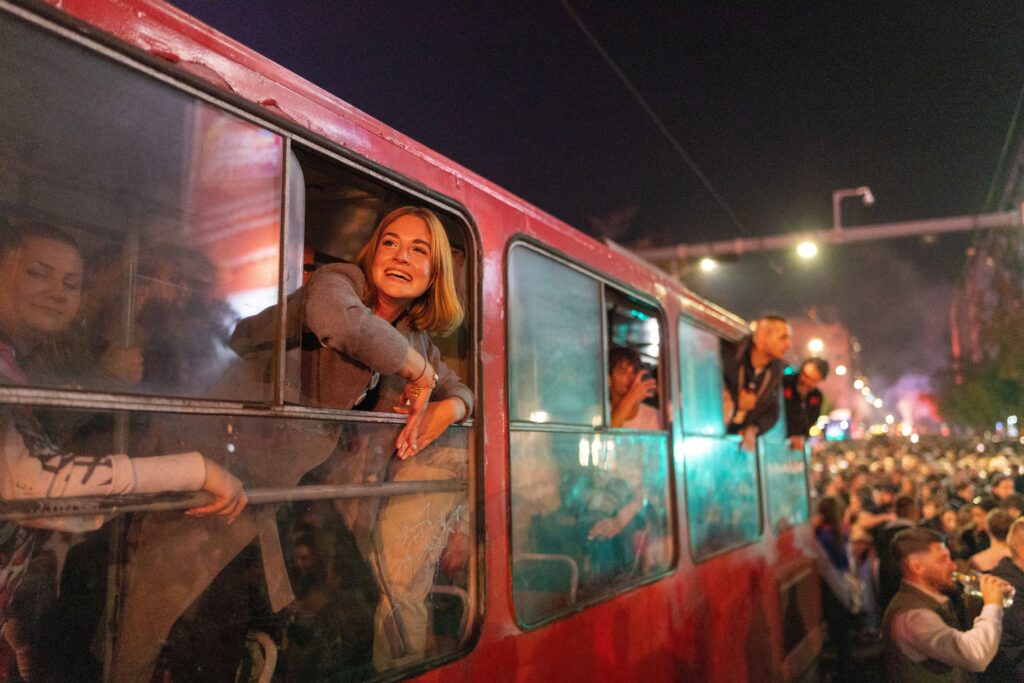
After his concession, Belgrade, the capital, erupted in celebration, and videos from Sunday show deafening cheers of “victory” and “he’s done” over the din of honking cars.
The win of the Student List, as the student-backed opposition was known, against the political juggernaut of Vucic’s Serbian Progressive Party heralds a profound political shift in a country of more than 6 million people. It may also give momentum to other student movements that have engulfed parts of Europe in protest, fueled by anger over rising costs of living, underinvestment in education and fears that their generation will end up worse off than the one before.
“After nearly two years of protests for democracy, the rule of law and the fight against corruption, Serbians turned out in historic numbers,” said Marta Kos, European commissioner for enlargement. “A new chapter can begin for Serbia. The door to the E.U. is open, and we are ready to move forward together.”
Vucic’s ouster is a blow to Russian President Vladimir Putin, who endorsed the strongman Serbian leader. The Kremlin denounced the student movement as a foreign-led attempt to unseat him. Putin already lost an ally earlier this year when Hungary’s Viktor Orban, an ally of Vucic, was voted out after 16 years in power.
Orban and Vucic were Moscow’s closest partners in Europe, other than Belarusian President Alexander Lukashenko: Hungary under Orban, as an E.U. member, often sought to weaken or block E.U. sanctions on Russia, while Serbia, an official EU candidate, repeatedly resisted E.U. pressure and declined to impose economic or political sanctions on Moscow after Russia’s full-scale invasion of Ukraine in 2022.
Kremlin spokesman Dmitry Peskov praised Vucic’s contribution to relations with Russia and said he hoped “the new political force will understand that cooperation with Russia is in Serbia’s interest,” adding, “but, as you know, it takes two to tango.”
The post Serbian students surge to power with defeat of strongman leader Aleksandar Vucic appeared first on Washington Post.