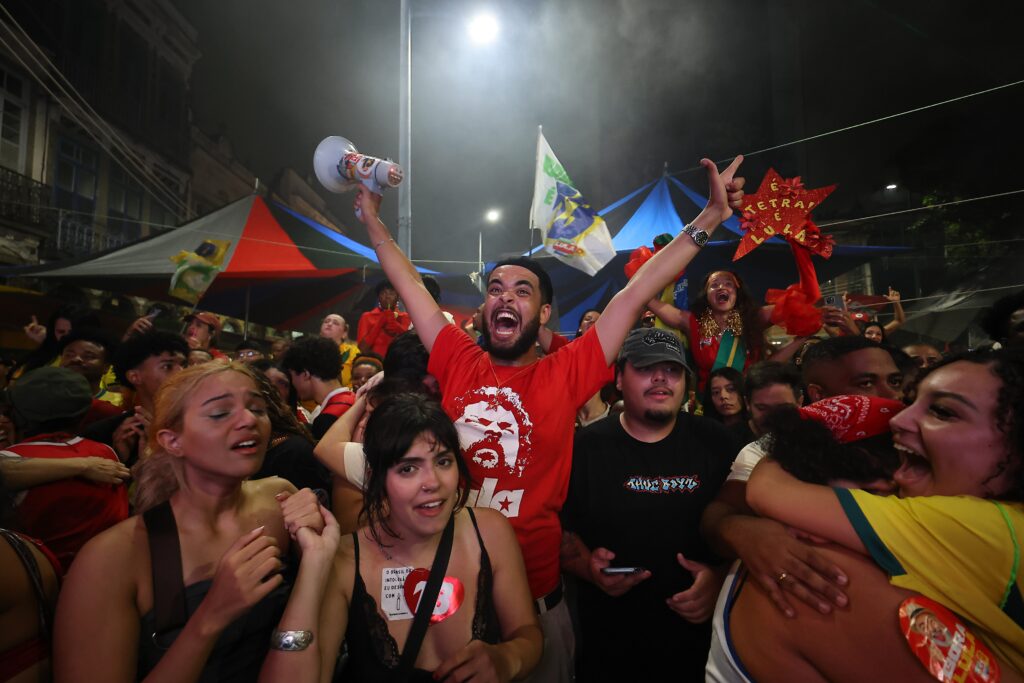
SÃO PAULO — Brazilian President Luiz Inácio Lula da Silva scored the biggest victory of his political career Sunday with a historic comeback to win reelection, though his opponent, Sen. Flávio Bolsonaro, is so far refusing to concede defeat.
After finishing second to Bolsonaro in the first round, Lula quickly retooled his campaign messaging and galvanized supporters, focusing on women and younger voters and employing a new digital strategy.
Lula began using a cellphone he got from an ally (he did not have one until this month) to record selfie-style videos, while lawmaker André Janones launched a WhatsApp channel that drew more than 10 million members in three weeks, expanding the campaign’s online reach.
Bolsonaro’s refusal to accept the result echoes his father, former president Jair Bolsonaro, an ally of President Donald Trump, who rejected his own defeat to Lula four years ago in an election decided by the narrowest margin in the country’s history. Jair Bolsonaro was later convicted of plotting a military coup to overturn the election.
Sunday’s vote came after Supreme Court Justice Cristiano Zanin issued an unprecedented order to extend voting by two hours nationwide, following requests from both campaigns amid reports of transportation problems and heavy rains.
Flávio Bolsonaro has cited that ruling in saying he will try to annul the outcome. However, the head of Brazil’s electoral court, Kassio Nunes Marques, who was appointed by Jair Bolsonaro, said the extension had not affected the results.
“Even in the face of all these circumstances, we took all the necessary measures and were absolutely successful,” Nunes Marques said.
With all ballots counted, Lula, who turns 81 on Tuesday, received 64.2 million votes to 59.8 million for Flávio Bolsonaro.
Lula said he had defeated lies, and he thanked the young people who took to the streets after his surprising first-round defeat. He vowed to change the way he governs, with greater public participation and a stronger presence on social media.
In an obvious nod to Trump, Lula also said Brazil was not the backyard of any other country and he cast his victory as a rebuke to what he described as interference by social media platforms that he accused of trying to sway the election for his opponent.
Here are five takeaways from the election:
1. Lula’s historic comeback
Lula became the first Brazilian candidate ever to finish second in the first round and go on to win the runoff. He gained more than 10.4 million votes in the runoff, while Bolsonaro added about 3.7 million.
The scale of the turnaround surprised even members of Lula’s inner circle. Two allies, speaking on the condition of anonymity to discuss the campaign, said the president was shaken by his first-round result, when he received 45 percent to Bolsonaro’s 47 percent.
The challenge was formidable. Analysts expected Bolsonaro to capture much of the support won in the first round by other right-wing candidates, capitalizing on voter frustration with Lula’s bid for a fourth, nonconsecutive term.
Lula managed to win over some of those voters, according to electoral data, but his campaign also focused on mobilizing people who had stayed home or cast blank or invalid ballots in the first round. A total of about 3 million people who did not participate in the first round cast ballots in the runoff.
“We managed to convince them that their vote was important to protect democracy,” Lula said after being declared the winner.
2. Bolsonaro fights the result
Bolsonaro has refused to accept defeat, despite losing by nearly 4.5 million votes. His father is serving a 27-year prison sentence for attempting a coup after losing the 2022 election.
“What happened today was not normal. It was even unacceptable,” Flávio Bolsonaro told reporters in Brasília after the results were announced.
He added it was “impossible” to accept the outcome and vowed to seek its annulment, citing the Supreme Court’s extension of voting hours. However, Nunes Marques, the head of the electoral court, said there was no basis for that claim.
Reports of transportation problems prompted Lula’s campaign to seek judicial intervention. Bolsonaro’s campaign later filed a similar request to extend voting, citing rain and flooding in parts of the country.
Nunes Marques did not grant either request, prompting Lula’s campaign to appeal to the Supreme Court.
Bolsonaro can request to annul the result, but he appears unlikely to succeed given the size of Lula’s victory and Nunes Marques’s comments. The heads of the lower house of Congress and Senate also recognized Lula’s victory.
3. Trump’s influence will be tested
Lula’s reelection is a setback for the Trump administration, which had hoped to draw Brazil closer to its agenda. Lula is now positioned to be a major regional counterweight to Trump’s vision for Latin America.
Trump did not endorse Flávio Bolsonaro, as he did Jair Bolsonaro in 2022. But Flávio had pledged to join Trump’s Shield of the Americas security and political initiative.
The Trump administration also took a series of steps at the Bolsonaro family’s urging, imposing tariffs on Brazilian goods, placing sanctions on Brazilian officials, designating Brazilian criminal gangs as terrorist organizations and planning to send two State Department officials to scrutinize the election system.
Lula and Trump, by contrast, have an uneven relationship with moments of rapprochement giving way to public clashes. But it is clear that Lula will not adopt the more accommodating posture toward Washington that Bolsonaro signaled during his campaign.
Brazilian diplomats say they expect the relationship with the United States to remain pragmatic, with each government having reasons to negotiate on trade, security and other shared interests.
4. Polarization will outlast the election
The election laid bare the deep divisions that will continue to shape Brazil. Deeper conflicts over the country’s identity, democratic institutions, social values and place in the world are likely to continue long past Lula’s inauguration in January.
Lula entered the campaign drawing on a political legacy that has made him one of Latin America’s most consequential left-wing leaders and a defining figure of the Brazilian left for decades. He governed from 2003 to 2010, with the benefit of an economic boom fueled by high commodity prices that allowed an expansion of social programs and lifted millions out of poverty.
He left office with approval ratings above 80 percent and returned to office in 2023 after defeating Jair Bolsonaro in an election he framed as a battle between democracy and authoritarianism.
But Lula’s third term has not translated economic gains into a broader sense of financial well-being for Brazilians, and it created an opening for Flávio Bolsonaro’s strong challenge. The election campaign showed the limits of Lula’s legacy, and victories by right-wing legislative candidates in Congress and state governments will give them greater power to shape the country’s political future.
5. Meta’s alleged meddling
Lula’s campaign accused Meta of tilting its platforms toward Flávio Bolsonaro in the final days of the race, raising questions about whether the tech giant’s algorithms and moderation decisions may have disadvantaged Lula and the left.
“This election, we had to overcome outside interference through digital platforms,” Lula said after the results were announced. “We cannot allow monstrous corporations to make millions, pay no taxes and try to steer this country’s election results.”
Bolsonaro campaigned with the help of right-wing influencers with millions of followers, live streams and a constant supply of short videos, reflecting a movement that has made social media a central tool for political mobilization.
Lula’s online messaging focused on defending democracy and civil rights against what it portrayed as the authoritarianism of his opponent.
As Lula’s campaign ramped up its own digital operation, it alleged that Meta was creating obstacles: that search results sidelined progressive activists, that videos critical of Flávio Bolsonaro were removed without explanation, and that pro-Lula posts reached fewer people.
Meta, the parent company of Facebook, Instagram and WhatsApp, denied favoring Bolsonaro. In a statement, the technology giant attributed the incidents to technical glitches and errors in its AI safeguards, saying they “affected campaigns across different political spectrums in Brazil’s 2026 elections.”
As a result, Lula’s new government could seek to impose tougher regulation on digital platforms.
The post Takeaways from Lula’s win in Brazil: Polarization and scrutiny of digital platforms appeared first on Washington Post.