When Raphael Metzger, a lawyer in Long Beach, Calif., remodeled his kitchen in 2020, he selected a quartz countertop, tan and white, flecked with gold. He didn’t want anything entirely white or hard to clean.
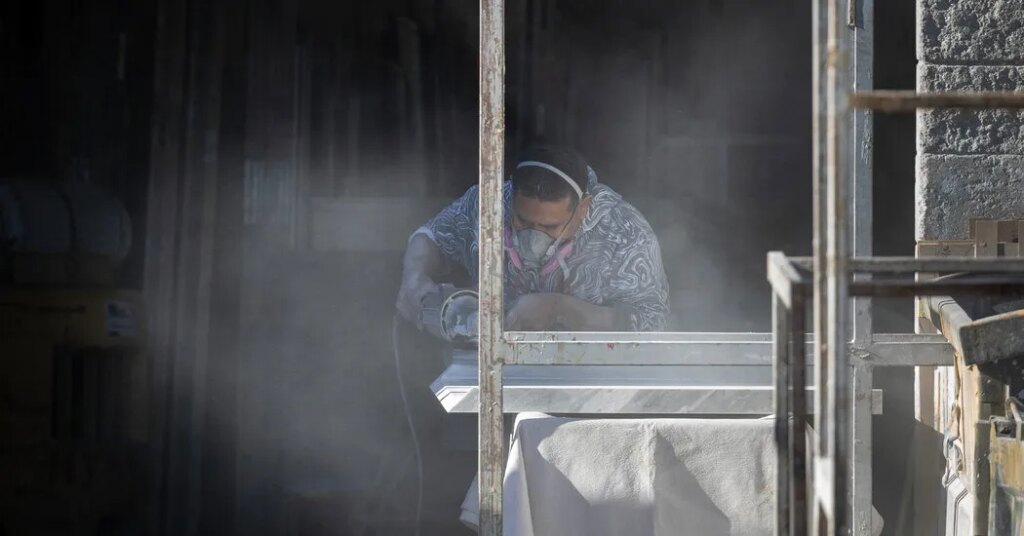
A year later, Mr. Metzger’s law office took on the case of a man with silicosis, a deadly lung disease, who had worked at a countertop fabrication shop in Los Angeles. It became one of the first lawsuits to claim that quartz kills workers who inhale a toxic dust thrown off when it is cut.
“Now I know,” Mr. Metzger said with a bitter laugh. A quartz countertop poses no risk unless it’s being cut, so removing it could be dangerous. “I only hope the workers who did it are OK.”
Mr. Metzger has filed about 260 cases on behalf of stone workers in California, where public health authorities have identified 668 cases of silicosis tied to quartz cutting. The state is poised to ban the production and installation of quartz countertops, despite pushback from the industry and questions about the feasibility of enforcing the change.
Engineered stone is a growing $30 billion global industry, and quartz is one of its more popular products. But as the dangers of silicosis have become more apparent, the industry has adapted, and so have American consumers.
Quartz is often marketed as “natural stone.” In fact, quartz countertops are made by mixing pulverized quartz — an abundant natural rock made of silicon and oxygen — with resins and pigments and pressing it at high heat into slabs.
Quartz is often mistaken for quartzite, a natural stone, cut from the earth, that is also used for countertops. Quartzite also contains crystalline silica, but because the rock hasn’t been ground to a dust and processed, it hasn’t been linked to the same dangers as man-made quartz.
Quartz became popular in the 1990s as a low-maintenance alternative to granite and marble. Companies like Caesarstone, Cosentino and Cambria manufacture it in an array of colors and patterns, and sell it through dealerships and big box stores.
About a decade ago, health officials began warning about the risks of exposure to silica dust. The plumes from cutting quartz lodge deep in the lungs, forming scar tissue and silicosis.
Lots of jobs entail exposure to dust that can be dangerous — baking, construction, carpentry. Processed crystalline silica, public health experts say, appears to be particularly lethal, possibly because the particles are so tiny.
In pushing to ban quartz countertops, California’s public health authorities said they had concluded that they lacked the resources to inspect all the small, below-the-radar fabrication shops where silicosis cases have emerged.
California’s Occupational Safety and Health Standards Board next meets in November. If it passes the ban, the effect on quartz sales could be quick, because of the state’s large market and because other states often follow its product safety standards.
In 2024, Australia banned engineered stone containing more than 1 percent crystalline silica, citing the risk of silicosis. Cosentino and Caesarstone promote lines of recycled and low-silica slabs. IKEA’s U.S. stores have shifted to alternative materials, including recycled glass composite.
“Glass composite uses a minimum of 80 percent recycled glass (with the remainder made up of resins and pigments) and with that contributes to the IKEA ambition to use recycled and renewable materials, where feasible.,” an IKEA representative said.
Peter Dominguez, the president of California Surfaces, a countertop fabrication and installation company in Santa Fe Springs, has watched in recent years as silicosis cases climbed and lawsuits mounted.
At least 85 percent of the company’s orders were for quartz. California Surfaces does mostly new homes and commercial jobs like airports and hospitals. As one of the larger shops in California, with 65 employees, it has automated machinery, including a robotic saw that cuts slabs with running water, which limits contact between workers and dust, Mr. Dominguez said.
But he saw the way the winds were blowing and decided to stop working with quartz. “It’s good for us, good for our employees,” he said.
Mr. Dominguez has pivoted to amorphous silica products, which have almost all the features of quartz. “If you are meeting the expectations of the vast majority of people who are using it, that’s good enough,” he said.
It has been more difficult to persuade his customers, typically builders or contractors, to change the materials specified in their projects. “It’s a lot of work for them to make that change,” Mr. Dominguez said, but “at a certain point, you become at risk of not being able to complete your project” because of the ban.
California’s occupational safety board received dozens of responses to its proposed ban from public health groups, businesses and industry organizations. Many sought clarifications, including whether natural stone that contains crystalline silica — like quartzite — would also be banned, or if the ban would apply only to man-made slabs.
On Friday, the board posted an edited draft clarifying that the ban would apply to artificial or engineered stone slabs and extend beyond countertops to surfaces including baths, fireplaces and flooring. It said installation included “any alteration that removes material from the slab beyond that necessary for a minor fit adjustment.
The International Surface Fabricators Association, which represents manufacturers and some fabricators, opposed the ban and suggested a licensing system for fabrication shops.
The post California’s Potential Quartz Ban Pushes Contractors and Retailers to Alternatives appeared first on New York Times.