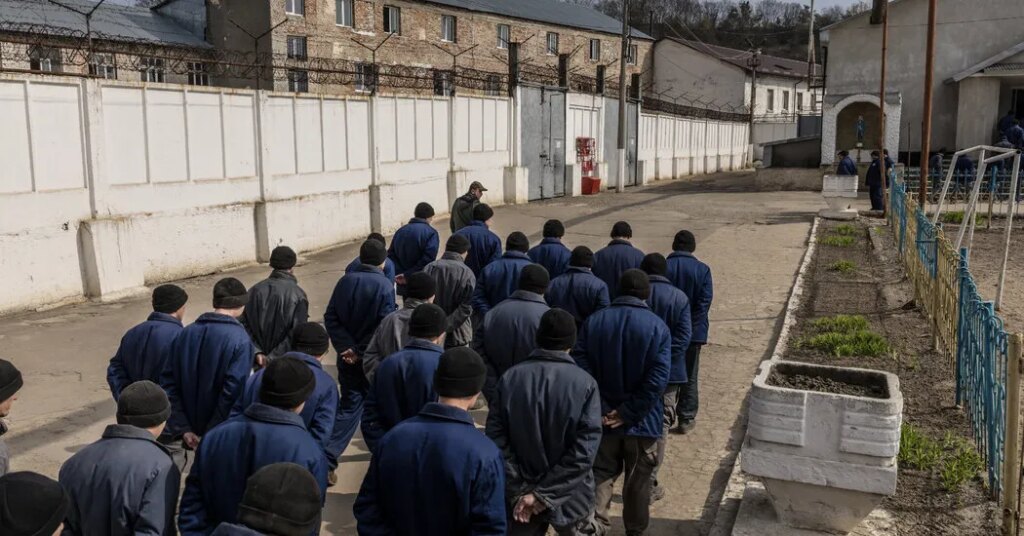
For two years, the only Russians Oleh saw were trying to kill him in battle. Now hundreds of them have him surrounded, by his own choice, at a camp for Russian prisoners of war.
Guarding, feeding and treating enemy soldiers is fraught in any country. But Ukrainians working with these P.O.W.’s have the added challenge of knowing that Russian forces invaded their land and committed atrocities, while their own country wants to show the world it treats prisoners with a decency that camp workers may not feel.
They have vastly differing motivations for taking it on. Oleh said that for him, it was about exorcising his hatred.
“I wanted to look them in the eyes,” he said.
For others, it can be curiosity, a contribution to the war effort, or just a paycheck.
Russia’s systematic mistreatment and torture of prisoners of war has been well documented by the United Nations and rights groups. While Ukraine has faced accusations of extreme mistreatment of Russian soldiers, particularly during their apprehension, independent monitors say such cases are far more isolated.
That imbalance is visible in split-screen images of prisoner swaps — skeletal, wounded and ill Ukrainians, traded for healthy-looking Russians. It spurs pain and anger in Ukraine, and profound emotional struggle for many of those who look after Russian prisoners.
Oleh, 58, keeps his job at a camp in Lviv, in western Ukraine, a secret from everyone but his wife. His brothers and nephews are still fighting on the front lines.
“How can I say to them that I am caring for the Russian P.O.W.s?” he asked.
‘This Benefits Ukraine’
Ivan, 42, helped set up Ukraine’s first P.O.W. camp after Russia’s 2022 invasion, and later the one in Lviv. Like all camp employees interviewed, he asked to be identified by only his first name, for security reasons.
From early in the war, Ukrainians saw the atrocities by invading forces in places like Bucha, near Kyiv. Encountering captured Russian troops “was uncomfortable for everyone,” said Ivan, a camp administrator, and “each of us had to cross a certain internal line.”
Prison administrators had to make clear that cruelty was prohibited.
Ukraine takes pains to differentiate itself from Russia, presenting itself to the world as following international law.
While there is always a concern that camp visitors get a sanitized view, the Red Cross, the United Nations and news outlets go there regularly and have interviewed thousands of prisoners. Those organizations have largely been denied access to Russian camps. The Red Cross has trained Ukrainian camp workers on the rights of prisoners under the Geneva Conventions.
The U.N. assistant secretary general for human rights recently reported that in Ukraine’s prison camps, “conditions generally comply with international humanitarian law and have improved since 2022.”
Visiting journalists get largely unfettered access. Several times, The New York Times has visited the Lviv camp, one of the largest, without seeing signs of mistreatment. Workers and prisoners can agree or refuse to talk, often out of earshot of camp staff. (The Times generally does not interview prisoners, whose cooperation could be coerced, or show their faces.)
Ivan said he faced constant criticism from fellow Ukrainians who question why Russian prisoners are treated well.
“People need to understand that this benefits Ukraine,” he said, getting animated. “It shows us as a civilized European country, unlike our enemies.”
Constant Discomfort
Russian prisoners file into the camp cafeteria for a lunch of borscht, stewed meat, pasta and bread.
For Roman, who oversees food and nutrition for P.O.W.s., they are constant, painful reminders.
The Russians have killed people he was close to, he said, and yet works surrounded by “those who did this, while others like them are still doing it now.”
He struggles to keep his emotions in check.
There was a time after his wife’s cousin was killed in combat, he confessed, when it was simply too difficult to go to work. He took a short leave to let the “emotional flame” die down, at least a little.
When he returned, Roman said, he minimized communication with prisoners.
The barrier is “always there,” he said, “and it can’t be otherwise.”
‘They Destroyed Everything’
Oleksii maintains physical, not just emotional, distance from the prisoners.
“I see them as an enemy, someone who would’ve tried to kill you,” he said, standing about 10 feet from two dozen prisoners next to a dirt soccer field.
He said that working at the camp is harder for him than for others, because he is from the Donetsk region of eastern Ukraine, which Russia invaded in 2014 and aims to seize entirely.
“They destroyed everything I had,” Oleksii said, adding, “How am I supposed to feel about them?”
Exacting revenge would achieve nothing, and “it would be worse for our country if we didn’t follow these rules, right?”
Still, he said of Russian prisoners, “Knowing what kind of people they are, it’s better to keep your distance.”
Humanity for a Foe
Distance is not an option for Robert, a camp medic, who must make physical contact with P.O.W.s.
At first, that meant an internal skirmish, Robert said, constantly asking himself if his work betrayed his country, his friends in the army, the people who have been killed.
“Everyone has his own cemetery of people who died in the war,” he said.
Robert, 38, learned his patients would be Russians only when he showed up for a trial day. He was briefly taken aback but accepted the role because he saw it as contributing to the war effort and thought it would be “unique, kind of spicy.”
The struggle within him subsided over time, though never completely. He tries not to think about how Russians he heals might return to the fight.
Jumping up from a swivel stool, he rushed into another room and grabbed a small container, shaking it like a rattle. It contained shrapnel the medics had removed from prisoners’ wounds.
His eyes welling and his voice starting to break, he asked why the humanity required to do his work “is it not knocked out, not washed away with tears, not burned out?”
‘I Feel Sorry for Them’
For Maryan, 43, who oversees a workshop where prisoners weave wicker furniture, the job is about compartmentalizing, separating “the moments when you’re just working with them and when you’re fighting them.”
There are sharp blades throughout the shop, but he never feels unsafe.
He said he chats with prisoners in free moments, on smoke breaks, asks how they’re doing, asks about wives and children, and they open up to him.
A wartime enemy becomes abstract. Few people get close enough to hear and smell them, to face them directly.
“Often,” Maryan said, “I feel sorry for them.”
Some prisoners have told him they were promised work in field kitchens only to find themselves on the front line, he said. Others said they enlisted to offset financial woes. Most were “deceived by their own state,” he said.
Maryan said he could feel empathy for prisoners and still be pained by Russia’s actions. Once, he said, a former member of his furniture crew who had been released in a prisoner swap walked back into the workshop and waved, having been captured again.
While “it was a very strange moment,” Maryan said, he was glad.
“It’s better that he’s here doing something useful,” he said, “than killing my fellow citizens.”
Letting Go of Hatred
Oleh, who conceals his work from nearly everyone, was initially shocked by the offer to run a construction workshop at a P.O.W. camp.
He had been a soldier, wounded in combat against the Russians. “I was used to seeing them through my gun scope,” Oleh said.
He hated them and struggled to see how he could stomach being around them. Then he realized he needed to try.
“I wanted to see if I would be able to forgive them, to treat them as humans,” he said as an air-raid siren wailed over the sound of a circular saw.
He needed to know “if I would live all my life with this hatred,” he added.
In his first days at the camp, Oleh said, he walked around dazed, sizing up the prisoners. They looked, he said, like a gray mass. Pathetic. He was surprised to feel no anger.
Soon he was having conversations with prisoners.
“I needed to know how a person decides to invade another country and start killing people,” he said.
Now he sees them as mere humans, and he feels lighter.
While he can sympathize with the prisoners, Oleh said he forbids himself from feeling any fondness. Forgiving does not mean forgetting.
“Too many of my people have died for me to just let it go,” he said.
Oleh hopes to return to combat. If he encountered a freed prisoner from his crew there, he said, he would “shoot without hesitation.”
“But now,” he said, “I will do it without hatred.”
Oleksandr Chubko and Oksana Parafeniuk contributed reporting.
The post To Work With P.O.W.s, Ukrainians Suppress Feelings About the Enemy appeared first on New York Times.