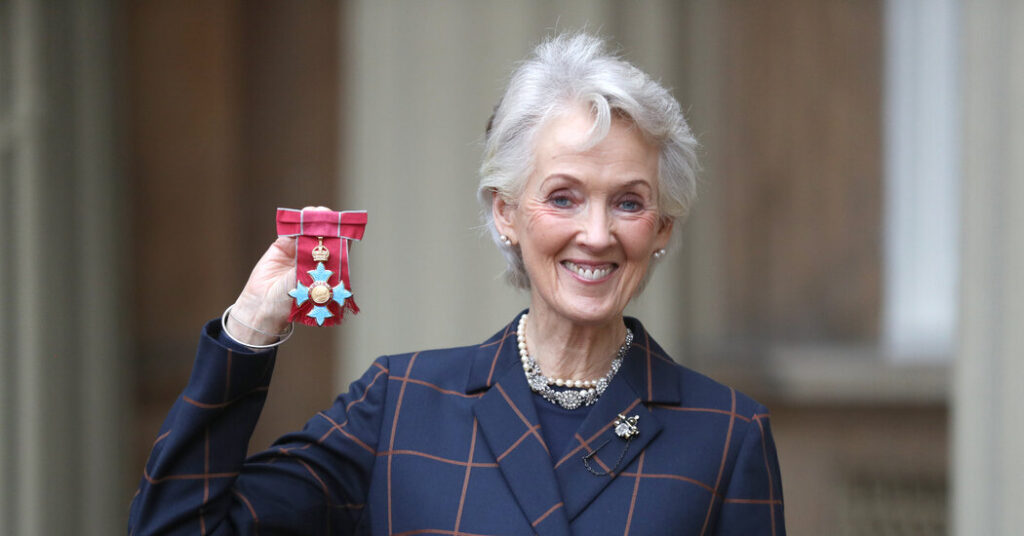
Joanna Trollope, who wrote popular British novels that grappled with adultery and the complexities of family life, died at her home in Oxfordshire, England, on Thursday. She was 82.
Her death was announced by her literary agency, Felicity Bryan Associates, which did not provide a cause of death.
Ms. Trollope had multiple best sellers, but her books were sometimes dismissed as “Aga sagas,” named after a type of stove symbolic of well-to-do English provincial life. And because some involved clerics, she was compared to a distant relative, Anthony Trollope, whose novels often involved churchmen. These were comparisons she rejected, and her books grew darker and more ambitious over time.
Joanna Trollope was born on Dec. 9, 1943, in Minchinhampton, Gloucestershire, England, the daughter of Rosemary Hodson, an artist and author, and Arthur Trollope, a banker.
She went to Oxford and worked for a time in the U.K.’s Foreign Office before beginning to write historical novels under the name Caroline Harvey.
She turned to her more well known contemporary novels under her own name with “The Choir” in 1988. The books, many of which were best sellers, often described empty marriages, love affairs (with tasteful sex) and heroic clergymen.
Ms. Trollope married David Potter, a banker, and had two daughters, and later married Ian Curteis, a television writer. Both marriages ended in divorce. She had a long partnership with a musician, Jason Kouchak, which also ended before her death.
She was quoted in The Independent comparing living with a Labrador to living with a man as “duller, but with much less potential for tension or disappointment.”
Her survivors include her daughters, Louise and Antonia, and multiple grandchildren.
Ms. Trollope created memorable characters, some of them of advanced age. In a 1993 review of “The Men and the Girls,” Lynn Freed wrote in The New York Times: “Her fictional ancients are variously voluble, imperious, selfish, stubborn, demanding, poignant, indiscreet and, of course, more lovable for being so.”
In a 1994 review of “The Rector’s Wife” in The Times, Patricia T. O’Conner found “big dollops of ‘I am woman hear me roar’ feminism, all about self-fulfillment and preserving one’s identity.”
In a sympathetic article and interview with Ms. Trollope in 2002, the author Will Self believed he had found a pigeonhole for her writing: “To me, she is a quintessentially English phenomenon, the lower-middlebrow novelist who has just enough sophistication to be able to convince her readership that they may be getting an upper-middlebrow product.”
Ms. Trollope described her own work in modest terms. “I’m no lyrical stylist, you wouldn’t pick me for a perfect sentence, and I certainly wouldn’t describe my novels as intellectual,” she told the Guardian in 2006. “But it’s good clear stuff.”
The Guardian characterized her work as “quiet anguish and adultery among the azaleas.”
Several of her novels were adapted for British television, including “The Rector’s Wife,” “The Choir” and “A Village Affair.”
In 2013, she tried her hand at a modern retelling of Jane Austen’s “Sense and Sensibility.” But she hardly expected to match the master.
“The comparison to Jane Austen makes me fidget.” she told The Independent. “There is a huge gulf between being great and being good. I know exactly which category I fall into and which she falls into. They are not the same. On a good day, I might be good.”
She was not a direct descendant of Anthony Trollope, but rather a fifth generation niece. She rejected the simplified classification of her or her distant relative as authors of church-themed novels.
“Would you say that two novels of mine out of 13 being set in the church qualified as an obsession?” she asked The Independent in 2005. “Anthony Trollope wrote 47, and only six of those are clerical. Labels like these, inaccurate labels, are as annoying as they are lazy.”
Alex Marshall contributed reporting from London.
Victor Mather, who has been a reporter and editor at The Times for 25 years, covers sports and breaking news.
The post Joanna Trollope, Popular British Author, Dies at 82 appeared first on New York Times.