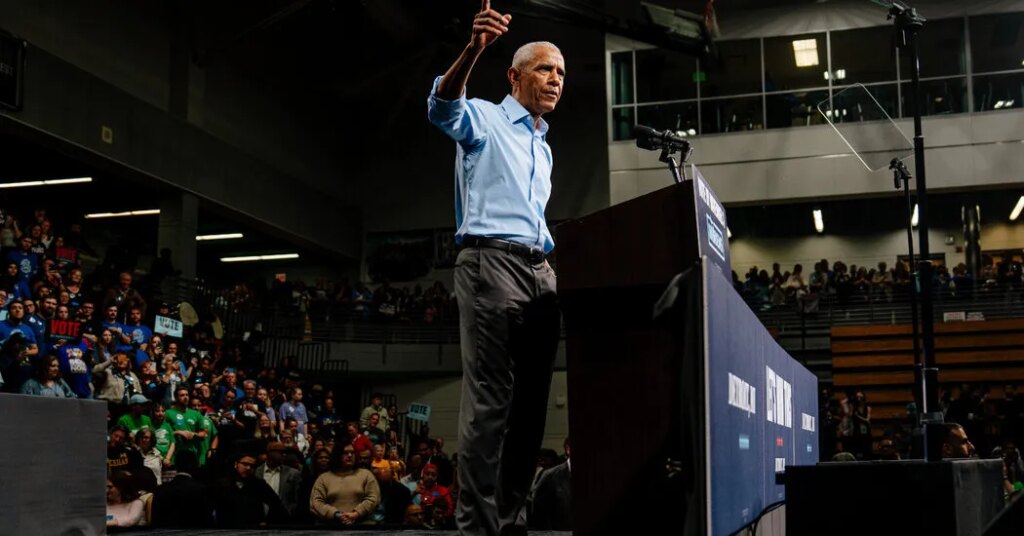
Former President Barack Obama returned to the campaign trail on Saturday for midterm rallies in Cleveland and Detroit, setting up a rare split screen with President Trump, who staged a rally in the evening in a small city in central Georgia.
Their pitches offered a contrast in style and substance. Mr. Obama prosecuted his case against the Trump administration in two tightly scripted, roughly 40-minute bursts on Saturday.
Mr. Trump, who has been crisscrossing the country for weeks in a midterm push to save his party’s congressional majorities, defended his administration in a rambling and at times profane hour-and-a-half speech Saturday night.
Here’s how Mr. Trump and Mr. Obama made their arguments 10 days before the election.
On the Iran war
Mr. Obama assailed the Iran war, which has driven up prices, describing it as an “unnecessary war” that “nobody asked for.”
“Our allies and our bases have been attacked,” Mr. Obama said in Cleveland. “Americans have been killed. Hundreds of Americans have been wounded. We have run down our stock of missiles. And Iran now has veto power over the Strait of Hormuz, where oil goes through to the world market.”
He said a central goal of the war — preventing Iran from acquiring a nuclear weapon — had been better addressed through the nuclear deal he reached with Iran in 2015. Mr. Trump pulled out of that agreement during his first term.
Mr. Trump said the unpopular war had been a success and had cowed Iran. He said Mr. Obama’s deal had been a “road to a nuclear weapon for Iran.”
“We defeated them militarily, financially and otherwise,” Mr. Trump said of Iran, though the war continues and administration officials are concerned that Iran is in the advanced stages of plans for attacks against U.S. officials.
“We have to make sure that they never, ever have a nuclear weapon, and we’ll do that very easily,” Mr. Trump said, adding, “Our country is getting stronger and stronger all the time.”
On the economy
Mr. Trump spent much of his speech warning about a risk he said Democrats would pose to the economy. A vote for Republicans, Mr. Trump said, was a vote for “more money in your pockets,” lower taxes and a “booming” economy.
If the Democrats win back Congress, he claimed, the country will fall into a “1929-style economic depression the likes of which you have never seen before.”
“They want all the things financially bad,” Mr. Trump said, citing transgender athletes in women’s sports, without explaining how that could affect the economy.
Mr. Trump also reminded voters of his promise to send $5,000 to every American adult if Republicans win in November. He argued that his sweeping tariff policies had “made us rich” and led to companies “pouring in” to the United States.
Mr. Obama said that presidents did not have “control over the entire economy.” But in this case the “administration’s actions are directly responsible for rising costs,” he said, citing the Iran war.
“This is the reason why the price of oil is up — nobody disputes that,” Mr. Obama said. “This is the reason the price of diesel is up. This is the reason why the price of just about everything is up.”
Mr. Obama ridiculed Mr. Trump’s tariff regimen, saying it, too, had contributed to rising prices. He mocked Mr. Trump for picking a trade fight with “that well-known evil empire Canada.” And he suggested that Republicans should have passed legislation responding to inflation.
“The only bill they passed of any significance in the last two years was a trillion-dollar tax break that mostly benefited the richest Americans,” Mr. Obama said.
On what’s ‘radical’
Mr. Obama pushed back on a core Republican argument going into November: that Democratic candidates are extreme.
Mr. Obama, chuckling, said in Detroit that Republicans’ ads were aimed at convincing voters that his party was made up of “radicals or communists or jihadists or the woke police that will come arrest you and force-feed you tofu.”
“We are not going to fall for that okey-doke,” Mr. Obama said.
Mr. Obama was joining Dr. Abdul El-Sayed, the progressive Democratic Senate nominee in Michigan, who is in a close race and whose platform calls for universal health care. Mr. Obama objected to Republican efforts to cast Dr. El-Sayed as extreme.
“Wanting everybody to have health care — how is that radical?” Mr. Obama said. “Wanting everybody to have a place to live that they can afford — how is that radical?”
Around the same time, Mr. Trump was arguing in Perry, Ga., that his party was running against “radical-left” candidates. He claimed that Democrats wanted to “loot your wealth” and “annihilate your borders.”
He charged that Democrats were running as communists, though no Democrat in any midterm race of note identifies as a communist. (Some Democratic candidates, mostly concentrated in deep-blue districts, identify as democratic socialists.)
“Less than two years ago, the radical-left Democrats handed us the dark age — it was a dark age — of America,” Mr. Trump said in Georgia, where he described the incumbent Democratic senator on the ballot, Jon Ossoff, as a “radical-left senator.”
Mr. Ossoff, a mainstream Democrat, has held a durable lead in the polls over his Republican challenger, Representative Mike Collins.
On challenges facing America
Mr. Trump and Mr. Obama offered different takes on the most pressing issues facing the country.
Mr. Trump said the “hardest job” was addressing the threat posed by immigration. He cast economic challenges as comparatively minor, and said deporting immigrants was “nasty work.”
“Some of them are so dangerous, Rick, we don’t want to get them out, we have to put them in jail,” Mr. Trump said, speaking from the stage to Rick Jackson, the Republican nominee for Georgia governor.
Mr. Obama said in Detroit that “we do need to make sure our border is orderly and secure,” but suggested that Mr. Trump had reached beyond his 2024 campaign promises by “sending masked agents running through our streets.”
And he questioned whether Mr. Trump was “thinking deeply” about the challenges facing Americans. As he closed his speech, he reflected on artificial intelligence.
“I know it’s been hyped, but there is a real technology that’s coming,” Mr. Obama said. “It is going to change a lot.”
He added: “These are serious times. This is not the time for reality TV.”
(Both presidents are set to return to the trail before the Nov. 3 election.)
The post How Obama and Trump Made Their Cases in Dueling Midterm Speeches appeared first on New York Times.