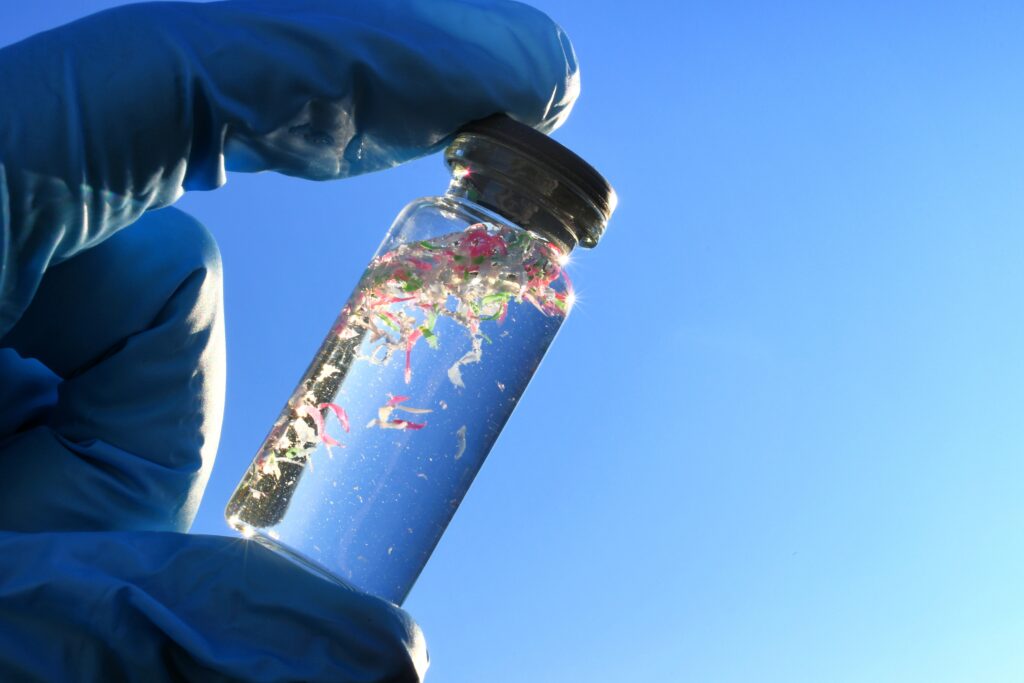
For decades, scientists believed that plastics were some of the safest materials around. Their long chemical chains, companies and researchers believed, wouldn’t react with food, water or — perhaps most importantly — the human body.
Now, a new study in the journal Nature shows just how flawed that assumption was.
The research from scientists at Columbia University shows that when water is exposed to tiny microplastics, it releases highly reactive chemicals. These chemicals, known as reactive oxygen species (ROS), are known to contribute to heart disease, cancer and neurological diseases like Alzheimer’s.
“They can essentially react with nearby biological molecules such as proteins, DNA, lipids, RNA — you name it — and damage them,” said Wei Min, professor of chemistry at Columbia University and one of the authors of the study, which was published earlier this month. “Because they’re high energy, they can, for example, bump into DNA and cause mutations.”
A range of studies over the past few years have found links between microplastic exposure and various health problems. In humans, research has shown that higher microplastic concentrations in a key artery are linked to heart disease. In experiments with mice, scientists have found that exposure to microplastics can lead to Alzheimer’s-like symptoms and atherosclerosis.
But what these experiments haven’t found is a clear mechanism of action, an explanation for why microplastics could cause these harms. The new paper suggests that the chemicals they release could be causing oxidative stress, where the production of dangerous free radicals in the body overpowers natural defenses. That, in turn, can contribute to inflammation and other health problems.
In one experiment, the researchers took tiny particles of polystyrene — the plastic used in Styrofoam cups and other take-out containers — and combined them with water and methyl orange, a type of dye that degrades when exposed to reactive oxygen species.
Over the course of 10 days, the methyl orange degraded to leave the water nearly clear — eaten away by the high-energy chemicals. The scientists also examined other common plastics, like polyethylene, used in cups and as a lining in take-out containers, and PET, used for water bottles.
The human body, of course, is mostly water. Researchers also tested the effect of plastic particles in blood serum and cell cultures, and found that the reactive oxygen species were still present.
Astrid Delorme, a lecturer at the University of Hawaii at Manoa and a scientist studying plastics degradation, said that researchers have long thought that only older plastics, weathered by the wind and sun, had chemical effects.
“Here, they’re showing that even pristine plastics, just in the context of water, are chemically reactive,” said Delorme, who was not involved in the study. “It’s a huge finding.”
It’s all about the size of the tiny plastics, according to researchers. While large pieces of plastic are unlikely to react with water, tiny microplastics have a larger surface area, which provides more opportunity for them to form dangerous molecules. When a plastic credit card breaks into microplastics, for example, its surface area increases by a thousand-fold, Min said. That surface area is part of what allows water to split into reactive chemicals.
The human body does have some defense mechanisms to root out reactive oxygen species. But scientists worry that microplastics may build up in the body, creating more reactive chemicals than the immune system is prepared to handle.
“Plastics last for a long time,” Min said. “I think everybody will start to worry because this will likely trigger chronic inflammation.”
The post Scientists were unsure of how microplastics harmed the body — until now appeared first on Washington Post.