William Diaz has a mantra: His only political party is his Venezuelan community.
He doesn’t abide by strict partisan rules, and doesn’t believe in only voting for Democrats or Republicans. He supported Republicans Sen. Rick Scott and Secretary of State Marco Rubio when they were running for office in Florida, where Diaz has lived for 37 years.
For these midterm elections, however, the Orlando resident hopes to make a clear statement: He does not support President Donald Trump’s immigration policies and is unhappy with how Republican-backed initiatives have affected his community.
Read More: An Idaho ICE Raid Rounded Up Hundreds. The Fallout Could Change How ICE Operates
“I voted already, and what I did when I was voting and when I was with my ballot, I was really thinking and praying for all those that has no voice, those that can not vote, those immigrants that are right now victim of actions on the streets,” Diaz tells TIME, referring to Trump’s mass deportation agenda and the expansive influence of Immigration and Customs Enforcement (ICE). “My people have been suffering that much.”
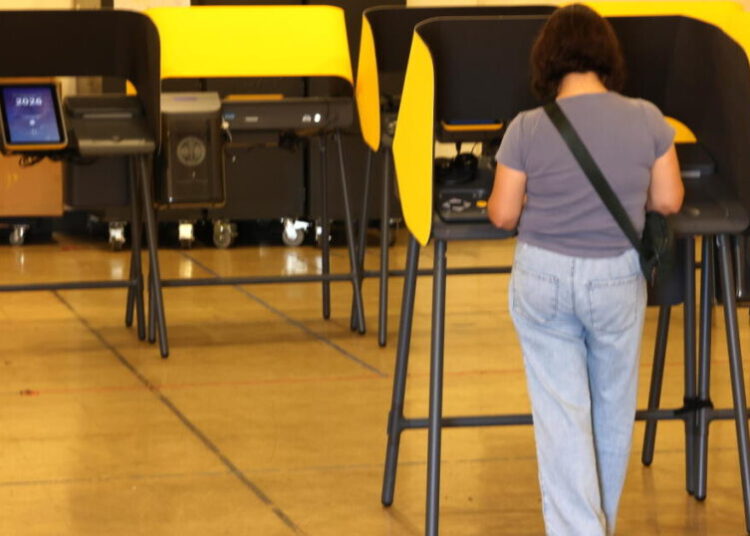
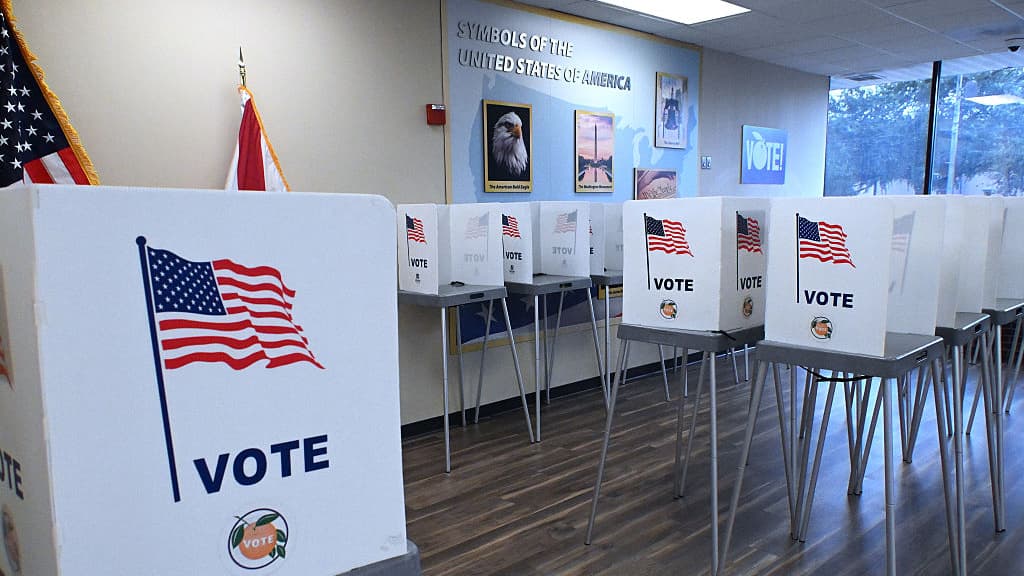
Diaz is one of more than 2.6 million people who have already cast ballots in Florida, either by mail or through in-person early voting, according to state figures released Sunday. In-person early voting began in some counties Oct. 19 and expanded statewide Oct. 24.
Diaz’s community is one part of a Florida Latino electorate with varied national origins and political loyalties. Taken together, however, Latino voters are a swing vote in several closely watched races statewide. They were key to Trump’s Florida victory in 2024, with 56% supporting him over Kamala Harris, according to the 2024 American Electorate Voter Poll.
But new polls ahead of Election Day suggest that Latino support for the GOP may be on shaky ground—a shift that could put Republicans to the test in Florida and shape the political landscape beyond November.
Why Florida’s Latino voters are frustrated with Trump
Dissatisfaction among Florida’s Latino voters reflects a broader national mood, according to Stephanie Valencia, a co-founder of Equis Research, an organization that studies Latino voting behavior.
Concerns about the economy and immigration enforcement tactics are fueling dissatisfaction among Latino voters, who “make up a huge part of the electorate in Florida,” she says, pointing out that both of these issues are “disproportionately impacting” them.
A Univision/YouGov poll, conducted Oct. 2–15, showed that 41% of registered Latino voters in Florida were “very or somewhat worried” that they, a family member, or someone close could be detained or otherwise directly affected by immigration enforcement, compared with 27% of Florida voters overall.
The same poll showed that 4 in 10 Latino voters in the state felt that their finances had worsened over the past year, with 70% disapproving of Trump’s handling of the cost of living in the U.S. That stands in comparison to a 63% disapproval rate from Florida voters overall.
Read More: Midterm Ad Spending Has Surpassed $10B. Where Is the Money Coming From?
For Johanna Chavez, a Dominican immigrant living in Kissimmee, Florida, the economy is top of mind.
“Many people are concerned about the economy and the price of gasoline … and then there’s the cost of rent, it’s become incredibly, overwhelmingly high,” Chavez, who speaks Spanish, tells TIME through a translator. “All the things they promised would be done—nothing has happened.”
In the past few years, Chavez says it has felt like the United States has started “regressing,” and the opportunities she was looking for when she arrived here have not materialized in the way she had hoped.
“It’s starting to feel just like the situation back in my home country, the Dominican Republic,” she says. “We all came here hoping for change, seeking a better life, but it’s ending up being the same thing all over again. Things just aren’t what they’re supposed to be.”
Jared Nordlund, the Florida State Advocacy Director at UnidosUS, the largest nonprofit Latino rights organization in the U.S., says this is a common refrain among Floridian Latinos; people are upset over how the economy has been affected by tariffs and the war in Iran. Florida was hit particularly hard by rising gas prices after the closure of the Strait of Hormuz squeezed the global energy supply, he says.
“Florida is not a state friendly for public transportation, so people are highly reliant on the cars, and so what they would be paying for food now is having to kind of get broke between … paying to get the gas and then going to get food,” Nordlund says.
The question now is whether that dissatisfaction will translate into votes against Republicans—and whether it will be enough to tip the state’s close races.
Trump’s declining Latino support puts Florida Republicans on notice
Trump’s approval rating has plummeted with Latino voters in Florida, dropping from 58% approval at the start of his term to 36% ahead of midterm elections, according to Equis Research.
According to an AP-NORC poll from October, about 6 in 10 Latino voters disapprove of how Trump is handling the presidency, and more than 7 in 10 disapprove of how he is handling the economy.
A Pew Research Center poll found that Trump’s job approval rating among Latino voters dropped from 38% in February 2025 to 24% in September and October. Of those who backed him in the last election, approval dropped to 57%—down from 93% in early 2025.
The shift may be resonating with Republicans like Rep. Maria Elvira Salazar, who is seeking re-election in Florida’s 27th District in Miami-Dade—a majority Latino district that Trump carried by some 15 points in 2024. She publicly broke with Trump in her campaign and criticized his immigration policies.
In one ad in September, Salazar said that Trump has “gone too far” with his deportation agenda.
“In July, 50% of the 50,000 people that were detained had no criminal record,” she notes in the ad.
“Be careful what your advisers are telling you about immigration policy,” Salazar continues, addressing Trump. “The same Hispanics who helped you get to the White House in 2024 feel betrayed today.”
Why Latino frustration may not translate into Democratic votes
Guillermo Grenier, a Cuban American professor of sociology at Florida International University (FIU), agrees that many Latino voters are “ticked off” at Trump.
“The population, if you look at the whole Latino conglomerate, is turned off pretty strongly with Trump,” he says.
But South Florida’s Latino electorate is unique; Grenier points out that the state is home to 1.9 million Cuban Americans—the largest concentration in the United States.
As a voting bloc, the community has significant sway. In 2024, FIU’s Cuba poll found that 68% of likely Cuban American voters in Miami-Dade County supported Trump, compared to 23% for Harris—representing his highest-recorded support level in the poll’s history.
A shift away from Republicans among Cuban American voters could therefore have significant consequences in South Florida. But disillusionment doesn’t always turn into action, according to Grenier.
“I think a lot of Cubans are pissed off at Trump, but they’re still Republicans,” he says.
The Democratic Party’s response to this potential opening may unfold over several election cycles.
“Democrats are going to be in a probationary period with Latinos and with all voters, quite frankly, on whether they can deliver or not,” Valencia says. “One election is not durable support among a particular group.”
Both Valencia and Grenier suggest that it will come down to Democrats proving that they are willing to reinvest in Florida.
What are the key races to watch in Florida?
There are several key races at stake in Florida. Although the state has leaned reliably red for the past three election cycles, Democrats are investing late in the race through campaigning and financing.
Florida Democrats posted a larger monthly net gain in active registered voters than Republicans, according to figures the party highlighted Oct. 1. The Florida Democratic Party touted the gains as a sign of its growing base in the state.
“We’ve spent years rebuilding this party from the ground up. Our organizers are in communities year-round, our volunteers are knocking doors across this state, and Democrats are having real conversations with Floridians about what’s at stake,” Florida Democratic Party Chair Nikki Fried said in an October statement. “The momentum is real.”
Gov. Ron DeSantis is term-limited and cannot run for re-election, leaving the role open for Byron Donalds, the Republican candidate who has been endorsed by Trump, and David Jolly, who is running as a Democrat after leaving the GOP in 2018.
A poll released Oct. 21 by the Public Opinion Research Lab (PORL) at the University of North Florida (UNF) found that Donalds leads 49% to 47%—within the poll’s almost 3-percentage-point margin of error.
Latino voters could be important to Jolly’s chances. The Univision/YouGov poll found that they favored him over Donalds, 48% to 43%, even as Donalds led 50% to 42% among Florida voters overall.
Democrats are taking note. Weeks after Jolly beseeched the Democratic Party to send money to his campaign, the Democratic Governors Association announced Oct. 20 that it will invest $1 million to help close the narrowing gap in the weeks before Election Day.
That trend follows in certain congressional races downballot.
A September poll found Salazar leading Democratic challenger Eliott Rodriguez, a former local news anchor, by just 1 point.
Angie Nixon, a member of the Democratic Socialists of America, is an underdog for Senate, taking on Republican incumbent Sen. Ashley Moody. A recent UNF poll has Moody leading by 49% to 45%, halving the advantage she had in July.
National Democratic leaders and allies have made the trip to Florida to bolster these close races.
Independent Sen. Bernie Sanders, a Democratic ally, rallied in Tampa for Nixon on Oct. 17. House Minority Leader Hakeem Jeffries campaigned with Rodriguez on Oct. 16; they held a campaign event at a Cuban coffee shop and bakery.
The decision received some blowback, with one conservative Cuban influencer taking to Instagram to slam the business for hosting Jeffries. He argued that associating with the Democrats equated to supporting socialism.
For Grenier, the incident shows that Democrats have some serious work to do to gain trust in Florida—and while it might be “too late” to invest in candidates in this election, the party can lay the groundwork for 2028 and beyond.
He said that if Democrats want to build on the momentum after the midterms, they can’t get “gun shy.”
“This new beachhead that [Democrats] are trying to establish is the way to go for the next elections,” Grenier says.
“You know, it was 10 years of investing before Republicans flipped the state in 1996,” he continues. “So, they need to just keep it up, and have national leaders support local leaders.”
The post What Does Trump’s Declining Latino Support Mean for Florida? appeared first on TIME.