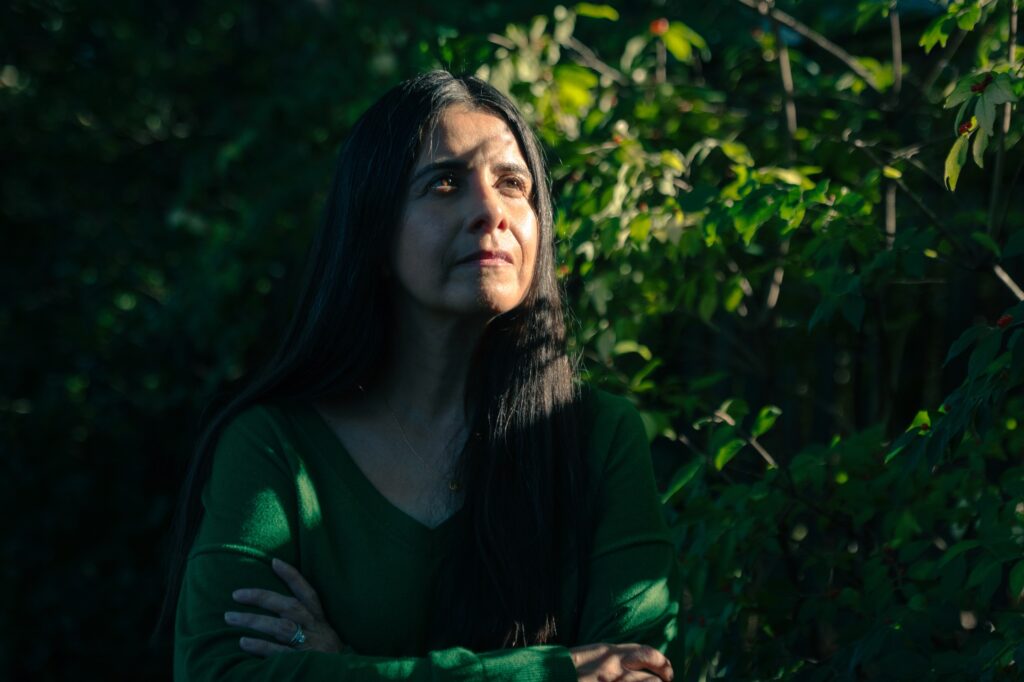
THE JUDGE HAD JUST CALLED COURT TO ORDER on that winter morning, and already, a dozen attorneys waited on her TV screen, each with an urgent request. Their clients, all locked up and facing deportation, needed hearing dates scheduled or bond requests considered. As always, the judge had prepared for every case days earlier, because almost nothing happened in Courtroom 15 that she didn’t anticipate.
Then the door behind her swung open, thudding against the wall. In walked her supervisor.
“Are you on the record?” he asked, questioning whether she was in session.
Karen Donoso Stevens was in session, and she was certain he knew it. The judge held up a finger — wait — as she announced a recess inside the Annandale Immigration Court.
A Homeland Security attorney at the prosecution table watched in silence, as did her legal assistant.
She drew a long breath, then stood in the black robe she’d worn for nearly a decade, its cloth fraying at the elbow.
Here we go, the judge thought, certain she was about to be fired.
In the hallway, she recalled, her supervisor said he’d been instructed to pull her from court.
“Why?” she asked.
“I don’t know,” he replied.
It was Jan. 14, one year into the most tumultuous period in the U.S. immigration court’s history. President Donald Trump had inherited what was widely seen as a broken system. Exacerbated by an influx of migrants under President Joe Biden, its backlog exceeded 4 million unresolved cases, and Trump’s administration had vowed to address it.
The public broadly supported tighter border security before his election, though the aggressive crackdown that followed alienated many voters, recent polls show. As the administration stripped protections from asylum seekers and dispatched thousands of ICE agents onto American streets, leading to more detentions and deportations, two U.S. citizens were killed by federal officers in Minneapolis, igniting a backlash.
But no cog in Trump’s effort to expel millions of “illegal aliens” was more essential — and less familiar to the public — than the immigration courts that decide who stays and who goes.
The sprawling system doesn’t operate like most courts. It exists within the Justice Department, which is overseen by the attorney general and, ultimately, the president. Nevertheless, it is obligated to afford migrants due process and manage cases according to the law, nothing else.
And yet, in the first year of Trump’s second term, the Justice Department fired some 100 of the country’s roughly 700 immigration judges and began to replace them with what the administration called “deportation judges.”
Donoso Stevens, 53, should have been insulated from the institutional chaos, according to fellow judges and attorneys whose cases she oversaw. Before joining the bench in 2016, she’d spent a decade at Homeland Security, earning a reputation as a formidable prosecutor. She was Annandale’s most tenured “detained judge,” one of three who decided what to do with migrants in custody, the court’s highest-stakes cases.
Every year, Donoso Stevens had denied asylum in more than half the applications that came before her, a record consistently in line with national averages. She hadn’t resisted case quotas imposed by the first Trump administration and seldom took sick leave. She never fell behind on her docket.
But on that morning in Northern Virginia, she feared none of it mattered. By then, Donoso Stevens said, another supervisor had already ordered her to reverse four rulings at the direction of unidentified “higher-ups,” a violation of judicial authority she once considered inconceivable. The interference, she said, had only escalated since.
The allegations, which she’s sharing publicly for the first time because of her deep concern for the court’s integrity, were corroborated by her extensive contemporaneous notes as well as colleagues, family and private attorneys interviewed by The Washington Post. They contradict Trump officials’ insistence to the public and to The Post that — as required by law — immigration judges serve under the administration as independent arbiters of justice.
Outside her courtroom, Donoso Stevens tried to make sense of what was happening. She would remain on the bench but no longer oversee cases for migrants in detention, she was told by Robert K. Lundberg, Annandale’s acting assistant chief immigration judge, a largely administrative role he’d been moved into a week earlier.
Donoso Stevens asked if she could finish the hearing. He said no, she recalled: “You’re not allowed to go back and say what happened.”
The judge returned to court and turned on her camera.
“I’ve been told I’m no longer able to finish these hearings,” she said, her voice quavering.
On the video call, she heard attorneys gasp. Then the judge walked out. Word spread through the legal community within minutes. Many assumed she’d been fired.
Back in the hallway, Donoso Stevens saw Lundberg escorting her replacement, a man she’d trained and mentored, toward her courtroom. He immediately took over her docket, including a prominent case that legal experts had said could set a precedent with sweeping consequences for tens of thousands of Afghans seeking refuge in the United States.
Donoso Stevens returned to her office and removed her robe. She wept.
In the hours that followed, colleagues and friends tried to console her. At least, they said, she still had a job. But the judge, who so often preached that her only duty was to follow the law, asked herself: What would she have to do to keep it?
DONOSO STEVENS BEGAN TO WORRY, she said, on the 26th day of Trump’s second term. She was in the car with her husband, headed home from a Valentine’s Day dinner, when her phone buzzed, then kept buzzing.
“No way,” Donoso Stevens blurted as she read the texts.
Her supervisor, Rebecca Walters, had been fired, one of seven assistant chief immigration judges dismissed that day. Appointed under Biden, Walters was credited with dramatically improving Annandale’s case-completion numbers, an achievement that colleagues hoped would ingratiate her with a Trump administration that had imposed quotas during his first term.
Dozens of other terminations soon followed, spotlighting what many legal experts have called a systemic flaw in the court system: Unlike federal judges protected from political retaliation by lifetime tenures and the constitutional separation of powers, immigration judges work for the executive branch.
No administration had ever carried out a purge at this scale. Trump officials asserted they had every right to banish, as the White House put it, “activist judges who slow-walked deportations and granted asylum at sky-high rates.” But even as the expulsions instilled what surviving judges in private conversation began to call a “culture of intimidation,” the Justice Department insisted it would not interfere with their rulings.
“They are required to adjudicate cases independently and impartially without favor to either party,” Sirce E. Owen, appointed under Trump as acting director of the Executive Office for Immigration Review, wrote in a memo last summer. Owen declared that no one in the executive office, the agency that oversees the entire immigration court system, can “direct any adjudicator to rule in a particular way” before appeals are settled.
Donoso Stevens wanted that to be true, because the institution had become central to her identity. She’d endured a two-year application process before being appointed to the bench a decade earlier by Democratic Attorney General Loretta E. Lynch. The job was the zenith of her career and, she thought, its destination. She found purpose in studying the law and applying it, even if that meant ordering the deportation of people whose pleas for sanctuary devastated her.
She’d believed in the sanctity of America’s legal system since well before she swore an oath to the Constitution. Donoso Stevens decided to become an attorney when she read “To Kill a Mockingbird” as a high school junior. The ideals of truth and justice appealed to her, as did getting paid to persuade people she was right. The middle child of Ecuadorian immigrants in the Chicago suburbs, she’d always served as her siblings’ advocate, negotiating punishments and bedtimes. When she turned 17, her dad ordered a vanity plate for the pickup they shared: “2 B LWYR.”
She met her eventual husband, Damon Stevens, when they competed against each other in moot court at Michigan State University College of Law. She won.
“She’s got an edge,” he said, recalling how her diminutive stature, at 5-foot-3, could mislead. “If you’re opposing her, she’s not a wallflower.”
After graduation, Donoso Stevens prosecuted misdemeanor assaults and DUIs in a Chicago criminal court until she followed her husband to California, where he’d been stationed as a judge advocate in the Marine Corps. Amid cross-country moves, she had two kids and worked at a nonprofit to help children who’d arrived in the U.S. without their parents. In 2007, she joined Homeland Security as a prosecutor.
“I remember how proud I was to be a federal employee,” said Donoso Stevens, whose parents had instilled a deep allegiance to the country that gave them citizenship. “I never saw myself doing the law for money.”
She was especially tenacious in trying to deport immigrants accused of domestic violence or harming kids, according to defense lawyers, who noted they never found her unreasonable.
“She was agreeable when there was room to agree,” said Anam Petit, then a private attorney who later served as a judge before being fired without cause last year. “She was always thoughtful.”
In liberal Washington, Donoso Stevens knew that many people considered her job distasteful because it often meant fighting to deny immigrants a home in the United States. Weary of being asked how she could sleep at night, she stopped revealing what she did for a living.
“I work for the government,” she’d say, and nothing more.
Back then, she said, Homeland Security attorneys weren’t evaluated on wins and losses. If immigrants proved they deserved asylum, she didn’t fight them.
Ricky Malik once represented an attorney from El Salvador whose family had been terrorized after the woman investigated gang members. In court, Donoso Stevens confirmed the story, then told the judge that Homeland Security did not oppose her application.
“Justice, that was her main goal,” Malik said. “Not just, ‘I’m going to win every case, and I’m going to have a body count.’”
Still, when she was appointed to the bench, at the time an uncommon transition for a Homeland Security attorney, Malik and other defense lawyers protested. How, they asked, could she rule with impartiality when former colleagues sat at the prosecution table?
“This is unfair,” he said, before she began overseeing his cases. As the years passed, Malik said, he found in her what he wanted most from every judge: She followed the law.
HOW TO FOLLOW THE LAW got more complicated on a Friday afternoon in September 2025. In a 14-page ruling, the Board of Immigration Appeals, stocked with members appointed under Trump, stripped judges of a power they had exercised for decades.
Undocumented immigrants who weren’t apprehended until after they entered the country had long been allowed to request bond, leaving judges to decide whether it was safe to release them as their cases proceeded. Suddenly, the board decided that anyone who came unlawfully should remain jailed, even those with clean records and family ties.
Donoso Stevens disagreed with the board’s legal interpretation, but her view, she said, made no difference. She treated its decisions as the mandates they are.
Still, she and other judges quickly spotted a potentially critical omission: The opinion failed to account for children who came to the United States without a parent or guardian and had since reached adulthood, a group that, in their view, fell under distinct legal guidelines.
Less than two weeks later, four such people asked Donoso Stevens to release them. She studied the law and consulted with colleagues, then decided the immigrants were eligible. She granted bonds.
On Sept. 17, Annandale’s then-acting assistant chief, Eric Dillow, called her.
“Dillow … said bond is a hot topic. Wanted to discuss bond decisions,” Donoso Stevens jotted in a green steno pad reviewed by The Post. He told her he knew about the four cases and had just emailed her a separate ruling that, he believed, meant she could have denied bond.
When Donoso Stevens pressed him, she said, Dillow acknowledged the four cases had been “elevated” to him. He didn’t say by whom, and she neglected to ask. Nevertheless, it was a stunning disclosure. As far as she knew, none of her rulings had ever been reported to a supervisor.
She hung up and read the ruling Dillow had sent, then he called back. From her office, Donoso Stevens told him she could see the merits of the argument, even though it came from a federal court in New York that couldn’t require her or any other immigration judge in Virginia to follow it.
“What should we do?” he asked.
She told him Homeland Security should follow legal protocol: The department could either file a motion asking her to reconsider or request that the appellate board intervene. He agreed, according to her notes, but called back a few minutes later.
Suspicious, she allowed another judge who had come to her office to listen in.
“He said higher-ups said I had to vacate my decs sua sponte,” Donoso Stevens wrote in a note that abbreviated “decisions” and used a Latin phrase that refers to judges reversing their own rulings unprompted.
Dillow did not name the “higher-ups.” Donoso Stevens pushed for an explanation: “Why can’t DHS file a motion to reconsider?”
“Oh no,” he replied. “They’re not going to do that.”
The call ended.
“Is this our red line?” Donoso Stevens asked the other judge. The colleague, to whom The Post granted anonymity because they fear professional retaliation, confirmed the details of the call.
To Donoso Stevens, Dillow had not only told her how to rule, directly violating the executive office’s vow of judicial independence, he’d implied that Homeland Security had ordered the court system to acquiesce.
The Post described the allegation to three legal experts, and all of them condemned it as unacceptable.
“It’s an example of direct interference in an immigration judge’s handling of a case,” said Jill E. Family, a professor at Widener University Commonwealth Law School. “That is a very disturbing affront on the basic norms of our legal system.”
The Post sent a detailed list of questions to the Justice Department and Homeland Security as well as Dillow, Lundberg and every other government official Donoso Stevens named in her account of what happened. None responded to the allegations.
“DOJ’s approach is to impartially adjudicate cases as efficiently as possible in accordance with the law and evidence,” an executive office spokesperson wrote in a statement. “It does not view adjudications in terms of outcomes and does not have a stake in any particular outcome.”
Donoso Stevens said she considered refusing Dillow’s order to overturn her rulings. But because she conceded that the New York case offered a reasonable counterargument, the judge reluctantly agreed to reverse herself, she said, a choice she still debates.
A week later, after backlash over a push to rapidly dismiss cases and expedite arrests, the executive office insisted again that the court had total independence. It issued a memo that appeared in conflict with Dillow’s edict: No one in its leadership “may direct an Immigration Judge to decide a case in a particular way.”
But in private, leadership continued to undermine its public pronouncements.
On Nov. 18, Teresa L. Riley, appointed under Trump to lead the country’s entire immigration court system, emailed Donoso Stevens, demanding justification for why she’d granted bond in six other cases. Donoso Stevens said she couldn’t provide the message to The Post because of pending litigation, but she described it.
When Dillow called to discuss Riley’s email, Donoso Stevens told him she hadn’t acted unilaterally. Federal courts had ordered bond hearings in all six of her cases, in response to habeas corpus petitions challenging the government’s legal right to keep migrants locked up. Dillow told Donoso Stevens he understood, she said, and promised to convey her account to his bosses. Riley, who didn’t reply to a request for comment, never followed up with Donoso Stevens.
The bond issue seemed to recede until early January, when Lundberg replaced Dillow as Annandale’s acting assistant chief.
Within a day or two, Lundberg appeared in her office doorway.
“Judge, just because habeas hearings are ordered doesn’t mean you have to grant bond,” she said he told her. Donoso Stevens interpreted that as an instruction to conduct “show” hearings, she said, where the outcomes for immigrants would be predetermined.
“If bond is warranted — if they prove they’re not a danger or a flight risk — then I’m going to grant bond,” the judge said she told him.
He looked at her, she said, and walked away, silent.
Less than a week later, he opened the door to her courtroom and asked if she was on the record.
NEWS OF DONOSO STEVENS’S DEMOTION stunned private lawyers and dismayed fellow judges, but the most immediate effects fell on the immigrants who would have appeared before her.
Since the start of Trump’s second presidency, Donoso Stevens had denied about 85 percent of her asylum claims, according to a Post analysis of Justice Department data. She largely ascribed the highest rate of her career to how much more difficult the board’s mandates made it to approve applications. Her replacement, Richard VanVeldhuisen, who joined the bench in 2023 and had never overseen a docket of detained immigrants, denied about 95 percent in his new assignment.
His rate mirrors the court’s soaring national averages in 2026. While the board’s decrees are limiting, legal experts say, judges have succumbed to immense pressure from the Trump administration to deny applications.
“It is a hurricane-force wind against judicial independence,” said Dana Leigh Marks, a former immigration judge who, since retiring after 35 years, has become a fierce Trump critic. “Everybody has a different tolerance point.”
The effects have been profound.
The most high-profile asylum case VanVeldhuisen inherited from Donoso Stevens was that of an Afghan who, after supporting the United States’ cause in his home country, escaped with his wife on a U.S. military plane as American troops withdrew in 2021. In July of last year, ICE officers arrested the man, whom The Post is identifying as H out of concern for his safety, on his way to work at an accounting firm.
In court, Homeland Security attorneys argued to Donoso Stevens that H, who has never been charged with a crime, could be safely sent back, despite the Taliban’s brutal regime. If the courts accepted that rationale, legal experts suspected it could help the agency expel thousands of other Afghans.
Homeland Security later submitted surprise evidence: an unsigned FBI memo that accused H of no wrongdoing but described him as “a potential threat” because of distant relatives who were associated with terrorist groups. Donoso Stevens pressed the prosecutor for more details on the memo, but he provided none, saying his “chain of command” had given it to him.
Donoso Stevens can’t share how she would have ruled, she said, but there were signs in court that she found the government’s case unconvincing, noting that H, who’d answered hundreds of questions under oath, had not “testified to anything that would make him a national security interest.”
After Homeland Security announced the FBI had yet to finish his background check, a frustrated Donoso Stevens acknowledged that, by law, she didn’t have the option to grant the father of two asylum until he was cleared by the bureau, which the Justice Department also oversees. A prosecutor reminded the judge she could reject H’s application at any time. She declined.
The clearance arrived three months later, in January — just nine days after Donoso Stevens was removed from the case.
On Feb. 18, VanVeldhuisen, who had never consulted with her about it or held a hearing on H’s case, ordered him to be sent back to Afghanistan.
The judge wrote that because of H’s relatives, he “may pose a danger to the national security.” In a footnote, VanVeldhuisen, who did not respond to a request for comment, mentioned that the judge “formerly assigned to this case is unavailable to complete” it. Donoso Stevens remained on the bench, in a courtroom not far from his own.
H’s attorney filed a habeas corpus petition to the Eastern District of Virginia, but a Trump-appointed judge denied it, citing, among other things, VanVeldhuisen’s conclusion that H may be a danger, “which this Court cannot second-guess.”
OVER AND OVER, TRUMP OFFICIALS have demanded more productivity from immigration judges. His first administration asserted that “efficient adjudication” served “the national interest” and instituted quotas. His second administration has set strict case-completion deadlines “to address the substantial backlog exacerbated by prior leadership.”
“No more endless delays,” the White House declared. “Only results.”
Donoso Stevens believed in results, too. That’s what so infuriated her one February morning after her demotion when she discovered seven white cardboard boxes outside her chambers. The executive office had instructed judges to rule on 95 percent of their motions within 30 days. Now, beside her door, she found more than 100 of VanVeldhuisen’s unresolved filings — all from Homeland Security and all at least six months old.
Donoso Stevens struggled to understand how ignoring the government’s legal requests served its own goal of “efficient adjudication.”
And she was suddenly responsible for every one of them.
“This is f—ing unbelievable,” she said to herself.
Donoso Stevens, who, in her new role, had already taken on about a thousand asylum applications from immigrants not in detention, demanded an explanation from Lundberg’s staff. When none came, she requested a meeting. The judge pitched him on ways to make Annandale more efficient, she said, but the discussion in early March, which included other administrators, quickly turned combative.
“So you’re basically telling me all the things I’ve done wrong,” she recalled him snapping.
Donoso Stevens left the meeting shaken and angry. On March 6, in an email she read parts of to The Post, the judge followed up on their discussion.
“Annandale Immigration Court and the broader EOIR,” she wrote, “are understandably and correctly under significant pressure from DOJ and the American people to be as efficient as possible in significantly reducing the longstanding backlog of cases.”
She created a spreadsheet for every outstanding motion and, over two months, cleared them all. On April 20, Lundberg signed her performance review, grading her “satisfactory,” the highest possible rating. In the accompanying email, she said, he thanked her for her work on the motions. The same day, she wrote in her notes, he stopped her in the hallway: “Said I was doing a great job completing cases.”
On May 21, Donoso Stevens hurried out of the courthouse just after lunch for a doctor’s appointment. A mammogram had spotted a mass, and she needed another test to determine whether she had cancer. Regardless of the diagnosis, she intended to head back to court for an afternoon hearing.
After the scan, she was sent to a waiting room while a doctor studied the result. There, in her gown, she noticed a text from Lundberg.
“Good afternoon. The EOIR Director forwarded to me the Notice of Termination that you received this morning,” he wrote at 2:35 p.m. “I looked for you but you had left the court.”
Donoso Stevens had never seen an email.
“I don’t know what you are talking about,” she replied.
Then the doctor called her in: She didn’t have cancer.
On her drive back to court, she realized the Trump administration had fired her nine months before she would have become eligible for her pension.
Lundberg met her in the lobby. He refused to let her inside.
ONE THURSDAY MORNING LAST MONTH, Donoso Stevens made a vanilla latte and settled onto her living room couch. Wearing a sweatshirt and yoga pants, she tried to talk her husband into a shopping trip, because she had little else to do. Her black robe sat folded in a bedroom dresser.
Then her phone started to vibrate.
The U.S. Court of Appeals for the 4th Circuit, which has jurisdiction over Annandale’s cases, had rejected the administration’s legal argument to deny bond hearings to every immigrant who entered the country unlawfully.
“Holy s—,” she said.
It was the latest in a series of 11 federal appellate courts that had weighed in on the bond question, nine of them deciding against the government. The Supreme Court is expected to settle it by June, but as the appeals have plodded through the system, thousands of migrants have agreed to leave the country rather than wait behind bars.
For Donoso Stevens, the September ruling affirmed her resolve to hold bona fide bond hearings, despite the pressure not to. As she read the 86-page decision, the texts popping up on her phone all delivered a version of the same message: You were right.
Former colleagues praised the principled commitment they suspected had cost Donoso Stevens her career.
Lundberg never provided a reason for her dismissal. Like most judges, her termination letter cited “Article II of the Constitution,” a reference to the executive branch’s powers.
“EOIR continually evaluates all immigration judges, regardless of background, on factors such as conduct, impartiality/bias, adherence to the law, productivity/performance, and professionalism,” a spokesperson wrote in a statement that noted the executive office doesn’t comment on personnel matters, “to include a disgruntled former employee’s allegations against the agency.”
Donoso Stevens wouldn’t speculate on her firing because she’s appealed it, making her one of at least a dozen former immigration judges across the country who argue they were unlawfully dismissed. A federal appeals court in D.C. will soon hear oral arguments on the central case hers could hinge on, but ultimately, the Supreme Court may settle that issue as well.
In the meantime, legal experts say the Justice Department’s transformation of the immigration court has set a precedent that could upend the system each time a new president takes office: more mass firings, more ideological hirings, more pressure to appease whoever is in charge.
Democrats in both the Senate and House have introduced bills that would remove the court from the executive branch, affording it true independence, but without Republican support, the legislation has little chance of passage.
“We were public servants, and I feel like something was taken from me, something that I loved,” Donoso Stevens said. “The argument the administration is making is that, under Article II, we can be fired for any reason. And if we allow that, then we are basically becoming de facto political appointees.”
FIVE WEEKS LATER, H, the Afghan denied asylum by Donoso Stevens’s replacement, returned to immigration court. The U.S. government — the same one that had worked for months to deny immigrants like him bond — had requested a hearing to decide whether he should be released.
It didn’t say why. H’s attorney, Justice Haynes, suspected Homeland Security wanted to preempt any new habeas petitions prompted by the 4th Circuit’s bond decision.
By then, H, 30, had lost faith in the American legal system. He couldn’t bear what would happen to his children in Afghanistan if he were sent back, but the stress of staying, and fighting, was so intense his hair had begun to fall out. His brother, a delivery driver who had served as an interpreter for the U.S. Army, struggled to cover a mortgage while he supported two families. H’s wife quit her English classes and had to visit local food banks every week. His daughter, 4, had stopped asking when her dad would come home.
Now H, eyes bloodshot and baggy, watched on a video screen as one of his attorneys argued that, after 15 months in ICE detention, he should be released while his appeals proceed. The lawyer reviewed his clean record, professional résumé, community support, love for his kids and devotion to his new country.
Then, from the prosecutor’s table, a Homeland Security attorney reminded the court of the ruling from VanVeldhuisen, who had decided in February that H was a national security risk.
If not for that decision, the judge acknowledged, she would release him.
“But I can’t undo what another judge already found,” she said. “My hands are really tied.”
So she denied bond. As H returned to his cell, he once more imagined how differently his life might have unfolded if the case had been decided all those months ago by Donoso Stevens.
“I think the first judge I had,” H said later, “she was a victim of this politics.”
“She was fair,” he added, because she had listened to his story and scrutinized the facts and challenged the government, as he always thought judges in America were supposed to do.
He’s been told it could take another year for the courts to decide whether to let him go back to his family, or send him to the Taliban.
Emmanuel Martinez contributed to this report.
The post Trump’s DOJ told a judge how to rule. Then it pulled her from court. appeared first on Washington Post.