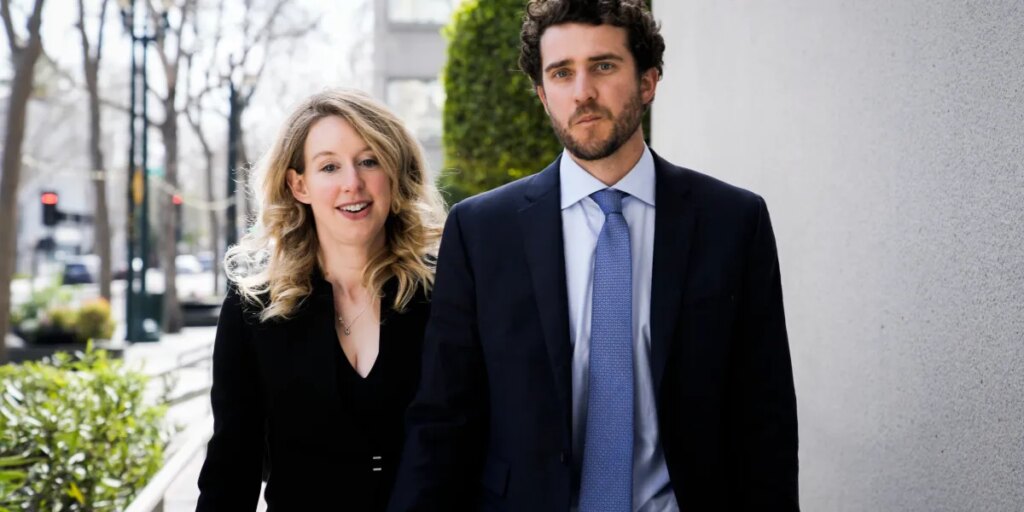
Billy Evans has spent the past week as the breakout character of the year’s most talked-about documentary. Now attention is turning to his day job.
Evans, the longtime partner of convicted Theranos founder Elizabeth Holmes, runs Haemanthus, an Austin-based startup that says it can use lasers to detect disease in blood, saliva, and urine. Interest in the company has surged since A24 released You Can See Everything, Nathan Fielder and Lance Oppenheim’s documentary about the couple, on Oct. 16.
Haemanthus has reportedly raised as much as $20 million and holds at least one granted patent. What it doesn’t have, at least publicly, is a product customers can buy, or published data showing its technology works. It has also lost its chief technology officer.
Set aside the “Theranos 2.0” jokes, and a more basic business question remains: What has Haemanthus actually built?
Who is Billy Evans?
Evans, 34, is a grandson of William and Anne Evans, who founded Evans Hotels in San Diego in 1953. The privately held, family-owned company operates three resorts in Southern California. But in an Oct. 1 statement, Evans Hotels said Billy Evans is neither an employee nor a shareholder.
Evans graduated from MIT in 2015 with a degree in economics. After a stint at LinkedIn, he worked as a special projects manager at Luminar Technologies, a lidar startup building sensors for self-driving cars, from 2017 until January 2019, according to Forbes. His LinkedIn profile has since been scrubbed of every job except Haemanthus. Luminar filed for Chapter 11 bankruptcy in December 2025, nearly seven years after Evans left.
Evans met Holmes at a party in 2017, when Theranos was already engulfed in scandal. They have two children, William, 5, and Invicta, 3. Evans refers to Holmes as his wife, but Holmes told People that the couple never legally married. “Maybe we’ll get married someday, but our bond is more than a piece of paper,” she said.
How Haemanthus says its technology works
Evans has listed himself as Haemanthus’ CEO since October 2022. According to marketing materials reviewed by The New York Times last year, the company’s device uses a laser to scan biological samples “on a molecular level,” identify biomarkers such as glucose and hormones within seconds, and use AI to detect cancer and infections.
The underlying technique, Raman spectroscopy, is not new. Shining light on a sample and reading the signal that scatters back is a long-established way to identify chemicals. Forensic investigators use handheld Raman devices to identify suspected drugs at crime scenes, and labs can analyze substances through plastic bags or glass without opening them.
Blood is a much harder problem. The molecules researchers want to detect are often present in tiny amounts, so their signals are faint. Other components in blood can produce stronger signals that drown them out, according to a scientific review published in Applied Spectroscopy.
That approach is also what separates Haemanthus from Theranos. Holmes’ company claimed it could run conventional lab tests on a miniaturized machine using a few drops of blood. “Theranos attempted to miniaturize existing tests,” Haemanthus wrote on X in May 2025, describing its own approach as fundamentally different.
A Raman spectroscopy patent assigned to Haemanthus and granted in January 2025 names two inventors, one of them former CTO Joseph LaChapelle, according to Forbes. Several of the startup’s early staffers, including LaChapelle, worked with Evans at Luminar, NPR reported. Eric Potma, a UC Irvine chemistry professor who consults for the company, told WIRED that the concept isn’t pulled out of thin air, though he declined to go into detail because of his advisory role.
A patent, however, does not establish that a test can accurately diagnose patients.
Haemanthus plans to start with veterinary testing before pursuing human applications. That market is far less regulated. The FDA does not require premarket approval for devices intended for animals, though it can take action against misbranded or adulterated products.
How much money has Haemanthus raised?
According to investor materials the Times reviewed last year, Haemanthus initially raised $3.5 million from friends and family. In spring 2025, it began approaching wealthy investors in Austin and the San Francisco Bay Area for another $15 million. The materials described an eventual wearable device for humans that would take three years and $70 million to develop. WIRED has since reported that the company has received as much as $20 million.
A person who spoke with Evans this spring told Forbes that Evans said early Palantir employees had invested.
The company has yet to launch a commercial product or disclose independently validated diagnostic results.
A quiet CTO exit
LaChapelle told Forbes he left in March. “I resigned on March 16, 2026, due to a conflict of interest associated with a stealth startup I had founded prior to Haemanthus,” he said, declining to elaborate.
Evans has told it differently. The same person who spoke with Evans this spring told Forbes that Evans said he had let the CTO go. That person also recalled Evans describing the company as “Theranos 2.0,” a label Haemanthus has publicly rejected. Evans did not respond to Forbes’ request for comment.
Is Elizabeth Holmes involved?
Holmes is serving an 11-year sentence for defrauding Theranos investors at a federal prison camp in Bryan, Texas, roughly a two-hour drive from Austin.
In May 2025, NPR reported, citing two sources with direct knowledge, that Holmes had been advising Evans from prison, though the nature of that advice was unclear. Haemanthus denied it on X, saying Holmes had “zero involvement” and “no role, now or future.” WIRED reported that Holmes’ name does not appear in Haemanthus’ incorporation documents.
The documentary muddies that picture. It shows Evans and Holmes on fundraising calls and discussing a medical-testing venture, and Evans tells Fielder, “The idea is to put the band back together and do it all again.” Forbes noted it’s unclear whether those calls were for Haemanthus or another venture. A source close to Evans told New York Magazine that the project in the film was separate from Haemanthus. According to that source, it aimed to make medical testing cheaper without conventional chemical methods and was shelved when a panel of tests still cost several hundred dollars.
Evans has acknowledged the film may backfire. Speaking at the All-In Summit before he had seen the finished cut, he said, “I might think this is like the dumbest thing I’ve ever done.”
A fight over the film’s profits
The documentary reveals that Evans asked for a share of its profits, a request that worried the filmmakers about their independence. Fielder says they reluctantly agreed. A postscript says Evans ultimately decided not to accept payment.
That may not be the end of it. Page Six reported on Friday, citing unnamed sources, that Evans has been seeking Hollywood legal representation over a possible cut. One prominent litigator reportedly declined to take the case, and a source said Evans might donate any proceeds to charity.
The film has put Holmes back in the spotlight. Theranos whistleblower Tyler Shultz and Bad Blood author John Carreyrou have both weighed in, and Fortune has questioned whether her new persona distracts from the real story. It has also drawn far more scrutiny to Evans and Haemanthus. The company has yet to publicly show that its technology can reliably detect disease. It also remains unclear when its veterinary device will reach the market, or how close its larger ambitions are to reality.
The post Billy Evans’ ‘Theranos 2.0’ startup has patents, investors, and a missing CTO—but no product appeared first on Fortune.