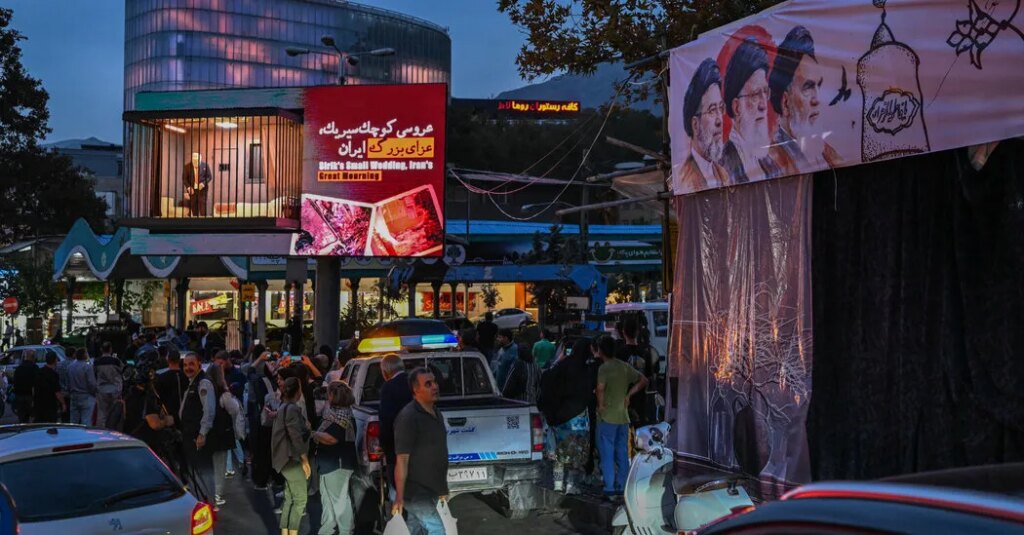
Many Iranians living in the country began the week on Saturday with anxiety and dread, closely following reports that the United States and Israel have drawn up plans for another wave of attacks on Iran in the coming days or weeks.
Parents agonized over whether to send their children to school or keep them close at home. Businessmen canceled work trips to avoid getting stranded if airports closed and roads became too risky. Residents in Tehran flocked to gas stations to fill up their tanks, withdrew cash from banks and stocked up on basic food items.
Some social media influencers warned their followers to keep a low profile in the coming days, and avoid unnecessary travel. Some people said that planning for war had become a new norm and they were feeling numb, as Iran has gone through two intense periods of fighting since June 2025.
“I just told my wife not to wake up our son in the morning, and keep him home, we can decide day by day how to proceed,” said Majid, a 42-year-old businessman in Tehran, in a telephone interview. He said his wife, who works at a ministry that could become a target, planned to call in sick. Majid, like all Iranians interviewed, asked that their last name not be published because of fear of retribution.
President Trump has said he was considering an attack on Iran after the U.S. midterm elections if a diplomatic deal was not reached, insisting that Iran could not have a nuclear program. American officials said last week that the United States and Israel have devised specific plans for renewed strikes.
Mr. Trump has swayed from threatening to annihilate the country to promising to rehabilitate its economy if they reach a deal. U.S. officials have said that the president could still veto the plans, as he has done in the past.
Iranians say his unpredictable nature only adds to their agony.
Shadi, a schoolteacher in Tehran, said she planned to show up for work every day unless the government closes the schools. “But in the back of my mind I keep thinking about how I can protect my students, how to act so they are not scared, if explosions happen during school hours.”
On Feb. 28, the United States struck an elementary school in the city of Minab, killing 156 children and teachers. American officials have ascribed the school strike to a targeting error caused by outdated data.
Behnam, a 38-year-old musician in Tehran, said that he felt numb and less afraid because he has survived two rounds of fighting. “What worries me and those around me most is the lack of money and simply surviving,” he said. “Everyone is trying to find a way to make money and get by.”
Israel’s Prime Minister Benjamin Netanyahu, who faces a tight election on Tuesday, said last week that the United States and Israel must join forces to topple Iran’s regime. The comments have raised concerns in Iran that Israel may carry out military strikes before the vote.
Negotiations have stalled between Tehran and Washington, despite a frenzy of diplomacy last week by Pakistan, Qatar and Russia. In public statements, Iranian officials have said they will not surrender to Mr. Trump’s demands about Iran’s nuclear program.
Iranians have seen their own government, from military commanders to lawmakers, make daily declarations about their intent to forcefully retaliate if attacked and set the region aflame. Hard-line supporters of the government, who are a minority of the population, hold nightly rallies chanting for escalation and revenge. U.S. officials said on Friday they had obtained intelligence that Iran was planning to target American personnel in the region.
Yet some prominent politicians and pundits have openly called for the government to tread carefully and do all it can to avoid a military escalation, fearing more suffering, destruction and instability for Iranians.
Javad Emam from the main reformist party addressed the government on social media last week: “The responsibility for today’s decision lies with you; the cost of war will be borne by the nation.”
At least 1,900 civilians were killed in 40 days of bombardment this year, according to Iran’s Red Crescent Society. The government said damages from the war amounted to about $300 billion. The economy has been in a tailspin: Sanctions and the U.S. naval blockade have contributed to the currency plunging against the dollar, and prices for some basic foods have skyrocketed more than 200 percent.
Alireza, a 54-year-old veteran of the Iran-Iraq war who lives in the city of Kerman, said that while he did not want Iran to surrender and suffer a humiliation, he was angry at the government’s lack of transparency and inability to find a peaceful solution.
“I hope the war ends as soon as possible, because war brings nothing but death and destruction,” he said in an interview from Kerman. “People are under enormous pressure and are being crushed by the economic siege.”
The post Iranians Face Anxious Wait as Threat of Attack Looms appeared first on New York Times.