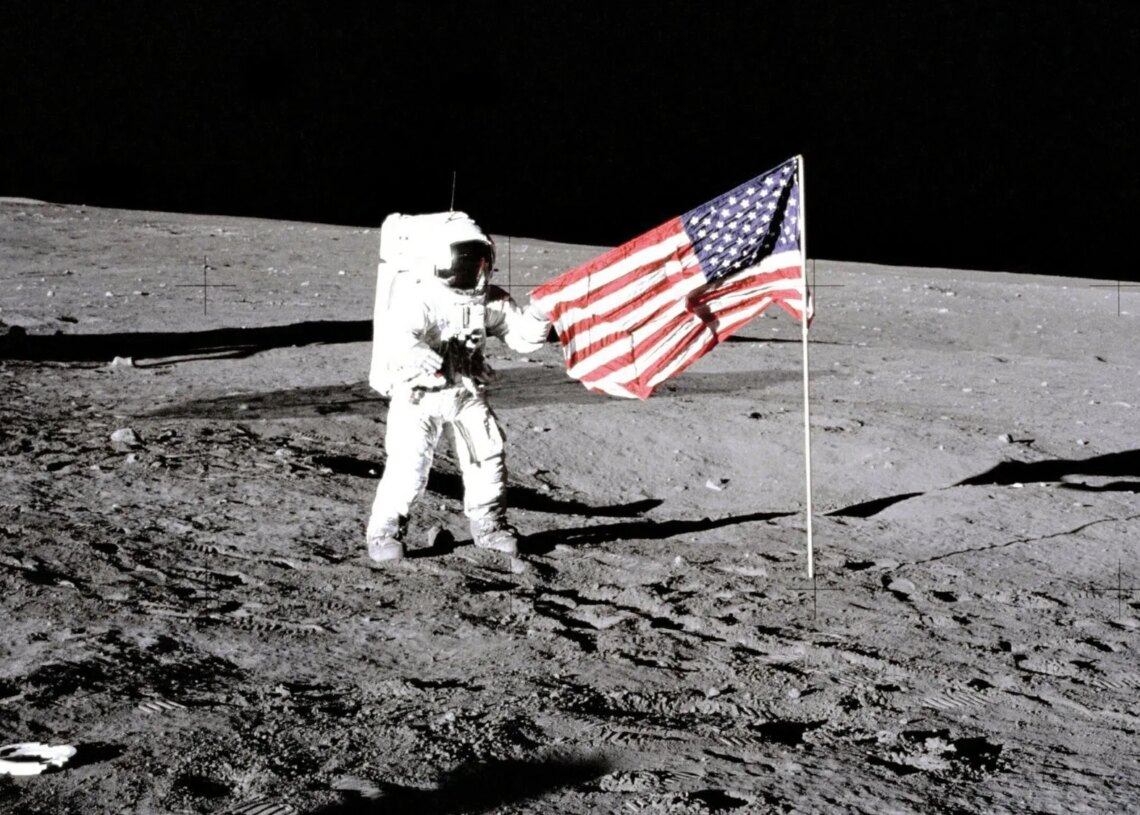
On July 20, 1969, millions of TV viewers tuned in to watch man walk on the Moon for the first time as part of the Apollo 11 mission. “That’s one small step for man, one giant leap for mankind,” Neil Armstrong famously said after the live feed from the lunar surface was patched in to CBS News:
However, not everybody believed that what they saw on-screen that day was authentic. In less than a decade, conspiracy theories about the Moon landing being faked started to gain traction. It probably didn’t help matters that CBS had utilized visual simulations and scale models leading up to the broadcast’s big moment:
Did Stanley Kubrick Leave Clues About Faking the Moon Landing in ‘The Shining’?
At some point, Stanley Kubrick, who’d filmed 2001: A Space Odyssey prior to the Moon landing, became the top choice for skeptics to accuse of perpetrating the alleged hoax. 2001, they claim, is proof that the technology was available to fake such an event in the 1960s. And, of course, the true filming location has been narrowed down to Area 51. People have even suggested that The Shining was Kubrick’s way of confessing, because Danny Torrance can be seen wearing an Apollo 11 sweater and the letters on the “Room No. 237” keychain can be rearranged to spell “Moon room.”
This is all despite an overwhelming amount of evidence to the contrary. To begin with, Kubrick had a well-documented fear of flying and opted to film his movies overseas following the release of 2001. It also would’ve been a technical impossibility for him to pull off a scam of this magnitude back then.
The Apollo 11 cameras shot at 10 frames per second, whereas a typical 35mm film is shot at 12 frames per second and would’ve required six and a half reels to capture the 143 minutes of footage that exists from that day—none of which shows any signs of having been edited together from different reels. As for the idea that the astronauts were shot in slow motion to simulate the Moon’s low gravity, that would entail filming at a higher frame rate. But in those days, magnetic disk recorders were only capable of storing 30 seconds of slow-motion video.
Still not convinced? What if we told you that probes from the U.S., India, and Japan have since taken photos of the Moon that show tracks left behind by the astronauts? And then there’s the fact that 400,000 people were involved with the Apollo 11 mission. Don’t you think one of them would’ve slipped up or written a tell-all by now if there was any truth to this theory? We rest our case.
The post The Wild Conspiracy Theory That Stanley Kubrick Helped Fake the Moon Landing, Explained appeared first on VICE.