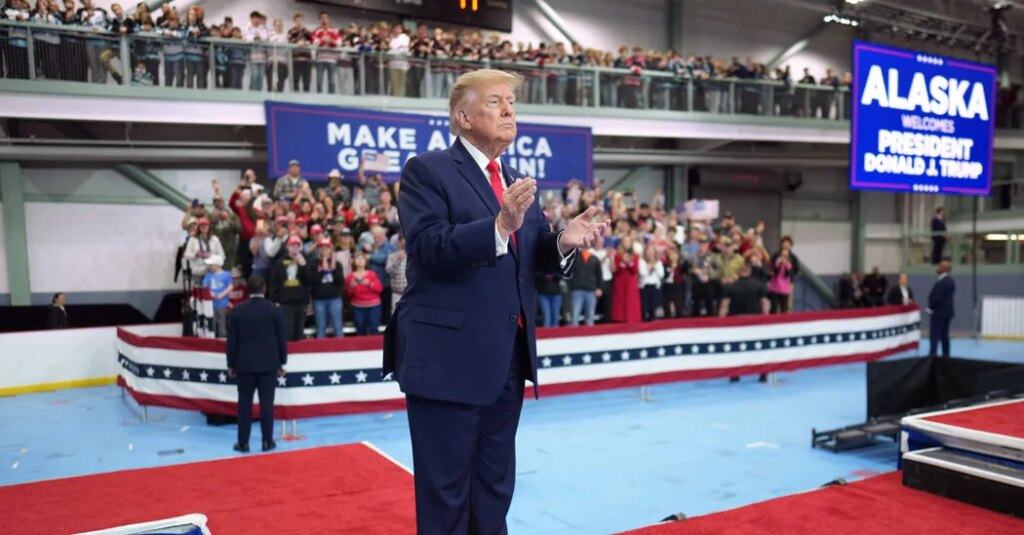
In his second term, President Trump has seldom let a day go by without repeating lies about election results or casting doubt on the country’s voting system.
They are falsehoods that in some cases act as a prelude to actions his administration has taken to intervene in the midterm elections, like preemptively seeking to block election results in Alaska should the Republican incumbent narrowly lose or suing California over its voter rolls.
Mr. Trump has only ramped up his attacks as the midterms near and as control of Congress hangs in the balance. He has amplified conspiracy theories about how votes are cast and how they are counted in various states and baselessly declared past election results fraudulent, paving the way for him to question the integrity of the November election.
Here’s a guide to some recent claims.
What Was Said
False. Alaska voters approved a ranked-choice voting system in a 2020 ballot initiative. There is no “guy sitting behind a table just picking a winner.” Rather, voters rank candidates by order of preference. There is no evidence that the system benefits one party over the other.
Under a ranked-choice voting system, voters select their favorite candidate and can indicate their second and subsequent choices. If one candidate receives a majority of first-choice votes, that candidate wins outright. But if no candidate achieves a majority, the candidate with the fewest votes is eliminated, and the ballots of voters who ranked that candidate first are then reallocated to their next choice. The process repeats until someone receives a majority of votes.
Asked for evidence that ranked-choice voting was a Democratic “scam,” the White House cited Democrats’ winning House elections in Alaska in 2022 and Maine in 2018.
But in the 2022 election, Alaska voters also used the system to elect a Republican senator and a Republican governor. Two years later, voters used the system to select Mr. Trump and a Republican representative.
The 2018 election in Maine was one of four recent elections in which a candidate in second place in the first round of voting ultimately won after candidates with fewer votes were eliminated. While the victor in that race was a Democrat, two other elections were won by Republicans and another by a Democrat, according to a tally by FairVote, a nonpartisan electoral reform group.
Some research and polls show that Mr. Trump would have been a more likely beneficiary of ranked-choice voting in both the 2020 and 2024 elections, as voters who cast ballots for third-party candidates preferred him to the Democratic nominees.
Ranked-choice voting is still relatively uncommon in American elections, and efforts to expand it may have stalled in recent years. But Mr. Trump is wrong that “everyone is repealing it.”
More than a dozen states, largely Republican strongholds, have banned ranked-choice voting since 2022, but voters in jurisdictions where it is already in place have also rejected efforts to repeal it. Currently, two states (Alaska and Maine) and the District of Columbia use ranked-choice voting for federal and state elections and about three dozen cities use it for local elections.
In 2024, Alaska voters voted to retain ranked-choice voting, as did voters in Bloomington, Minn. Voters in four states did reject efforts to switch to ranked-choice voting, and Missouri banned the practice, but three cities adopted it.
What Was Said
False. Mr. Trump’s baseless election claims have long zeroed in on Arizona. At a recent rally, he again repeated a long-debunked falsehood about the 2022 midterm election in the state.
On Election Day in 2022, technical glitches disrupted the vote counting, but not the ballot-marking process. The glitches affected tabulation machines, which optically scan and count ballots in lieu of hand-counting, in 71 of 223 voting centers in Maricopa County, Ariz.
Two county officials, both Republicans, said on social media that voters could still drop their ballots in a secure box and officials would take their ballots to a central tabulation center later that night. The officials emphasized in a news conference that day that “everyone is still getting to vote,” that “none of this indicates any fraud” and that the secure box option was a “fail safe that functions the exact same way as early voting.”
Officials reported later that day that they had identified the cause of the glitch: Some printers were not producing dark-enough markings on ballots. According to the county’s post-election analysis, the issue had been resolved at most sites by midafternoon and, overall, about 16,700 ballots were affected.
A judge did deny a Republican Party request to keep the polls open for three additional hours, noting that there was no evidence that anyone had been unable to vote.
Kari Lake, the Republican candidate for governor, filed a lawsuit against the county disputing her loss, arguing in part that the glitches were caused intentionally and resulted in a change in outcome. But a state judge ruled that Ms. Lake produced no evidence supporting that assertion. An appeals court upheld that ruling, and the state’s supreme court denied her appeal request.
What Was Said
False. It is rare but not unprecedented for the party in control of the White House to retain or expand control of one chamber of Congress in the midterm elections. In Mr. Trump’s first term and two other instances, the party lost the presidency in the next general election. In three other instances, the party retained it.
The Republican Party lost 40 seats in the House of Representatives in the 2018 midterms, but gained two in the Senate (whether that is a “tremendous” gain is a matter of opinion). Mr. Trump then lost his re-election bid in 2020.
In the 1998 midterm election, Democrats gained five House seats and retained control of the Senate, with no net change in the balance of the upper chamber. Vice President Al Gore then lost the 2000 presidential election.
In the 2022 midterm election, Democrats lost nine House seats and gained one seat in the Senate. Vice President Kamala Harris then lost the 2024 presidential election. By Mr. Trump’s logic, Ms. Harris’s loss, too, should have been “impossible.”
The Democrats lost seats in the House and gained seats in the Senate in the 1914 and 1962 midterm elections, and retained control of the White House in the 1916 and 1964 general elections. Republicans lost seats in the House and gained two seats in the Senate in the 1970 general election, and President Richard Nixon won his re-election campaign in 1972.
What Was Said
False. For months, Mr. Trump has long cited slow counting in the Los Angeles mayoral primary in June — and California in general — as evidence of election fraud, while embellishing details. But a candidate lagging in the initial count and then pulling ahead as more votes are tallied occurs quite often in races, including in elections in which Mr. Trump was a candidate. There is no evidence that the primary was “rigged.”
In recent elections, California has been one of the slowest states to count results. That is in part because it is the most populous but largely because of its counting process.
California relies heavily on mail-in ballots, which delays vote counting as officials verify signatures and give voters the chance to correct discrepancies. Ballots can also be counted if they are postmarked by Election Day and received within seven days, and officials have 30 days to count votes.
In the June mayoral primary in Los Angeles, the first batch of votes counted after polls closed showed Mayor Karen Bass leading with more than 117,000 votes, the reality TV star Spencer Pratt in second with about 86,000 votes and a member of the Los Angeles City Council, Nithya Raman, in third with nearly 62,000 votes. Mr. Pratt maintained his lead over Ms. Raman as more votes were counted on election night.
Ms. Raman spoke at about 11 p.m., when her vote count stood at over 81,000 compared with nearly 142,000 ballots for Ms. Bass and nearly 114,000 for Mr. Pratt. Toward the end of her speech, she began tearing up as she thanked her parents, in-laws, husband and children for their support and patience. She did not concede defeat and instead noted that “tonight may not give us a final answer on this race” and that “many thousands of votes will be counted in the days ahead.”
Mr. Pratt remained in second place for a few days as more votes were counted, but his lead began to narrow and Ms. Raman pulled ahead five days later. In the end, Ms. Bass and Ms. Raman advanced to the general election with 34 percent and 29 percent of the vote. Mr. Pratt, a Republican, received about 25 percent of the vote, which was comparable to Mr. Trump’s own vote share in the city in the 2024 election.
This development was not a surprise to local political observers, who noted that Ms. Raman’s younger progressive supporters tended to vote later than older conservatives who cast their ballots early or in person. Others have noted that Mr. Pratt’s third-place finish and vote share were nonetheless impressive for a first-time candidate in a very liberal city.
The post Trump Relies on Falsehoods to Cast Doubt on Elections appeared first on New York Times.