Hoping for a win before the midterm elections, the Trump administration is increasing pressure on Mexico to expand its cooperation against cartels, with an eye toward joint operations with the United States, according to Mexican and U.S. officials.
In recent weeks, U.S. officials have delivered a memo proposing a path to potentially having U.S. security personnel accompany counter-cartel operations inside Mexico, according to officials briefed on the letter. The memo included a number of other areas where Washington wants to become more involved in Mexico’s security, including broader intelligence sharing, according to U.S. and Mexican officials.
The Trump administration has been pushing Mexican officials to help deliver a concrete accomplishment on security that it can point to in time for the midterm elections, according to U.S. and Mexican officials. High gas prices and stubborn inflation have haunted Republicans, and Trump officials appear to be looking to Mexico for a public victory.
The memo is one of the firmest moves yet to get Mexico to accept a U.S. military presence in the country, putting new strain on the cross-border relationship. President Trump has repeatedly stated he wants to take U.S. military action against drug cartels in Mexico, which President Claudia Sheinbaum has steadfastly opposed. U.S. pressure temporarily subsided after Mexican officials killed a top drug lord in February, acting in part on U.S. intelligence, several people familiar with the events said.
“As President Trump has said, and as the U.S. government has repeatedly and clearly communicated, it is unacceptable that foreign terrorist organizations control vast territories across Mexico, including the entire region that directly borders the United States,” Lauren Bis, a White House spokeswoman, said in a statement to The New York Times. “These cartels wage an unrelenting campaign of violence against the United States and its people.”
The Mexican government declined to comment.
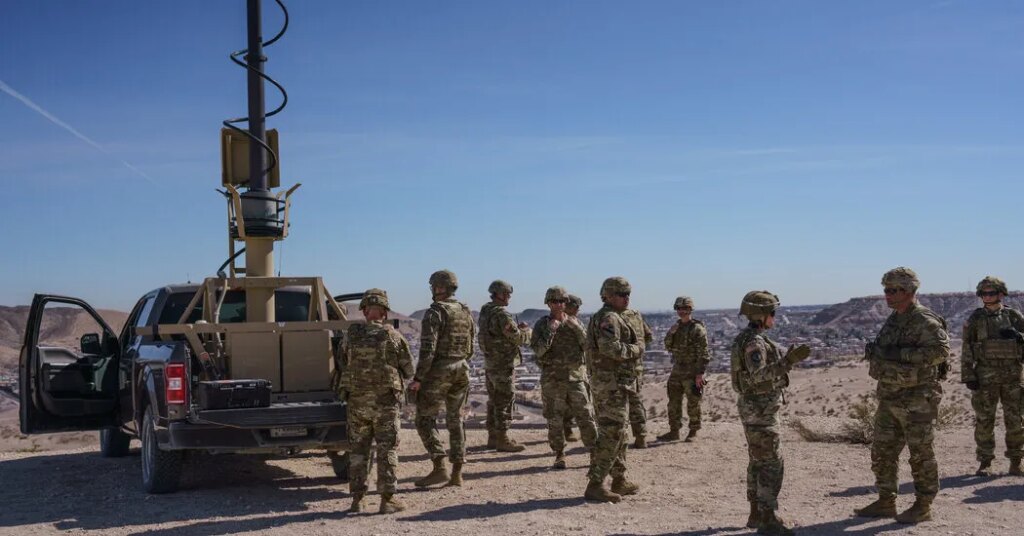
The Trump administration has successfully negotiated joint operations with other countries as part of a broader U.S. strategy in Latin America. Last month, U.S. soldiers participated in an operation on the ground in Ecuador. The United States has also built a military coalition of 19 regional partners that has vowed to help dismantle cartels.
Mexico, however, has repeatedly rejected requests from the United States to carry out joint operations or to allow U.S. drone strikes on Mexican soil, saying it would be a breach of its sovereignty. On the administration’s latest proposal, officials declined to say how or if the Mexican government had responded, but said that Mexico remained adamantly against U.S. forces inside the country’s borders.
The continued push for U.S. forces in Mexico, despite Ms. Sheinbaum’s repeated denials, highlights increasing tensions between the two countries despite their deep collaboration on security and trade. The people familiar with the push, including several U.S. and Mexican officials, spoke on the condition of anonymity to discuss private negotiations.
Mr. Trump suggested at a White House event last week that the United States was pushing toward a security presence inside Mexico. “We haven’t done the land full blast yet,” he said. “But it’s starting,” he added. “It started a few months ago. We’re hitting them very hard.”
On Monday, Ms. Sheinbaum pushed back. She said at her daily news conference that her relationship with Mr. Trump remains constructive but that she regularly tells him that Mexico is not controlled by cartels, as he has said.
“These are opinions they hold, and in a friendly way — without ever confronting them — we clarify that it’s not like that,” she said. “Remember that they’re on the campaign trail and often want to use Mexico as part of their campaign.”
The Trump administration’s demands for more action against cartels in particular have irked Ms. Sheinbaum, who has worked to expand security cooperation while naming direct U.S. intervention as her one clear red line. In response, she has sharpened her rhetoric against the Trump administration, putting stress on the relationship.
After Mr. Trump told the United Nations General Assembly last month that Mexico was “the epicenter of cartel violence,” Ms. Sheinbaum struck back.
“I could say, ‘It’s very difficult to live next to a country with such high levels of illicit drug consumption.’ Or I could say, ‘It’s very difficult to live next to a country that produces so many weapons,’” she told reporters the next day. “But I’m not going to say that.”
The Trump administration has also put Ms. Sheinbaum into a political bind by going after Mexican politicians accused of having ties to criminal groups.
In April, the United States indicted the governor of the state of Sinaloa and several other Mexican officials on charges that they had protected a cartel in exchange for political support. The United States has also canceled the visas of other politicians, including the son of Andrés Manuel López Obrador, the previous Mexican president.
Many of the officials in the U.S. cross hairs are from Ms. Sheinbaum’s political party, and she has refused the U.S. officials’ request to arrest Mexican politicians, saying they haven’t provided enough evidence.
Since last year, the Trump administration has been making demands of Ms. Sheinbaum, including by delivering a list of top security targets in Mexico whom U.S. leaders want apprehended, U.S. and Mexican officials said. Stephen Miller, the top White House official who has driven a hard-line policy toward Mexico for years, was instrumental in pushing for more aggressive action against cartel leaders, officials said.
The Mexican government, seeking to hold off a U.S. incursion, had made progress on the list by the spring, capturing or killing many targets, multiple people said. Chief among them was the leader of the powerful Jalisco New Generation Cartel, Rubén Oseguera Cervantes, known as El Mencho, said multiple people. Mr. Osegeura had long been elusive and heavily guarded, including by about 300 gunmen composed of ex-special forces from Colombia, Guatemala and Mexico, according to people familiar with his movements.
There was a reprieve in pressure over the summer, but Mr. Miller and others have since continued to push stronger U.S. involvement in Mexico, according to a person familiar with the effort.
On the other side of that push is a throng of U.S. military and law enforcement officials who argue that Mexican security forces are cooperating at higher levels than ever seen before, officials said.
Mr. Trump has been publicly expressing interest in striking cartels inside Mexico. U.S. military officials have warned that if Washington pursues unilateral action, it could make things much worse. Mexico could break its cooperation with the United States, the officials said, and the cartels could start a war in response. The officials cautioned that such chaos could also set off a migration crisis at a time when border crossings have dropped to historic lows.
The Trump administration is effectively reopening the war on drugs in Latin America as part of its broader effort to exert stronger influence over the region on security, immigration and the economy. That has included its military operation to capture Nicolás Maduro, Venezuela’s authoritarian leader; a buildup of personnel at U.S. bases and training centers in the region; and its campaign to bomb boats it says were trafficking drugs, killing at least 239 people in the waters around the region.
The Trump administration has not provided evidence showing the boats were carrying drugs, and a broad range of lawyers have called the strikes illegal.
Many Latin American governments have embraced the Trump administration’s renewed interest in the region, in large part because they are run by pro-Trump leaders. Over the past 18 months, right-wing candidates have swept seven presidential elections in Latin America. Brazil, the region’s largest nation, could make that streak eight in its election on Sunday. If elected, Flávio Bolsonaro, the right-wing candidate and son of the former president Jair Bolsonaro, has promised to turn Brazil toward Washington.
That would leave Mexico, and Ms. Sheinbaum, isolated as the last big democracy in Latin America still run by a leftist.
Steve Fisher, Jack Nicas and Maria Abi-Habib reported from Mexico City, and Eric Schmitt, Julian E. Barnes and Zolan Kanno-Youngs from Washington.
The post U.S. Pressures Mexico to Deliver a Security Win Ahead of Midterm Elections appeared first on New York Times.