Extreme drought, destructive flooding, deadly wildfires.
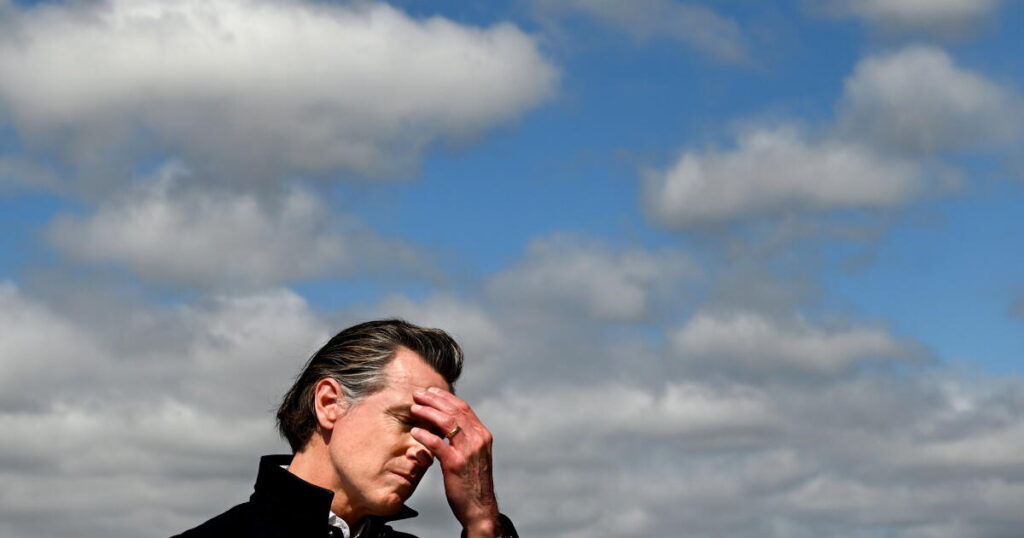
As California’s 40th governor, Gavin Newsom has confronted the impacts and causes of climate change in ways that few other state executives have, including his calls to “move beyond fossil fuels,” and the setting of aggressive renewable energy goals.
Yet after Newsom’s almost eight years in office, millions of Californians have been forced to contend with power blackouts, refinery closures and surging gasoline prices. At the same time, the Trump administration has sought to dismantle the state’s boldest climate initiatives, calling Newsom’s policies a disaster.
Now, as Newsom prepares to leave office in January and eyes a potential run at the White House, critics and supporters alike are reexamining his climate record, and its evolution from idealistic ambition to a politics more aligned with consumer affordability. Experts say Newsom’s environmental legacy won’t just define what’s next for California’s new governor; it could potentially shape the national agenda.
The ZEV governor
When Newsom took office in January 2019, he inherited major environmental programs from his predecessors, Jerry Brown and Arnold Schwarzenegger. Those initiatives included bold greenhouse gas reduction targets and the nation-leading cap-and-invest program, which forces large polluters to pay for their share of planet-warming emissions.
But many experts said where Newsom made his mark is in green transportation.
Under his administration, California invested heavily in electric vehicle charging infrastructure, sales incentive programs and advanced fleet requirements. In 2022, state officials passed a groundbreaking sales target for zero-emission vehicles, or ZEVs, essentially banning the sale of new gasoline-powered cars by 2035.
It is “probably the most consequential thing he did for the climate as governor,” said Barry Vesser, chief program officer at the Climate Center, a nonprofit think tank based in California.
The move stimulated the private sector and accelerated the deployment of EV infrastructure, Vesser said. The share of ZEV sales jumped from about 8% in 2020 to 23% in 2025, and California now has twice as many EV chargers as gasoline nozzles.
“It’s not where we need to be, but you still have to give the state a lot of credit for the amount of EV infrastructure we have available compared to where we were when he came into office, which was virtually nil,” Vesser said.
In a different federal landscape, this may have been the defining act of Newsom’s administration. But President Trump — against whom Newsom has positioned himself as an adversary — acted quickly to revoke California’s long-held authority to set stricter tailpipe emissions standards than the federal government, unraveling the foundation for the gas-car ban. The state is now suing the federal government over the move.
The ban “was a serious and important action,” said Mary Nichols, former chair of the California Air Resources Board. But it “got tangled up in another hostile agenda that the administration had, which rendered it less meaningful than it would have been otherwise.”
The Trump tango
It’s one of many ways Newsom’s track record will at least in part be tied to Trump, whose first and second terms bookended the governor’s.
In addition to his action on cars, the president also moved to open California’s coast to offshore oil drilling for the first time in decades and invested millions in a coal export terminal in Oakland that would be the first on the U.S. West Coast, despite the fact that California has eliminated its use of coal.
Earlier this year, the White House struck a series of deals with offshore wind developers to abandon projects off the coast and invest instead in fossil fuel infrastructure. The deals effectively killed three of the state’s five offshore wind projects, which would have produced about six gigawatts of clean electricity — a substantial piece of the 25-gigawatt goal established under the Newsom administration in 2022.
“The foundation of all [federal climate] policies is under attack, and that matters a lot,” said Kate Gordon, chief executive of the nonprofit California Forward and a former senior climate policy advisor to Newsom. “All of the states — and all of the ‘climate leader’ governors in this era — are to some extent defined by that.”
At the same time, Newsom has increasingly positioned himself as a national and international leader on the environment. While Trump withdrew the U.S. from the Paris climate agreement and skipped last year’s United Nations climate policy conference, Newsom attended the summit and touted California as a proxy for the country. He has also signed dozens of subnational agreements with other countries on issues such as emissions reductions, green ports, groundwater and clean energy development.
In fact, while Trump has taken steps to slow the clean energy transition, California has continued to progress: The state now has more than 23,000 megawatts of battery energy storage — up from about 700 megawatts when Newsom took office — and its grid runs on about 67% clean energy. The state hasn’t seen rolling blackouts since 2020.
“The dramatic growth in battery storage has happened under Newsom’s watch, and he should absolutely get credit for it,” said Ann Carlson, founding director of the Emmett Institute on Climate Change and the Environment at UCLA.
The oil and gas backslide
Though Newsom furthered California’s role as a leader on renewables, some said he also struggled when it comes to fossil fuels.
During his first term, the governor was ambitious about weaning off them. He announced plans to phase out oil extraction statewide by 2045, established a 3,200-foot buffer zone between oil wells and communities, and pledged to shut down Aliso Canyon, the site of the worst natural-gas blowout in U.S. history. In 2022, California sued five major oil companies over their “decades-long campaign of deception” about their role in climate change.
But as the years wore on, his ambition began to collide with the more practical challenges of decarbonization. California saw two major refinery closures, which tightened in-state gasoline supplies, and increased dependence on imported fuel.
Amid mounting consumer anxiety over rising fuel costs, Newsom in 2025 signed a law to boost oil production in Kern County, fast-tracking permitting for up to 2,000 new wells annually through 2036. Environmentalists were stunned.
“It’s not that he just stood still — it’s that he actually went the opposite direction,” said Leah Stokes, a political scientist at UC Santa Barbara.
Stokes said it’s part of a larger pattern for Newsom, such as when he announced a historic $54-billion investment in climate projects and programs in 2022, only to have it whittled down amid budget problems in the years that followed. “He kind of loves the announcement and lacks the follow-through,” she said.
Other environmentalists were equally disappointed by this year’s creation of a $4-billion incentive program for large polluters that invest in decarbonization projects — part of the broader cap-and-invest extension — as well as last year’s overhaul of the California Environmental Quality Act to expedite new construction.
These kinds of broad climate and economic moves don’t always translate into benefits or protections for communities most affected by air pollution, drinking water issues and environmental health burdens, said Nile Malloy, climate justice director at the California Environmental Justice Alliance. He chalked some of it up to Newsom’s presidential ambitions, which he said have pushed the governor to be more moderate.
“We’re thinking about a managed transition and really putting a lot of energy toward that, while the governor is just trying to get through until his term is over,” Malloy said. “Those are two different priorities.”
Top administration officials said these moves were less “pivots” than acts of adaptation — efforts to balance the state’s climate goals with growing concerns about affordability and reliability. Newsom is at least partly responding to global market disruptions, higher prices at the pump, and the fact that most people are still dependent on cars that run on gasoline.
Trial by fire
Newsom’s time in office will also be marked by the climate change-fueled disasters that have befallen California in recent years. The state dried up and then flooded, heated and caught fire, with a record 4.4 million acres burned in 2020. The wildfires also took lives and communities, such as the Eaton and Palisades fires in Altadena and Pacific Palisades, respectively, in 2025.
The result was a cascade of challenges, including the state’s largest utility, Pacific Gas & Electric, declaring bankruptcy over its role in the deadly Camp fire in Paradise in 2018, and a worsening home insurance crisis that is still taking shape.
Some said the wildfire problem only made Newsom cozier with utilities, whose profits have continued to soar. He negotiated a deal to help PG&E emerge from bankruptcy while preserving its position as a privately owned entity, and just this year, tried to pass legislation to shield utilities from liability over wildfires sparked by their equipment. (The package ultimately fell apart amid outrage from insurance companies and wildfire survivors.)
But others said the problem spurred the governor, and the state, to reconsider its approach to fire, including new emphasis on prescribed burns and forest management, beefed-up budgets for the California Department of Forestry and Fire Protection, and the establishment of the state’s wildfire task force.
These are complemented by other policies that evolved around the state’s landscape, experts and officials said. That includes the 30×30 program to conserve 30% of California’s land and coastal waters by 2030, advanced protections for wetlands and new efforts to rein in the use of harmful pesticides and single-use plastic.
California has also made progress on safe drinking water under Newsom, reducing the number of people served by failing systems from about 1.6 million in 2019 to 425,000 today, though there is still work to do. And in 2024, Indigenous leaders and activists celebrated as the state completed the largest dam removal effort in U.S. history along the Klamath River.
The abundance era
As affordability has risen to the forefront of American discourse, the politics of environmentalism have shifted, and Newsom has shifted with them.
In their 2025 book, “Abundance,” journalists Ezra Klein and Derek Thompson argue that red tape and overly complicated rules are obstructing climate progress and the clean energy transition, and they make the case for a “build more” approach that has been embraced by Newsom and many other Democrats.
“We’ve got to just move things,” Newsom said at a recent economic summit in Los Angeles. “It is an ‘abundance’ mindset. It’s a liberalism that builds.”
This shift has been most visible in his recent decisions around oil refineries and drilling, CEQA reform and housing affordability, experts said.
“If you start thinking of yourself as a national candidate for president, you start thinking about, ‘Where am I vulnerable being the governor of California?’” Carlson said. “Am I going to be painted as an ‘environmental crazy’? Am I going to be painted as somebody who’s responsible for the high cost of living? And I think the answer is those are places that he views himself as vulnerable, and so we see those pretty pronounced shifts.”
But Newsom will also be leaving Sacramento halfway through Trump’s second term, when many battles — and projects — remain unfinished. That’s allowed him to punt some vexing issues to the next governor, such as whether to extend the life of the state’s last remaining nuclear power plant, Diablo Canyon, to 2045.
Also unfinished are the high-speed rail and the Delta tunnel, major environmental infrastructure projects that have been seized upon by right-wing media as evidence of Newsom’s failures.
“What the next governor is going to have to really do is lean in on real, successful implementation that creates tangible benefits for people, because I do think we’re in danger of losing our political will on these issues in California,” said Gordon of Climate Forward. “Newsom did some really important things around the edges of that, but that’s going to have to be a central thesis for the next administration.”
Like Newsom, the next governor will also face unforeseen challenges — such as how to handle the growth of artificial-intelligence data centers on an aging electric grid, or how the Golden State will fare through more wildfires, coastal erosion, heat waves and storms as the global climate becomes ever more unstable.
“I just wish the next person a lot of strength and fortitude, because there’s a lot to do,” Gordon said. “There’s a lot on the table.”
The post From EVs to oil wells: How Trump and soaring fuel prices have shaped Newsom’s climate legacy appeared first on Los Angeles Times.