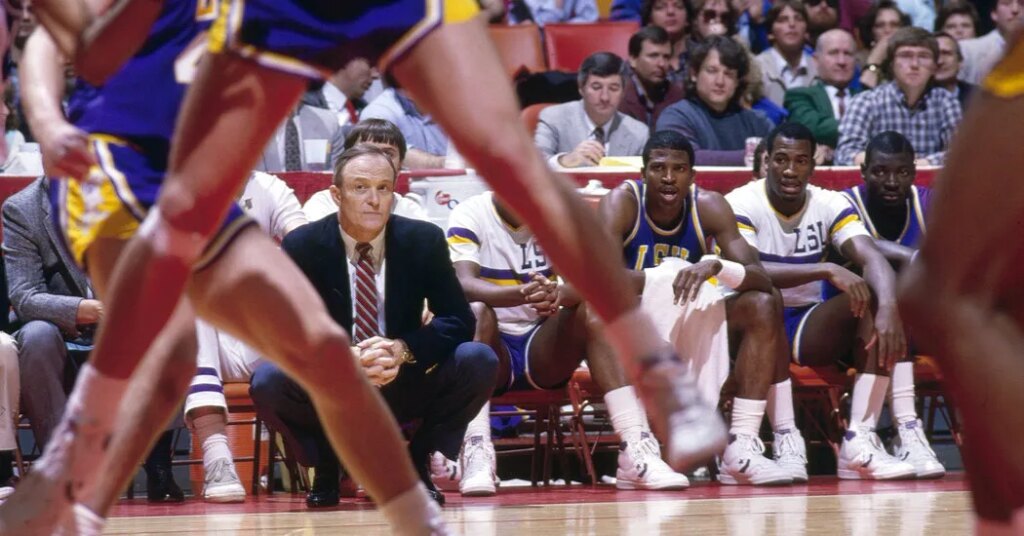
Dale Brown, the unfiltered and defiant former basketball coach at Louisiana State University who took his team to the Final Four twice, discovered the teenage Shaquille O’Neal by chance on a military base, engaged in a famous coaching feud and was a blistering advocate for reform in college sports, died on Friday. He was 90..
His death was announced by his family. No other details were provided.
When Mr. Brown was hired at L.S.U. ahead of the 1972-73 season, interest in basketball there sagged like the droopy socks worn by Pete Maravich, the men’s career leading scorer in Division I, who had left the school two years earlier for the N.B.A. The Tigers had not reached the Final Four, or even the N.C.A.A. tournament, in roughly two decades. Football had resumed its place as the dominant sport on campus.
After being hired, Mr. Brown drove around Louisiana, proselytizing about basketball and handing out purple and gold nets in the school colors. He fully integrated a team that had fielded only one Black varsity player before his arrival and became a lifelong member of the N.A.A.C.P., enduring hate mail and death threats.
“Dale Brown was a fireball, a renegade, a change agent,” Collis Temple Jr., who in 1971 became L.S.U.’s first Black varsity basketball player and joined the university’s board of directors in 2020, said in an interview.
In 25 seasons at L.S.U., Mr. Brown won more Southeastern Conference games (238) than any coach but Adolph Rupp of Kentucky (397), and his teams reached the N.C.A.A. tournament 13 times, including the Final Four in 1981 and 1986.
He may have also gone undefeated when it came to loquaciousness.
A sportswriter once likened his frenetic and random speaking style to “AM radio on search.” One minute he might talk about basketball, the next about his plans to search for Noah’s ark atop Mount Ararat in Turkey and the next about the extravagant shoe collection of Imelda Marcos, the former first lady of the Philippines.
Mr. Brown’s garrulous nature sometime veered into incendiary rhetoric, most notably in 1985 when he called the N.C.A.A. “Gestapo bastards” in a Sports Illustrated story. L.S.U. officials criticized his remarks, but Mr. Brown offered no contrition, telling reporters, “I am not looking to wear a white hat,” but “to do what in my heart and soul I think is correct.”
In what now seems quaint protest in an era where some college athletes make millions of dollars, Mr. Brown railed at the N.C.A.A. for its then unyielding — but widely and surreptitiously violated — rules of strict amateurism. (L.S.U. was sanctioned by the organization after a player reportedly received $5,000 from a booster in the mid-1990s.)
Mr. Brown believed, for instance, that athletes should receive a stipend of $200 a month for necessities and should be able to accept a pizza or paid travel to a funeral without breaking the rules. He frequently accused the organization of legislating “against human dignity.”
He wrote thousands of letters to university presidents, athletic directors and coaches, seeking rule changes. By his count, he recommended 43 changes, 32 of which were implemented before athletes gained the right to profit from their name, image and likeness starting in 2021.
“He was absolutely the nation’s leading advocate for N.C.A.A. reform,” Trent Angers, who wrote Mr. Brown’s biography, “Dale Brown Court … and the Battle for Human Dignity” (2023), said in an interview. “The N.C.A.A. feared him, loathed him. He was a troublemaker, but he was proud to say it was good trouble.”
Dale Duward Brown was born on Oct. 31, 1935, in Minot, N.D. His father, Charles Brown, struggling as a tenant farmer during the Depression, abandoned his wife and two daughters two days before Dale was born.
His mother, Agnes (Hennessy) Brown, moved into a one-room apartment above a bar in Minot and raised Dale and his two sisters — without complaint, he said — while supporting herself through domestic work, baby-sitting and welfare from the local county. Dale placed cardboard in his shoes to keep out the winter cold.
At age 10, he said in a 2021 interview with the Louisiana Public Broadcasting network, he witnessed a county official threatening to take away his mother’s monthly welfare payment.
“Never again, as long as I live,” he recalled saying to himself. “If I see an injustice, I’m going to stand up” to it.
That was evident in his battles with the N.C.A.A. and in one of college basketball’s most heated feuds of the 1980s between the pugnacious Mr. Brown and the cantankerous Coach Bobby Knight of Indiana.
After Indiana defeated L.S.U. 77-76 to reach the 1987 Final Four, during which Mr. Knight pounded the scorer’s table and broke a phone without receiving a technical foul, Mr. Brown called him a bully who intimidated referees and coaches. Mr. Knight questioned Mr. Brown’s coaching ability, and Mr. Brown challenged him to a naked wrestling match.
In 1959, Mr. Brown married Vonnie Ness, a teacher of folk dancing. In addition top his wife, he is survived by a daughter, Robyn Brown Prudhomme; and three grandsons.
He earned 12 varsity letters in basketball, football and track at what is now Minot State University, receiving a bachelor’s degree in physical education in 1957. He received a master’s degree in 1964 from the University of Oregon. His first job as a head coach came at L.S.U.
In 1985, while giving a basketball clinic at a military base in West Germany, Mr. Brown was approached by a towering but self-doubting fellow who asked for a few tips.
“How long have you been in the Army, soldier?” Mr. Brown asked.
“I’m not in the Army,” Shaquille O’Neal answered. “I’m 13.”
Mr. Brown grabbed him like “he had a secret” or “had found gold,” Mr. O’Neal variously said in the often-told story. They found his stepfather, a sergeant, in the base sauna and had a conversation. Mr. Brown began writing weekly to Shaquille, telling him to work hard and never give up. He signed with L.S.U. in 1989 on his way to a Hall of Fame career.
“I think I owed it to Coach Brown,” Mr. O’Neal said at a 2013 news conference, “because he believed in me when I didn’t even believe in myself.”
Mr. Brown kept in touch with many of the 160 players whom he coached and started a foundation to encourage those who had not received their degrees to complete their studies. Aside from his players, though, Mr. Brown remained a polarizing figure with L.S.U. officials and some fans.
It took nearly 25 seasons after Mr. Brown’s retirement before the school’s board of supervisors approved naming L.S.U.’s basketball court in his honor in 2021. Mr. Temple, the board member and former L.S.U. star, said that opposition stemmed, in part, from Mr. Brown never having won a national championship and, in a conservative state, to the belief by some that he relied too heavily on Black players.
“I don’t think I’ve ever dealt with a greater humanitarian,” Mr. Temple said. “He was all about helping the downtrodden. That’s how he grew up.”
The post Dale Brown Has Died. As L.S.U. Coach, He Discovered Shaquille O’Neal. appeared first on New York Times.