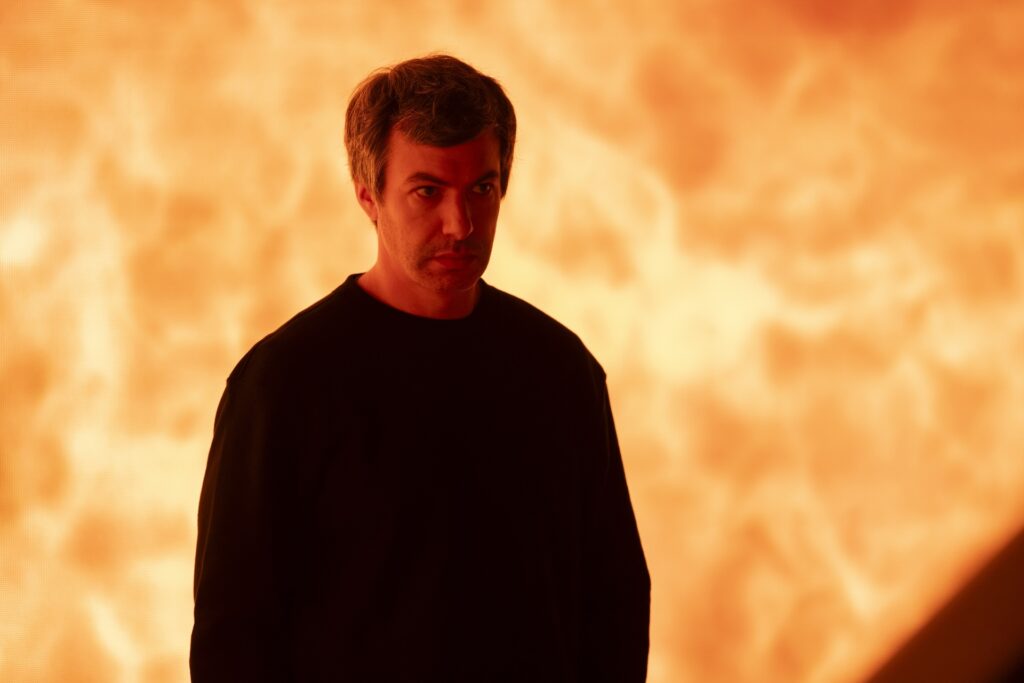
To some people, an unknown director named Nathan Fielder just came out of nowhere to light up our group chats and dominate our dinner table conversations.
His documentary about Theranos founder Elizabeth Holmes, “You Can See Everything,” delivers the kinds of shocking twists that beg to be discussed, and those who wanted to join the discourse fueled the film’s impressive opening-weekend box office numbers.
Another segment of the population will tell you that Fielder started creating mind-altering entertainment nearly two decades before he teamed up with co-director Lance Oppenheim to follow a disgraced fraudster before she headed to prison. For them, his new movie will feel somewhat familiar, incorporating his curious methods of inquiry and long-standing preoccupations: how people explain themselves, what their words conceal and whether we can really know another person.
For viewers just now discovering Fielder, his earlier work offers all the funny, unsettling and often morally questionable experiments that are finally making him a household name.
Here are the essential stops.
‘Even the Best’ (2007)
Fielder was an early content creator on YouTube, creating short, surrealist comedy skits about normal, everyday interactions. In this 2007 short-form video with Katie Crown, Fielder explores an awkward romantic encounter as a man and woman engage in stilted small talk and tragic attempts at flirtation. Just when you think you can’t handle the squirm-inducing horror, Fielder begins lip-synching to the cheesy background music: Howie Day’s “Collide.”
Finally, both characters stare into the camera, acknowledging its presence in the room, seemingly mocking the audience for even bothering to watch. The theme at play — the question of what happens during an intimate encounter when the participants know someone is watching — will echo through his later work.
‘Nathan on Your Side’ CBC interview (2008)
Fielder’s appearances on the Canadian news parody “This Hour Has 22 Minutes” demonstrate his earliest experiments manipulating and dismantling journalistic formats. His interview with CBC’s then-CEO Hubert Lacroix is a preview of how he would later interrogate other people, including eventually Holmes.
Here, Lacroix makes the mistake of complimenting Fielder’s work, which leads to the follow-up question of which interview was his favorite. Lacroix struggles, and Fielder refuses to help him save face.
Clips from the show are tough to find, but this YouTube playlist contains most of Fielder’s appearances.
Essential ‘Nathan For You’ episodes (2013-2017)
Watching all four seasons of this comedic documentary series is an easy recommendation. Fielder plays a business consultant who visits small businesses and pitches absurd ways to attract customers and boost revenue. Then he spends the production’s money trying to make these ideas work, with real owners, employees and customers responding to his increasingly absurd schemes. He once proposed that a store should sell alcohol to kids, with the caveat that the purchase was a claim ticket good for a drink once they hit 21. His reputation as a prankster who steals media attention started here.
The following four episodes, one from each season, trace his growth, as the show transitioned from a parody of marketing ingenuity to an examination of loneliness, performance and existential dread.
Season 1, Episode 2: ‘Santa/Petting Zoo’
Fielder’s first great publicity stunt, to boost the profile of a petting zoo, is to film a video in which a pig rescues a baby goat from drowning, goes viral, leaping on the public’s endless appetite for uplifting animal news. Guiding the pig in the fake rescue are submerged divers whom Fielder would later threaten to maintain secrecy. This episode demonstrates the great lengths to which he would go to make a story feel real. Fielder — or the character he portrays — will show this obsession can overwhelm reason.
Season 2, Episode 5: ‘Dumb Starbucks’
Conceptually, this is among Fielder’s least interesting tricks. He invokes parody law to create Dumb Starbucks, an idea originally meant to help a struggling local coffee shop before he takes back the plan as his own project. The simplicity of the concept and its execution make this the smoothest on-ramp to understanding his appeal. To meet legal standards as a parody artist, he spent weeks performing parody songs at open-mic nights and creating art exhibits. The episode is a showcase of his ability to research an issue and employ anyone willing to be on TV just to bring an idea to life. And often along the way, his obsession makes him lose sight of the original purpose.
Season 3, Episode 5: ‘Smokers Allowed’
This episode is the hinge between Fielder’s early and later work. Citing a theatrical exemption to indoor smoking bans, he proposes that a dive bar allow smoking by marketing that night as performance. Unexpectedly, the initial audience is receptive, viewing it as a slice-of-life show. Like a mercenary captain, Fielder hires actors to reproduce that same night as an extended run of a show. The business problem is replaced with an artistic quandary: Can imitating life produce feelings of its own? “The Rehearsal” would build two seasons navigating this uncertainty.
Season 4, series finale: ‘Finding Frances’
A search for lost love becomes an investigation into the stories people tell to make life bearable. Fielder helps Bill Heath, an elderly man introduced early in the series as a Bill Gates impersonator, find an old girlfriend. But Heath’s romantic aspirations falter as Fielder’s loneliness draws him into his own quest for companionship. This is no longer a show about pranks, instead it becomes, as Fielder describes in his narration, a story about lives “filled with moments of sincere joy, however fleeting.” Legendary documentary director Errol Morris praised this feature-length finale as “some of the most interesting ‘reality’-based work yet made.”
Fielder brings Susan Sarandon as a backup guest (2017)
Fielder often uses his late-night talk show bookings to further explore his reality-bending concepts. He dedicated an entire “Nathan For You” episode to staging an elaborate scheme he could use as an anecdote on “Jimmy Kimmel Live.”
The appearances are also great examples of his natural comic talent to control a room’s energy. While a guest on Conan O’Brien show, Fielder claimed to worry he wouldn’t be interesting enough, so he brought Susan Sarandon as an Academy Award-winning insurance policy against a lull in the conversation. The audience’s attention drifts from Fielder to Sarandon wordlessly sitting by as O’Brien sits flummoxed.
‘The Rehearsal’ (2022)
Kor Skeete is a Brooklyn trivia night aficionado who needs help admitting that he’s lied about his education to his trivia teammates. Fielder uses HBO’s budget to create a model of the bar where they hang out, and comes up with preplanned dialogue trees to explore every possible conversation that could happen, using dozens of actors to “rehearse” and boost Skeete’s confidence. This is the concept of “The Rehearsal,” which supercharges the impulse of “Smokers Allowed” to find answers to life in simulations. Of course, the season eventually would morph into being about something else as Fielder loses himself in the projects.
The second season widens its lens to a broader public issue. Fielder hypothesizes that airline crashes stem from pilots communicating with each other poorly, struggling to speak honestly across hierarchy and draconian federal regulations that ignore mental health. So Fielder re-creates an airport terminal and reenacts several airline crashes to examine the issue in absurd detail. Despite the raised stakes, the focus remains on how people communicate.
‘The Curse’ (2023)
Fielder’s first scripted series, co-created with Benny Safdie, follows couple Asher and Whitney Siegel, played by Fielder and Emma Stone, as they develop eco-friendly housing in New Mexico and make an HGTV show about their efforts to do good. What follows is a Lynchian deconstruction of White liberal guilt and the cost of turning life into content. The title stems from a curse put upon Asher after a selfish act that haunts him through the series. His shame and terror of people around him leads him and the viewer to question what’s real.
Even though the show dabbles in horror, it has all the hallmarks of Fielder’s work: The camera lingers on awkward silences and awful private moments designed to make an audience squirm. But in this case, the dialogue chills to the bone, with devastating remarks delivered in moments that feel painfully real. In Fielder’s universe, the most terrifying traumas stem from the words we say to each other.
The post If you haven’t seen everything, a guide to Nathan Fielder’s genre-defying work appeared first on Washington Post.