The Hotel Clark has been throwing its stately shadow across Hill Street since 1914, first as a fancy lodging in the formative years of downtown Los Angeles, then as a last-resort residential hotel for the aged and desperate, then as a vast, lifeless structure between Grand Central Market and Pershing Square (now Biddy Mason Park). The 11-story hotel hadn’t seen a paying guest for more than 30 years.
That is, until now.
Last month, downtown historian Nathan Marsak was at Angels Flight when, as he recalls, “A guy comes up and says, ‘You like the Clark? I just had drinks there.’ And he slaps his receipt down. And I lost my damn mind.”
Marsak, who admits to “a fetish for old, lost Los Angeles,” once called the Beaux-Arts hotel a “great gray monument to grinding attrition.” Since the 1990s, Marsak has kept watch on the Clark, often labeled a “zombie building” because of its long idleness. Marsak included it in his 2002 book “Los Angeles Neon,” and has looked down upon it from his part-time gig taking tickets atop the Angels Flight Railway on Bunker Hill.
In the downtown community, there had been rumors of a reopening over the years, but that seemed less likely as time went on. Kim Cooper, a close observer of downtown politics and co-owner of Esotouric tours, said that after a while, it seemed that the hotel’s owner, the Chetrit Group, “just locked the door.”
To see that structure “so dilapidated and dirty and covered in bird droppings and decades of grime, it broke my heart,” Marsak said. Still, “as long as they didn’t tear it down, there was always hope.”
A ‘zombie building’ awakes
When he and relatives bought the hotel 27 years ago, owner Michel Attias of the Chetrit Group said people assumed they would flip the building.
“I guess they know by now that’s not the case,” he said. “Many of those people have left town by now.”
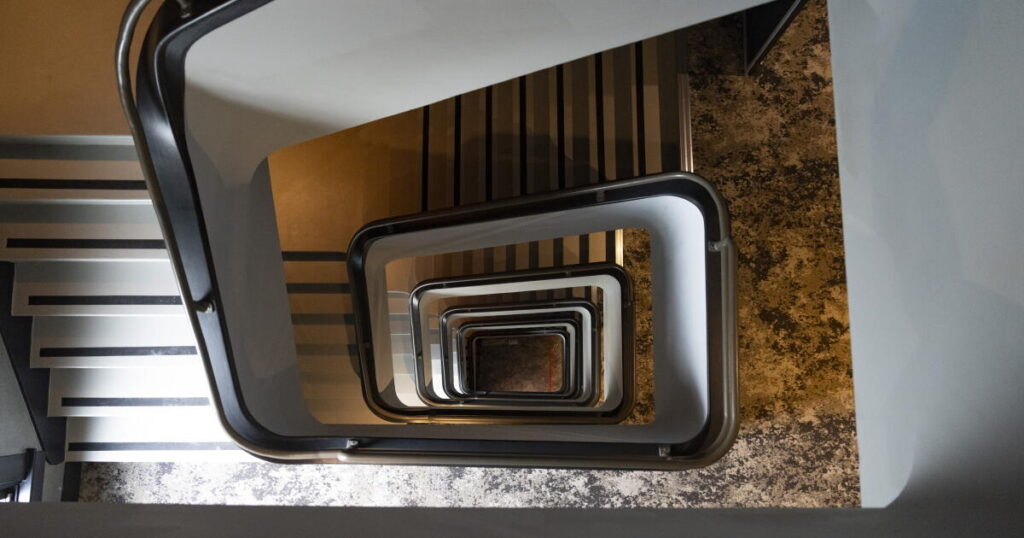
Attias stood in the hotel lobby, whose design leans toward gray, black, white, earth tones and chrome. Guest rooms include zebra-print wallpaper and faux alligator-skin panels.
“We wanted chic modern but also comfortable and warm,” said Attias, noting that new artworks and rugs are still arriving. A “luxury sports bar” is due to open by Super Bowl Sunday. As of Oct. 21, general manager Adrienne Craig said, about 120 of its guest rooms were ready to rent, with others soon to follow. Rates start at about $200 nightly.
There have been at least three near-openings during his firm’s ownership, Attias acknowledged. But now, he said, it’s the right moment.
“We have a lot coming,” he said. “We have the Olympics. Downtown is starting to move again. I’m very, very confident that downtown is going to get back on its feet.”
Members of the Chetrit family, based in New York, hold extensive real estate through multiple companies, some of which have suffered legal and financial troubles in the last two years. In Los Angeles, the Chetrit Group also owns the long-idle Trinity Auditorium, also known as the Embassy Auditorium and Embassy Hotel. Also a 1914 Beaux-Arts building, it includes about 180 guest rooms along with an 1,800-seat performance space. Attias said he hopes to open the Trinity Auditorium before the Olympics.
“We’re not done,” Attias said.
Added Craig: “Hotel Clark is amazing. Trinity is out of this world.”
The Clark’s rise, fall and long slumber
Look closely at the Clark, including the rooftop neon and the old fire escapes with the initials “CH” in ironwork (for Clark Hotel), and you may catch hints of its tangled history, from early opulence to urban decay, international intrigue and municipal dysfunction.
Eli P. Clark made big money as a railway pioneer in Los Angeles and beyond. But by 1914 he had moved on to other investments. He built the Clark Hotel with 555 rooms, each with a private bath (a notable luxury at the time) and a bold sign outside proclaiming its “absolutely fireproof” construction.
The building’s rooftop neon signage was apparently added a few decades later, along with the rounded letters that spell the hotel’s name and run vertically down one corner of the building. Dozens of vintage photos of the Clark’s ballrooms, restaurants, ashtrays, room keys, menus, postcards, matchbooks, coat hangers and candleholders are visible at BunkerHillLos Angeles.com, having been gathered by Marsak.
But somewhere in the middle decades of the 20th century, as investors began to look away from downtown, the Clark hit the skids. In a 1975 classified ad in the L.A. Times, the Clark offered rooms at $75-$95 monthly, including “special waterbed suites.”
By the 1980s, the Clark had become a residence of last resort, housing many seniors and others on limited incomes. The nearby Rosslyn (built in 1914, now a mix of low-income and market-rate apartments) and Hotel Cecil (built 1924, now low-income and supportive housing) followed similar paths.
By 1989, the Clark had been acquired by May Wah International Enterprises, which was rooted in China and associated with the Chinese government, Attias said. May Wah vowed to revamp the building with a “friendship store” to market Chinese imports and hotel above that might rival the Biltmore. But first May Wah wanted the old tenants out. Twenty of them filed suit against May Wah, saying they were subjected to spells without heat or water, and won a $1.7-million settlement. But by 1992, May Wah had succeeded in evicting the last two tenants.
By 1999, when May Wah sold it to the Chetrit family, the building was empty, its historic interiors rearranged in anticipation of the Chinese hotel that never opened. (During this period, Attias said, the building’s guest-room count changed from 555 to 348.) As Attias tells the story, the hotel was close to opening in 2008 when that year’s financial crisis hit. It came close again in 2013-14, when the Chetrit family invested in another renovation but ran into opposition from the hospitality workers union Unite Here Local 11 and L.A. City Councilman José Huizar.
“José Huizar,” said Attias dryly. “We know where he is now.” (Huizar, who served on the city council until 2020, pleaded guilty to corruption charges in 2023 and was sentenced to 13 years in federal prison.)
Though the hotel’s owners eventually got the city permissions they needed, Attias said, a partnership with other hoteliers dissolved and the Clark went to the back burner again, as did the Embassy Auditorium. Another near-opening followed in 2019.
Attias said the family decided in 2025 to finally open the Clark, later retaining OTH Hotels Resorts to manage it.
And now, said Attias, “we’re here.”
‘Nowhere to go but up’
In mid-September, the Clark had begun a quiet, soft reopening. Now configured with 348 guest rooms, it includes a Mediterranean restaurant called Votana; a cocktail lounge; a 17-by-29-foot courtyard pool, poolside bar and (in homage to Chetrit family history) a pair of Moroccan tile fountains.
In addition, a ballroom with space for 600 is due to be completed soon. Craig estimated that the business, a nonunion shop, employs about 100 people now and will likely reach 200 workers in coming months.
This rebirth may not comfort those seeking more affordable housing downtown, but for anyone eager to see more legal commerce on Hill Street or more hotel rooms in the run-up to the 2028 Games, it’s progress. This boost in room supply may also encourage travelers who have seen downtown hotel rates jump by more than 10% in the last year. Analytics company CoStar reports that downtown hotels averaged $200-$210 per night from June through September.
“There’s nowhere to go but up,” Craig said. “The possibilities here are endless.”
A few weeks ago, Craig’s team gave Marsak a tour of building (and bought a batch of Angels Flight tickets to distribute among guests. The historian declared himself mostly delighted.
“Having the Clark open, facing Hill Street — which can get rough — is so brave of them,” said Marsak. “I can’t applaud it enough.”
As for the inside and that zebra-print wallpaper, it’s “not what I would have done,” he said. “I believe that Beaux-Arts buildings should be Beaux-Arts inside and out. But you can’t have everything.”
The post After decades of false starts, the 1914 Hotel Clark finally reopens in downtown L.A. appeared first on Los Angeles Times.