To the Editor:
Re “165 Years On, a Vote to Stop the Clip-Clop” (front page, Oct. 23):
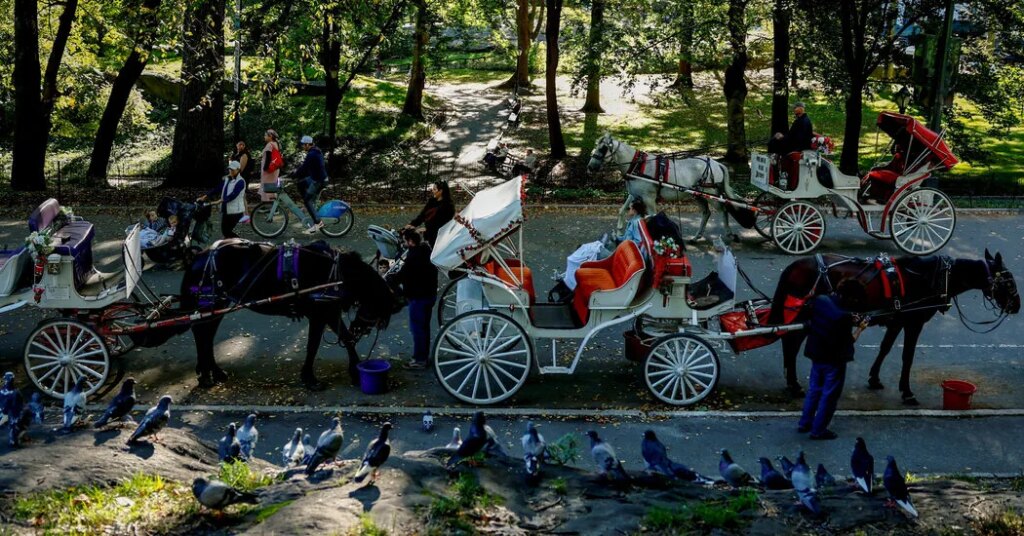
It is tragic that it had to take a human death to finally ban the carriage horse industry starting in 2028. And that the deaths of 40 horses since 1982 weren’t enough to put an end to the exploitation of the horses sooner.
I’ve witnessed lame horses pulling heavy carriages, horses whose ribs were showing, horses that looked so downtrodden it was heartbreaking. There is no adequate monitoring of the horses. I have seen them outside when the temperatures were above and below the limit for them to be working.
This is a great victory for those horses that have survived. They deserve to be sent to sanctuaries or to people who will let them live on farms to enjoy peace and quiet in the countryside.
Thanks to the City Council and the public for showing compassion for these magnificent animals.
Elaine Sloan New York
To the Editor:
I was heartbroken to hear about the tragic death of the young man involved in the horse-drawn carriage accident. While this tragedy deserves careful review, I do not believe that it should be used to justify banning horse-drawn carriage operations. One terrible accident should not erase an entire industry that has safely operated for generations and provides livelihoods for many hard-working families.
As a horse owner, I know firsthand the level of care, commitment and financial investment required to care for horses properly. A vast majority of carriage horses are valued partners, not disposable animals. They receive daily care, veterinary attention, proper nutrition and purpose in their lives.
Eliminating horse-drawn carriage businesses would not only affect the people whose livelihoods depend on them, but it could also put many horses at risk of uncertain futures. The answer is not to end an entire way of life because of one tragic event. The answer is to learn from the incident, continue improving safety and support both the animals and the people who depend on this industry.
Lisa Gambella Ashland, N.Y.
To the Editor:
If the horse-drawn carriage rides in Central Park are banned, we should replace the horses with an alternative ride. I think that electric-powered Model T cars would be popular for rides around the park. Such vehicles would be environmentally friendly and could continue to provide employment for the current drivers.
Ted Becker Miami
To the Editor:
How is it that a person dies in a horse-drawn carriage accident, and that is the impetus to finally ban the carriages, but when hundreds of children and teachers have been killed or wounded in school shootings there is still no federal ban on assault weapons? What is wrong with this country?
Alison Goodwin Schiff New York
Integrated Schools
To the Editor:
“New York City Leaders Say They’ll Integrate Schools. What’s Missing? How” (news article, Oct. 6) says proponents of integrating schools believe that it can help equalize educational resources for Black and Latino students. This is indeed a major goal of school integration. But it is not the only important goal.
All students — including white students — benefit from being in schools and classes with students of different racial and economic backgrounds. Integrated schools and classrooms are an incomparable setting for young people to learn from and interact respectfully with these diverse peers.
The multiracial democracy they will join and shape as adults and citizens requires high school graduates who themselves are “culturally competent,” who have learned in school to work with others of diverse backgrounds, who more deeply understand the diverse character of the American population because they have experienced it in school. Segregated schools cannot adequately serve these social needs.
All these values are under attack by the Trump administration in its demonization of diversity, equity and inclusion. All the more reason for public discussions of school integration to foreground the educational, personal and civic benefits of integration for all students in our public schools.
Lawrence Blum Cambridge, Mass. The writer is a professor emeritus of liberal arts and education at the University of Massachusetts, Boston, and an author of “Integrations: The Struggle for Racial Equality and Civic Renewal in Public Education.”
The post Should Horse-Drawn Carriages Be Banned in New York City? appeared first on New York Times.