The families had only just begun harvesting olives when the attack started. Clad in all black, bearing metal batons and guns, Israeli settlers materialized without warning.
Ilham Al-Bazari, one of the Palestinians farming, froze. It was too late to run, she said.
Her husband was shot in the leg, and settlers attacked her teenage nephew. Believing they might spare a 50-year-old woman, Mrs. Al-Bazari said she jumped on top of her nephew to protect him. They broke her arm instead.
Her cousin, Ali Al-Bazari, an off-duty captain in the Palestinian Authority’s security forces, raced to help and was shot in the back by a settler.
The Israeli military showed up shortly after, Mrs. Al-Bazari and other witnesses said, as her cousin lay on the ground dying.
“We called on the soldiers to allow an ambulance,” she said. “But they refused.”
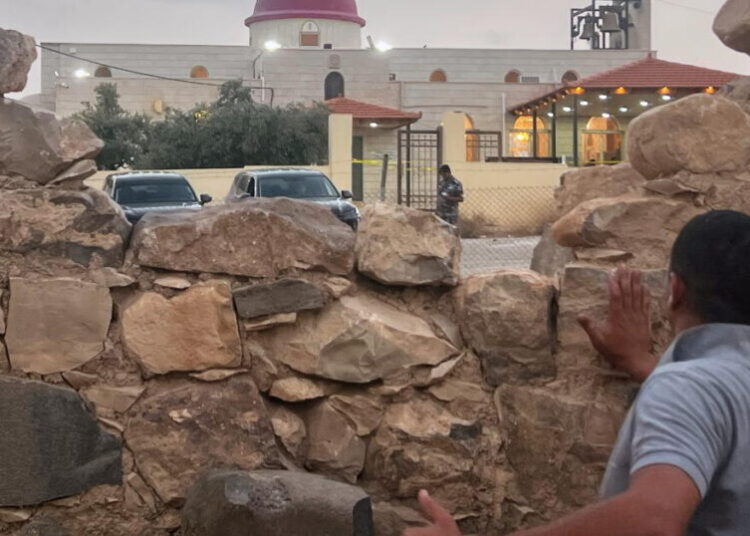
Mr. Al-Bazari, 44, died on Oct. 7, the first person killed in this year’s harvest — the most violent olive season in recent history, still weeks from ending. The Israeli military did not respond to requests for comment about Mr. Al-Bazari’s case or other incidents described by Palestinians or seen by journalists from The New York Times.
The violence of this year’s harvest is a distillation of the turmoil upending Palestinian life in the Israeli-occupied West Bank since the Hamas-led attacks of Oct. 7, 2023, which killed as many as 1,200 Israelis. As the country plunged into war in Gaza, Israeli settler expansion sharply accelerated in the West Bank, as extremist settlers — Jewish Israelis living in areas that Israel occupied in the 1967 Arab-Israeli war — push Palestinians off the land by intimidation and force.
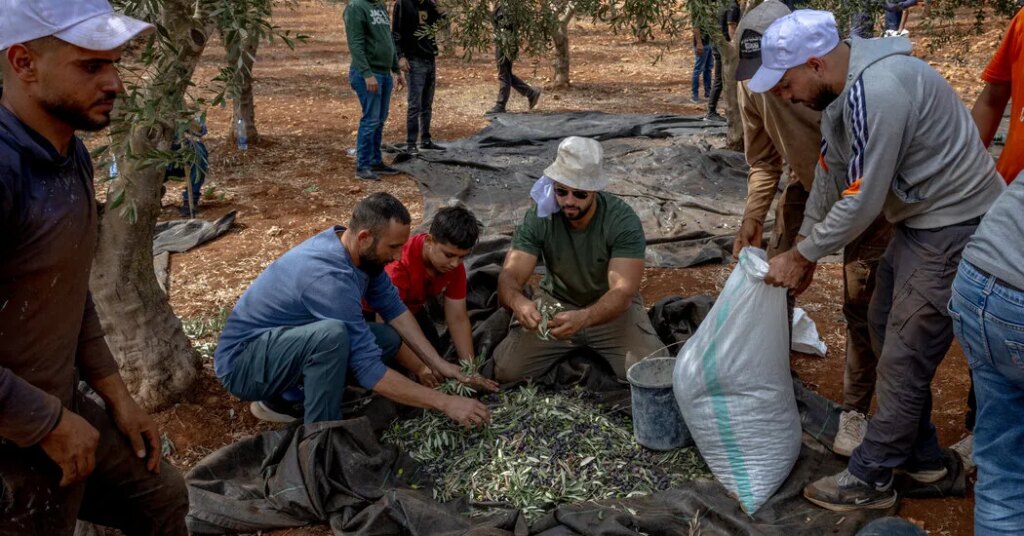
Each year, the olive harvest has grown more tense but endured as both a social and economic rite for Palestinians. Families gather in groves, serving coffee brewed over open fires as several generations pick olives together. As many as 100,000 families rely on revenue generated by the harvest, which typically runs from mid-October to mid-November, Palestinian officials say.
In the last three weeks alone, armed Israeli settlers have launched hundreds of attacks, according to the Israeli rights group Yesh Din, the United Nations and the Palestinian Authority. Settlers have lit trees ablaze, shot farmers and bludgeoned men, women and children. On Friday, Palestinian gunmen opened fire on Israelis: The Israeli military said that two soldiers and two Palestinian assailants were killed.
In at least three instances witnessed by The Times in the past week — in the villages of Khirbet Abu Falah, Turmus Ayya and Deir Abu Masha’al — soldiers stood by as settlers stopped Palestinians from harvesting olives.
The far-right government of Prime Minister Benjamin Netanyahu has vigorouslysupported settlers seeking to redraw the map of the West Bank. It has also allowed extremist settlers to operate with near impunity, even as violence has soared ahead of Israeli elections that could determine Mr. Netanyahu’s political fate.
Entire communities sit empty, residents run off by marauding settlers who have established more than 100 outposts over the last three years and are rarely stopped by Israeli troops. Hundreds of prominent Israelis, including former top-ranked military and intelligence officials, have accused Mr. Netanyahu’s government of allowing what they describe as ethnic cleansing.
Mr. Netanyahu’s office has rejected those accusations. Asked for comment about settler violence, an office spokesman, Doron Spielman, said: “While there is Jewish crime, it is not state-sponsored or state-supported. It is condemned; people are arrested and brought to court, and if they are found guilty, they are prosecuted.”
Three Palestinians have been killed in recent weeks, one during an olive harvest, with many others wounded and trees destroyed. A series of exceptionally brazen attacks have drawn condemnation from U.S. and other officials, some of whom have called them acts of terrorism.
In one attack last week, settlers assaulted European officials on a visit to a Christian village. In another, they badly beat a 63-year-old photojournalist from The Washington Post, breaking two of her ribs and fracturing several vertebrae.
Then, on Wednesday, a delegation of rabbis joined by several Americans, including Brad Lander, a Democratic nominee for U.S. Congress, were detained by Israeli authorities while accompanying Palestinian farmers near Bethlehem. The Israeli military said they were detained because of “the security risk posed by conducting an uncoordinated harvest near an Israeli community.”
Military aggression has also sharply increased in the West Bank: the Israeli military have killed more than 1,100 Palestinians in the last three years, a sum greater than the previous 17 years combined, according to U.N. data, a figure that includes combatants.
In many cases, the soldiers appear to protect their fellow Israelis while detaining the Palestinians who come under attack.
The Israeli military has rejected accusations that it supports “the actions of violent groups” in the West Bank. It says its mission is to “protect all residents,” and that any soldier who takes part in settler attacks or stands by while they occur is “acting in complete disregard” of their orders.
“The season is not starting off well,” said Ramez Obeid, head of the Palestinian Agriculture Ministry’s olives department. “We estimate 50 percent of the land will be inaccessible.”
Indeed, as settlers paralyze harvesting, some communities like the village of Jalud can barely harvest enough to produce oil for themselves.
Jalud and its surrounding areas stretch between several hills, nearly all of which have become home to new settler outposts since 2023. The settlers’ presence has made accessing more than 1,000 acres along the village’s periphery impossible.
“They stole my equipment just a few meters away from our home,” said Raed Al-Naser, the mayor. “And they are doing this to many others.”
Fearing for their lives, residents let the olives hang from trees, untouched.
Except where the settlers take them.
“It’s not the olive harvest season,” said the mayor. “It’s the olive stealing season.”
Precision Attacks
The attacks typically follow a pattern and are executed with precision, as Palestinians described them and as we saw ourselves.
Settlers have claimed the high ground in much of the West Bank, placing encampments above the olive groves that terrace up and down the limestone bluffs.
From the ground below, one can see the settlers preparing, usually dressed in black hoodies with masks and armed with rifles and other weapons.
They descend with speed, sometimes on foot, fanning out across the groves and hiding among the trees. In other cases, they barrel down roads into the lower ground.
This was the case in Khirbet Abu Falah last Friday, when 50 or 60 settlers laid siege to farmers harvesting crops before a group assaulted the veteran Post photographer. Mr. Netanyahu’s office said the “facts surrounding the confrontation” were being investigated.
Where they can, Palestinian lookouts scale unclaimed hillsides so they can warn their neighbors about attacks. Without them, the farmers would have no chance to flee before the settlers came storming down, like what happened with Mr. Al-Bazari.
By Israeli law, Palestinian villagers cannot be armed. Even throwing rocks at settlers could land a Palestinian in prison, often meaning that the only recourse available is to flee their own lands.
On Monday in Turmus Ayya, a Palestinian village filled with the homes of dual U.S. citizens, settlers attacked one such house while its owners were out harvesting olives.
We arrived after the assault began. Settlers burned cars, smashed a neighbor’s windows and beat an American citizen to the point of hospitalization, his family said. In the aftermath, we saw Israeli soldiers threaten the Palestinians outside of the home with tear gas if they did not disperse.
“But this is where I live,” said one Palestinian man, in English. “Where is your warrant saying we must leave our own lands?”
“For the Palestinians, we don’t need a warrant,” the soldier said. “We can just tell you to go.”
Everyone pressed inside the destroyed home, where glass crunched underfoot.
Hanan Mousa Hamayel, who was inside during the attack, shouted in despair.
“How long will it be like this?” she asked, adding, “We live in fear 24 hours. We cannot find peace even in our own homes.”
Shows of Force
In some cases, the mere threat of violence and the apparent complicity between settlers and soldiers was enough to halt the harvest.
We saw this in the village of Deir Abu Masha’al on Monday morning, when a farmer, Mahmoud Rabia, arrived at his olive fields to find a half dozen settlers already there.
Mr. Rabia, 60, expected the worst as he trundled into his grove, and the fear was palpable as settlers walked among the farmers, despite the presence of journalists and Israeli activists trying to help the farmers. A young settler jumped into an SUV, using it to block the road back to the village.
The crowd braced for an attack as four more settlers walked up the road to join the others.
And then the army showed up.
Only it wasn’t to push the settlers off the private land; it was to evict everyone else.
The soldiers forced the farmers and others away, brandishing a military order closing the zone. The settlers stood around laughing and smiling.
As one farmer attempted to drive away, another young settler jumped in front of his car to stop him. He told an officer to arrest him, claiming the Palestinian had attacked him. The military detained the man.
The boy then called out another Palestinian for holding a hand saw, and soldiers detained him, too.
Mr. Rabia fumed.
“My ancestors farmed this land,” he said. “And I have harvested these trees through the intifadas, through hard times and violent times.”
Through it all, he had never been kept from his own land.
“I don’t care if they have their outposts,” he said. “I just want them to leave me be.”
The post Israeli Settlers Turn a Palestinian Rite Into a Gantlet of Violence and Fear appeared first on New York Times.