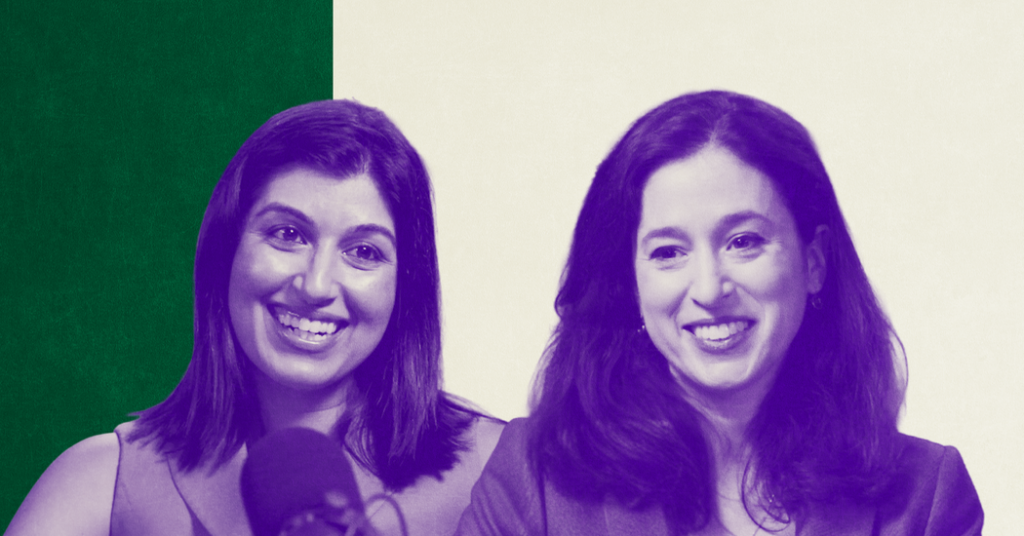
One of the biggest issue driving the midterm elections? The economy. On “The Opinions,” the economist Natasha Sarin and the Bulwark editor Catherine Rampell examine the strange disconnect between how the economy is doing and how Americans feel about it. How much of the blame belongs to Trump? And how much of this goes deeper?
Below is a transcript of an episode of “The Opinions.” We recommend listening to it in its original form for the full effect. You can do so using the player above or on the NYTimes app, Apple, Spotify, Amazon Music, YouTube, iHeartRadio or wherever you get your podcasts.
The transcript has been lightly edited for length and clarity.
Natasha Sarin: Catherine Rampell, welcome to “The Opinions.”
Catherine Rampell: Great to be here.
Sarin: Catherine, you are the economics editor of The Bulwark and host of the podcast “Receipts.” I am an economist. We are also very good friends and get to talk about the economy all the time. So I wanted to bring our group chat here, to this table, to try to unpack the extent to which Donald Trump is actually to blame for what is happening in the economy right now, and how people are feeling this giant issue ahead of the midterms — and you and I kind of disagree about this.
Rampell: To an extent, we do. Yeah.
Sarin: But before we do that, I feel like it would be helpful for us to talk a little bit about what is actually happening in the economy.
Rampell: Fair question.
Sarin: And maybe, to start us off, we can walk through some of these charts that you have right ahead of you. And remember, many people are listening to us and not looking at the screen, so if you can do a little bit of visual narration and tell us what we’re looking at.
Rampell: OK. So, for our first chart, we are looking at the S&P 500 index. In short: Line go up. That is how I ——
Sarin: In short: Line go up.
Rampell: That is how I would summarize this chart. The S&P 500 has hit a bunch of records, as we have heard ad nauseam from our president recently. And the question is: Why? Like, why is the stock market doing so phenomenally well, particularly relative to prior points in history? And we can get into what is actually going on in the economy, aside from the stock market, but I would say this is mostly a story about A.I., that there are a lot of things weighing on the economy right now. You have high interest rates. You have trade wars. You have an actual hot war.
The A.I. sector has been sort of impervious to all of that. And usually when you have high interest rates, that should weigh on the stock market, because there’s less money sloshing around, including in equities, and we have not seen that happen. And that’s because there is a lot of enthusiasm about A.I. You could call it a boom. You could call it a bubble. I don’t know. If you have a ——
Sarin: Topic of endless debate.
Rampell: I know. I don’t know if you have a referendum on that. But I would say, in this particular case, if you look at how concentrated the market is right now, it is extremely — like, historically — concentrated in A.I. Something like 45 percent of the market cap of the S&P 500 is in very A.I.-linked stocks. And if you look at how much capital investment there has been right now, relative to the overall size of the economy — so not just the stock market but the overall size of the economy — the last time we saw this amount of money going into the build-out of new infrastructure was probably during the railroad boom in, like, the 1870s. So that’s what’s driving all of this.
That does also mean that there’s a lot hanging on all of this. Bubble, boom — who knows? If it’s a bubble, if that bursts, that could be quite bad, given that the A.I. part of the market and the A.I. part of the economy seem to be propping up a lot of the rest of the economy.
Sarin: And I agree with that, but I also think that there are aspects that are kind of interesting, in that there was this good study that JPMorgan did, which documented that, since 2024, about two-thirds of all the gains in the S&P 500 are coming on the heels of A.I., or A.I.-adjacent types of stocks. But the flip side of that, as you’re starting to see, is a couple of tremors in the market. Some concern that actually some of these data center moratoriums are going to be pretty significant, and are going to delay the capacity to deploy the technology; or the possibility that the revenues that we think are going to be generated by A.I., and the productivity gains that come from us being able to much more easily deploy the technology, they’re kind of further out of reach.
Rampell: Yeah, you have companies borrowing a lot, a lot, a lot. And the question is: Can they ever actually deliver enough revenue to pay off that debt? And so you have seen, if you look at this chart, there have been some market wobbles, shall we say, toward the end of the line go up. Line dip down at the end. And that’s partly because of these concerns.
Sarin: Even in just the last week, we’ve seen a bunch of this, like, are we pulling back from the A.I. boom? Are we on the verge of some of these profitability concerns starting to be realized? But the flip side is that over the course of the last few months, what you’ve also seen is that the gains from A.I. are starting to be more dispersed in the economy. So you have something like nine out of the 11 S&P sectors are actually showing gains.
You have earnings reports that are billing success, not just in tech and tech-adjacent types of firms. They’re also in the banks. They’re also in the Walmarts, where they’re maybe deploying the technology, and that’s part of what the gains are being delivered or about to deploy it. But it’s not as concentrated as it has been over the course of the last couple of years. So it’s kind of like a positive story, at least about how the market looks at the moment. Totally plausible that we’re on the verge of a bubble starting to crack, and real concerns about that exist. But it is a story of A.I., and A.I. pulling up the rest of the economy, it looks like, alongside it.
Rampell: I think there is no doubt that A.I. will dramatically transform, disrupt — whatever verb you want to use — pretty much every major sector of the economy. But yeah, I think that there are likely going to be productivity gains. I hear it from, like, every C.E.O. that I talk with. I was talking with a company that sells artificial Christmas trees recently, and they have been hit by the tariffs. And he was saying that the C.E.O. of this company was saying that if the trade war had happened two or three years ago, he thought it would have been much more devastating for the overall economy. But now the drag of that has been sort of offset by some of the gains from productivity. And so that’s been able to help them hold on.
Sarin: Yeah, and interestingly, when the market is doing well, it also tends to be a moment when consumers, and Americans writ large, feel kind of good about the economy. That’s in part because our household finances are very significantly tied up in the stock market — at least for American workers who have 401(k)s that are being invested in the market. And so those gains are actually realizing for them, like, pretty significant wealth increases over the course of the last couple of years.
Rampell: Yeah, but they don’t seem to recognize that. OK, so the second chart is about consumer sentiment. Consumer sentiment has basically been in the toilet. It has been in the toilet for a long time now. If the other chart ——
Sarin: Record low. Lowest in our lifetimes.
Rampell: Yes. If before it was line go up, this is line go down, basically, since 2020. And according to this index — and this index, we should explain, is a series of questions that the University of Michigan has been asking consumers for decades at this point. And they’re questions like: Is now a good time to buy a house? Are your finances better this year than they were last year? Or what do you think the rate of inflation will be? Or how much higher do you think prices will be a year from now? Things like that. So it’s like a mix of different specific questions, as well as some softer questions about how you feel about things.
And things are historically bad, as you point out, Natasha. In fact, they are worse than they were during the financial crisis and the Great Recession. Let me tell you, as someone who covered the financial crisis and the Great Recession — in fact, I covered it for The Times — there is no way in hell that today’s economic conditions rival those. We had 10 percent unemployment; people were losing their homes. There was like ——
Sarin: Americans lost a third of their median net worth during the Great Recession.
Rampell: Yeah. It felt like we were on the edge of the abyss, right? I don’t think, as much as I believe people are actually struggling to get by today, it is not nearly as bad as it was then. So then the question is, how do we interpret this? And why do people say this economy is so terrible? Why do they hate it so much? And I think that there are a few different ways to understand this — and I’m sure you have theories as well. But one of them is just that answers to survey questions like this have gotten much more politically polarized.
So people are much more likely to say that the economy is bad when the person in the White House belongs to the party that they don’t. And that political lens has just become a lot thicker over time. So it’s partly that. But even Republicans have said that they like the economy less today than they did recently. It’s basically true across all demographic groups. I think the other issue is, when you ask people about their impressions of the economy, the question is: Compared to what?
They’re not being asked: How do you think about the economy today relative to 2008? That comparison that I just made. They’re being asked to talk about the economy today, and their reference point may be what they thought the economy would be. Donald Trump got into office. He was elected explicitly on a set of promises to reduce prices, to usher in a new economic golden era. And instead, we have had the opposite. We have had, actually, inflation re-accelerate due to a number of policies Trump himself has put in place. We have some signs of fragility in the labor market. And you do not see any signs of this new economic golden era in manufacturing, or anything else that he had promised. So if people are comparing today’s economic conditions to what they thought was going to happen, I get it. I get why they’re upset.
Sarin: I agree, but also I’m not fully sure I agree. I don’t really agree that the media environment or social media is polarizing and making us think things are worse than they actually are. There’s been some really interesting empirical work about the extent to which that’s true, if you look at ——
Rampell: Yeah, you see, like, fabulous vacations or something that’s influencing your thinking.
Sarin: Exactly. And you feel — it’s kind of like the “keeping up with the Joneses” thing, but it’s like “Keeping Up With the Kardashians,” right? We’re just more exposed to a lot of consumption, and the ways in which that makes you feel like you’re going without. That is, you can understand why that might have accelerated over time. But it doesn’t actually look like it lines up very neatly with what you’re seeing, with respect to things like consumer sentiment.
And so that seems like it’s probably a less likely driver of what we’re observing. I think some of this is deeper, in some sense, than just this particular moment, and in ways that make me wonder how much I should attribute the current pain and the ways in which this election in two weeks is also going to be decided on the heels of people saying that when they’re going to the polls, 50 percent of people say they’re doing so with cost of living issues as their No. 1 issue. How much of that is about a reaction to what we’ve seen over the course of the last few years, and how much of that is something much deeper and more structural about the American economy?
Rampell: I think that people have been ticked off about the economy, about rising inequality, about feeling like they’re being left behind, about rising prices at the grocery store and everywhere else. I think that they’ve been ticked off about all of that for a long time. And then you layer onto it the fact that they were promised that all of those problems would be magically fixed. And so that resentment, that deep well of frustration, of insecurity — I think all of it just gets so much worse because there’s disillusionment, essentially. People were already mad about all of these economic conditions. They were told they would get better. They have not gotten better.
In fact, many of them have gotten worse, and understandably, that disillusionment is feeding into this sort of rage about the economic conditions that they’re stuck with. And you know, there are different lessons that politicians could take away from that. And the thing that I worry about is that you will have this sort of doom loop, almost. The party out of power says: “Don’t worry, I will solve all your problems. Throw the bums out. Elect me.” They get into office. They cannot solve everyone’s problems. Or certainly not with the snap of fingers that has been implied by, like, “All we have to do is round up all of the immigrants,” just as an example.
And then people get even more frustrated and even more resentful, and then they’re susceptible to the, again, party out of power, which had been in power, promising the same thing. Except in this case, the party out of power says: “Don’t worry, I can solve all your problems. I can lower prices by just” — name a different scapegoat — “the billionaires! We’re going to punish the billionaires, and that is going to make your health care cheaper,” or what have you. And you end up with this populist doom loop. In other countries — we’ve seen it in Argentina, as an example, where you had the left-wing populist and the right-wing populist alternating power, always promising ——
Sarin: Horseshoe, right?
Rampell: Yes, but always promising that they could, that they had the magic bullet to solve everyone’s problems, when there isn’t a magic bullet. It’s, like, a bunch of boring technical stuff, the kinds of things that you worked on in the Joe Biden administration that don’t land — that don’t get spelled easily on a slogan. There’s almost an arms race in who can offer the most magical thinking. And nobody’s tethered to reality. I think that’s the real thing that I’m worried about.
Sarin: I’m super worried about that, too. I call it the affordability doom loop. Because if you take some of these policies and try to disentangle their likely economic effects — so if you go back to the 2024 presidential election, Trump’s “I will immediately bring prices down, starting on Day 1,” people are really upset that prices haven’t been lowered on Day 1. But guess what? It would actually be quite bad if prices were lower on Day 1, because what it would reflect is that we were in a downturn such that people had less dollars to spend, and they were spending less, and the result of that was that prices were falling because demand for goods was falling.
And if you take other proposals that you’ve seen over the course of the last few years — so Zohran Mamdani’s mayoral campaign to freeze rent, and that’s going to provide relief for people with respect to housing costs, which are hugely significant. So a big, important problem to solve, but it turns out that when you do things like rent freezes, you actually just make it more difficult for people to find affordable housing. There’s great work that’s been done by Rebecca Diamond at Stanford on this, where she points out that one of the effects is that a lot of rental units end up being redeployed or repurposed, such that they’re no longer available for people as a form of rental housing.
And so I worry that it’s because the nature of our political process is such that you’re constantly trying to craft policy for two-year election cycles. And there are no solutions to these types of problems that exist in that type of an election window.
Rampell: I think the problem is not just about the election cycles — it’s about the impatience of voters, right? If you tell voters, “Don’t worry, we’re going to expand supply, and we’re going to ——”
Sarin: Housing supply — really big deal.
Rampell: I know. “We’re going to make it so much easier to build, and we’re going to ——”
Sarin: Permit reform. We might do some of that, right?
Rampell: Yeah, some of it, some of it. That doesn’t solve the problem quickly enough, and we have gotten to a new norm where politicians have begun promising an immediate fix. You don’t win on a platform of: This will make the cost of living better 10 years from now. This will make the insurance pool function better 10 years from now because we’ll have less adverse selection or whatever.
All of these things, they’re both boring and technical and hard to message, but also they’re not immediate. And if you have one party that is offering immediate gratification in the form of policy solutions and the other party that is tethered to reality — the party that is tethered to reality is at a disadvantage. And so that’s what I mean when you say you get this arms race, where it’s like, if one side is offering rainbows and ponies, then the other side has to offer rainbows and ponies, even if the rainbows and ponies are not actually going to solve anything and may actually make things worse.
Sarin: Yeah. And I guess one interesting aspect of it, as you started to point out, is that this isn’t something that we’re uniquely observing here in the United States. We’re talking because, in part, there are midterm elections in a couple of weeks, where these issues are driving people to the polls. But another reason we could be talking at this moment is if you look at what is happening in France, with respect to literal protests on the streets by people who are, at their core, frustrated with a political system that they feel isn’t delivering for them in meaningful ways, with respect to education, with respect to pensions, with respect to government spending and revenue-raising writ large.
Rampell: And job opportunities.
Sarin: Totally. And feeling isolated and frustrated in ways that are actually very tied to the same sets of issues that we’re watching here in the United States. And I almost think about France as a cautionary tale for how things could go in the U.S. And one of my flash points for why is that at its core, what France is confronting, I think, is a debt problem. These types of protests at this particular moment are in part about the inability of the government to marshal a budget that meets its needs to raise revenue or cut spending seriously, and find opportunities to employ and educate its youth.
And that type of debt problem is actually one that we’re facing here in the United States, too. Ten years ago, 50 percent of millennials who didn’t own homes thought that someday they would. Today that number is like 30 percent. So increasingly, they’re feeling priced out of certain aspects of the American dream, almost by the fact that these costs are high and rising. And there actually is a direct connection between the way in which our government is spending and things that are very real to all of us.
Rampell: And again, these things are not particularly intuitive, like how interest rates relate to inflation, relate to mortgage rates, and how all of this stuff works. You and I have the luxury of having the time to spend on all of this stuff, and think about how these things work and how the mechanics could go awry. For most normal people, they do not. This is not their job. I am paid to follow these things. You are, too. Most normal people do not have the luxury of that time and bandwidth. So of course it’s going to sound appealing when you hear a president say: “Don’t worry, I am just going to cut everyone a check. I’m going to force the Federal Reserve to cut rates, and all of your problems are going to go away.” Even though in the longer term — even in the medium term — arguably, that’s going to make all of these affordability problems worse.
Sarin: So I totally agree with you on that. But devil’s advocate, slightly — this is an area where I ask myself: How much are the problems that we are observing in the economy today about the Trump administration and this president, and how much are they about broader structural forces that have been in the works for quite some time?
And interest rates and our deficit problems are a perfect example in that, it is true, we have made problems worse over the course of the last few years, in part because we had a giant deficit finance tax cut that delivered gains basically only to the top of the distribution, and actually delivered losses in the form of food stamp cuts and increased health care costs for everyone else. Medicaid cuts are coming. And by the way, after the midterms — very conveniently designed. Those consequences are really significant, and yet that entire package, by the way, added some $3 trillion to the deficit, so it made the problems worse. But even before then, we were on track for debt-to-G.D.P. ratios to rise to 125 percent.
And part of the challenge, by the way, is that I feel like all these numbers are totally meaningless to people. Like, oh, national debt is crossing $40 trillion, and it’s actually $33 trillion if you exclude intragovernmental transfers. What does any of this stuff actually mean, you know?
Rampell: Yeah, I mean, again, even for people like us, who are paid to pay attention to these things, at some point it all starts to lose meaning. Now, can you even just imagine for a normal voter, who has been scolded about deficits for 10 years, 20 years, and there was never a debt crisis that actually materialized — like, why would you pay attention to any of these concerns?
Sarin: And why would you care, and why would you connect those things to the fact that you’re watching mortgage rates rise? And you’re watching it become more expensive for you to buy a car because it’s hard to get financing for that giant purchase for your household. But in fact, these things are all connected. And even if you look at health care, obviously, a lot of damage has been done by this administration — with respect to both cuts that have already arisen and increases in the average family, whose employer provided health insurance, paying something like $27,000 for that package.
That is a very significant cost. And people are about to watch their plans increase from something like 8 to 10 percent over the course of the next year, which is the highest increase that we’ve seen since the early 2000s. But a lot of this is about the fact that we’ve had challenges with respect to both the delivery of health benefits and the cost of health benefits in this country that way predated this second Trump administration.
Rampell: Yeah. I, again, totally agree with all of that. There are problems that predate Trump. The problem is that he has made all of them worse. Because, just as an example with health care, he has taken money away from outreach efforts for recruiting people to the marketplace plans — the Obamacare plans, right? Outreach spending is actually really important, and the reason why is that people who are sick, who have poor health, they know that they need insurance. The people who are healthier, maybe this is less top of mind for them. So what happens is, if you don’t spend money on outreach, if you don’t do a lot of advertising to tell people what their options are, they may just decide: I’ve seen these numbers about insurance premiums going up 15 percent or whatever. I’m just not going to get it.
And then you end up having an increasingly sick population that does get the insurance, which actually drives the rates up the following year. And then repeat that several times; you get the death spiral, as it’s called in health insurance. And that’s all because of this stupid thing that the Trump administration did, which was just not advertise the fact that insurance was available, that open enrollment is happening, and that here are the subsidies available to you. And in fact, actually took away some of those enhanced subsidies. So this is just a little microcosm of this broader question. And that’s just leaving aside all of the other unforced errors that this administration has done on tariffs. And then you add on these ridiculous trade wars, which in addition to alienating all of our friends and allies around the world, are also raising the cost of living. You have that.
You have the war with Iran — we talked about trade wars, but there’s the actual hot war that’s driving up prices as well. You have the meddling with the Fed. There are a whole bunch of things that Donald Trump has done to make the economy objectively worse, directionally at the very least. Now, none of that has produced a recession, knock on wood, and hopefully will not. And so I don’t think that the economy is actually in the trash, despite those consumer sentiment numbers we were talking about. People say that they hate this economy, that it sucks, that it’s worse than the financial crisis and the Great Recession. I do not — again, I do not think any of that is true.
Sarin: Unemployment is very low. Unemployment is in the low fours. You’re starting to see pockets of concern. There was a great piece in The Times about how you’re starting to see African American unemployment tick up, which tends to be a leading indicator of problems in the labor market. There’s all this concern about A.I. doomerism and when it’s going to show up with respect to job displacement. And so in meaningful ways, the labor market is kind of holding up. And for large parts of the population, people who want jobs have them.
Of course, the long-term unemployed are going way up, and that’s really concerning for a set of the population that essentially, in this stalled, no-hire-no-fire economy, is feeling themselves lacking the opportunities to enter. But the labor market writ large is doing pretty well, relative to what you would expect if you take all of the things that you just listed about these policy errors and combine it with these consumer sentiment numbers. I think you would expect a picture that’s bleaker than you’re actually seeing.
Rampell: Yeah, absolutely. And again, the things that the administration has done have been bad for the economy, but they have not destroyed the economy. If Trump had been unfettered, and done a bunch of other things that he said he had planned to do, or that his underlings had said that they wanted to do — if Trump had been successful in firing the previous Fed chair, Jerome Powell, that might have caused a financial crisis. Those kinds of things, like the most extreme versions of what he wanted to do, I think, would have been completely devastating.
Instead, you just have this steady drag on the economy from all of the things we talked about — from the uncertainty, from how erratic policymaking is — all of it makes things a little worse, even if it doesn’t destroy the fundamental strength of the economy that we have. Which, again, to go back to the beginning of our conversation, is partly about this other thing completely unrelated to Trump: A.I. And so in some ways, he has been rescued by the A.I. investment boom, because it has provided a huge buffer in this economy against the kinds of things that he’s doing.
Sarin: And I think one of the aspects that we’re circling around a little bit, is that there seems to be this asymmetry with respect to the potential for policy to impact the economy in live time. Which is, on the one hand, if you’re looking for stuff that’s going to make people’s lives feel more affordable immediately, and tangible to them, and deliver lower prices or cheaper housing — that stuff, we’re telling you, is longer term. The real solutions take time to effectuate, and they take patience, and our policymakers are impatient, and perhaps all of us are impatient. But the flip side is, if you want to do a lot of damage, it’s actually relatively straightforward to do the damage quickly.
Rampell: Yes. The thing, the mantra that I have been saying, since the beginning of my career in journalism, has been that presidents get too much credit when the economy is good and too much blame when the economy is bad. They just don’t have that much control over the economy.
Sarin: Hard ship to turn, right? The American economy is a difficult ship to direct.
Rampell: Except I retract that statement. Officially, it turns out.
Sarin: You heard it here first.
Rampell: Yeah. Big news, I know. Ooh. You could do a whole supercut of all of the times that I’ve said this on TV and on radio and written in my columns, and stuff like that. It turns out it is true that it is difficult for the president to make the economy a lot better.
It is, unfortunately, very easy for the president to make the economy worse, because there are just so many buttons he can push that will make prices higher, will make businesses feel more uncertain about the future, will put more jobs in jeopardy. There are a lot of ways that the president can imminently make the economy worse. It’s just that previous presidents have not elected to press those buttons.
Sarin: And you know, what I think is really interesting is, in some sense, maybe the asymmetry is overstated, because some of the more damaging consequences of what this administration has done over the course of the last few years, we actually haven’t quite felt yet. Immigration is a very concrete example. You are in fact feeling, particularly in industries like construction, particularly for issues like the building of new housing — which is massively important to housing affordability — you’re already seeing the ramifications of this administration’s immigration policy on our capacity to build, and that is going to show up in prices if it hasn’t already.
But the longer-term consequences of having an economy where, essentially, we were projecting to get growth with respect to our labor supply that was entirely coming from immigration — or largely coming from immigration as a result of the demographics in this country that are tilting older, and people are delaying having children or not having children at all. Immigration is a really important booster of labor productivity, just labor supply growth in this country. We’ve kind of shut that down.
Rampell: Yes, there are a lot of ways in which a lot of the economic destruction that this administration will ultimately be responsible for is yet to be seen. It has to do with immigration. It has to do with institutions. It has to do with other boring stuff. I’m personally kind of obsessed with the attacks on our statistical agencies. Which is boring. Who cares about the fact ——
Sarin: No, we care about — we here at this table care about the statistical agencies.
Rampell: Yes! There are dozens of us! So things like, can you trust the numbers coming out of the census? Can you trust the numbers coming out of the Bureau of Labor Statistics, which produces our jobs reports and some of our inflation data? Those kinds of things — the degradation of trust in just numbers, in data, is really important. Because businesses need them, rely on this data, or the downstream versions of it, to figure out where to invest, what to buy, who to hire, what to stock in your stores.
And those things matter for delegating or appropriating money around the country. They matter for all sorts of things. And the consequences of making those numbers just a little bit worse or putting a little bit more doubt into them will not be felt today. It’ll be felt 20 years from now, when companies are making worse decisions about how to grow. Rather than thinking about the best way to optimize their, management or their processes or whatever, they’re going to be spending a lot more time doing dumb things like figuring out who actually lives here. Who are our customers?
And that’s true for a lot of the corruption stuff, too. Corruption is a tax on economic growth. A tax on rule of law, those are a tax on economic growth. And so all of those things, again, will not be felt immediately. They’re not going to be felt today or tomorrow, but the more time that you have businesses figuring out, like, “How do I appease the leader?” Rather than, “How do I come up with a product people like?” or whatever. The worse the outcomes are, the more that drags on our living standards going forward.
Sarin: And what I worry about is a lot of affordability is, like, the government should better be able to serve us, should better be able to provide us health care, should better be able to provide us opportunities for growth, should better be able to provide us benefits if we fall into hard times or if our jobs are displaced by artificial intelligence. And just the capacity to do that has been so meaningfully degraded by what we’ve seen over the course of the last few years. And the consequences of that, those are not things that are showing up instantly. They’re starting to, but they’re going to be felt over decades and generations, really.
Rampell: I mean, they will be felt the next time we have a recession.
Sarin: And I guess that brings us to these midterms. So I worry that we’ve made life very hard for the people running for office, because a T.L.D.R. version of what we’ve done is like, your policy solutions are unlikely to be able to very quickly solve the problem that real households are tangibly feeling with respect to the ways in which the economy isn’t working. And what does that mean, I guess? Like, what should they be saying right now or over the course of the next few weeks?
But more meaningfully, when they’re in office, what is the policy agenda that should be driving this group of policymakers as they seek to at least try to deliver something with respect to some of these problems?
Rampell: There is some low-hanging fruit — the tariffs, for instance. Again, huge unforced error that drives up prices, particularly on specific goods. Like, why are we tariffing tomatoes right now? Like, why is Trump trying to take away your salsa? I don’t know. Democrats definitely in Texas could run on: Don’t worry, we’re going to make sure that you get free salsa and chips at your local Tex-Mex restaurant. Like, maybe that would be a winning message.
Sarin: Also very popular in my household. My toddler’s very into tomatoes.
Rampell: OK. So I’m sure that they are very unhappy about the rising price of tomatoes. So there are things like that that I think are easy to deliver. Some of this other stuff that we’re talking about — it’s a lot more challenging and may be painful, in fact, in the near term. To the extent that part of the issue that’s driving up high interest rates is that we have an unsustainable level of debt in this country. The solution for that would be to try to make that debt more sustainable. But you know what that means? That means a lot of really unpopular things, like raising taxes or cutting spending programs.
So I’m not sure that I would encourage politicians to lead with that, per se, but those are the kinds of things that, over the long run, are going to make a difference, and in the near term may cause some pain. Because, again, if you are the party that is saying, “We’re going to give you the sober-minded, no-nonsense analysis of all the boring things that we’re going to do, and how you have to be patient and all of that,” and you’re running against a party that is saying, “Don’t worry about those nerds. I’m just going to push this button, and it’s going to make everything better.” It’s really hard to compete.
If you are promising big, splashy solutions that are going to make things worse and people actually expect you to deliver on those things, then yeah, you’re setting yourself up for failure.
Sarin: Well, hopefully they won’t set themselves up for failure, and at the very least, they’ll be able to undo the bad. I think that’s our message for them, and we’ll have to work on what to do about the good going forward.
Rampell: Yes.
Sarin: Thanks so much, Catherine, for joining me today and for this great conversation.
Rampell: My pleasure.
Thoughts? Email us at [email protected].
This episode of “The Opinions” was produced by Emily Holzknecht. It was edited by Alison Bruzek and Kaari Pitkin. Mixing by Carole Sabouraud. Video editing by Jan Kobal, Dani Dillion and Steph Khoury. Cinematography by Kyle I. Kelley and Marina King. The postproduction manager is Mike Puretz. Original music by Carole Sabouraud and Aman Sahota. Fact-checking by Julie Beer, Mary Marge Locker, Michelle Harris and Kate Sinclair. Audience strategy by Shannon Busta, Kristina Samulewski and Ali Baluch. The director of Opinion Video is Jonah M. Kessel. The director of audio engineering is Isaac Jones. The deputy director of Opinion Shows is Alison Bruzek. The director of Opinion Shows is Annie-Rose Strasser.
The Times is committed to publishing a diversity of letters to the editor. We’d like to hear what you think about this or any of our articles. Here are some tips. And here’s our email: [email protected].
Follow the New York Times Opinion section on Facebook, Instagram, TikTok, Bluesky, WhatsApp and Threads.
The post There Are Solutions to This Crazy Economy. Voters Will Hate Them. appeared first on New York Times.