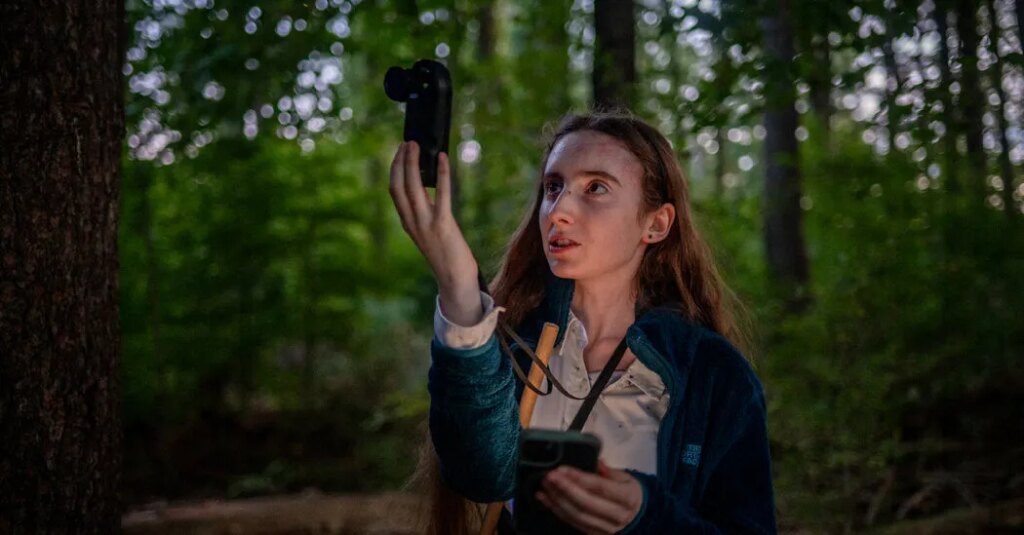
As the sun went down one night in September, 16-year-old Violet Clinton marched into a meadow of goldenrod with her butterfly net.
Every few minutes she flicked it toward a speck in the air. She knelt to examine a bug that looked like a toasted pecan with antennae.
“This is a three-lined leafroller moth,” she said. “There’s one kind of woodgrain leafroller moth that looks similar, but those came earlier in the year.”
She snapped a picture with her smartphone, then set the moth free. Onward she went toward a cluster of pines where an even greater variety of insects awaited.
“That’s a pug moth. That’s an elegant grass-veneer moth. And that’s a wasp.”
Violet is a high school junior by day and a moth researcher by night. While many of her Gen Z peers scroll through TikTok or fret about college applications, she spends two or three evenings a week “mothing” — think birding, but without the feathers — in the Eugene and Agnes Meyer Nature Preserve in Westchester County, N.Y.
She has cataloged more than 11,300 insects so far as part of a seven-month study she is conducting of moth diversity and abundance in the area. Her goal is to identify which species are present in three habitats under different weather conditions and moon phases — information that can be used to aid conservation efforts for moths and the plants they pollinate.
Violet’s findings have placed her in a league with researchers decades her senior: At this summer’s annual meeting of the Lepidopterists’ Society, she took second place in a research competition among a field of college and graduate students.
Her work is filling in gaps in scientists’ knowledge of where moths can be found, especially common moths that do not attract as much research funding as pest species, said Jason J. Dombroskie, an entomologist and the manager of the Cornell University Insect Collection.
The decline of the global insect population has put key pollinators, like bees, in jeopardy. Violet wants to know just how much moths can help pick up the slack.
“Realistically, this data will outlive her — it will be useful well into the future,” Dombroskie said.
Beyond the data, Violet hopes to persuade others to be a bit kinder in their estimation of moths — not exactly the prom queens of the insect world.
“A lot of people think that moths just eat clothes,” she said. (Their larvae are actually to blame, she added, and it’s only a couple of species.) They tend to be seen as drab brown pests, perennially overlooked in favor of flashier, more charismatic winged insects like butterflies.
Violet wants people to appreciate that moths are important. If you look closely enough, she said, you may even find them beautiful.
Her research takes up a lot of her free time, although she also plays cello and has written a draft of a novel about a girl who loves moths. It is rare for her to come across a moth she cannot identify. But that night, the woods were full of surprises.
“Oh, I’ve never seen this species before,” she said, brightening with excitement as she crouched to take a picture. “I’ll figure it out.”
‘Impossibly Ambitious’
Violet was dressed like a typical teenager, in Saucony sneakers and a teal zip-up fleece. As we walked, she showed me moths the size of Oreos and moths that looked like splinters, moths with brilliant red underwings, moths that disguise themselves to resemble bird poop. She treated each one with affection, as if it were an adorable newborn kitten.
“I feel comfortable picking up and touching every bug,” she said.
She moved through the woods with the seriousness of a seasoned entomologist, pausing occasionally to record the temperature, air pressure and humidity in a spreadsheet. Soon she reached the first of three data-collection stations she had set up earlier that evening, where a sheet of canvas glowed purple under two UV lights.
Violet had bought one light with money from her after-school job shelving books at the local library; the other was technically a Halloween decoration. A gardening cage nearby was draped with a damp T-shirt that Violet had soaked in her homemade moth bait: a mixture of mushy bananas, brown sugar and beer.
“I have to buy the beer,” said Brian Clinton, Violet’s father, who trailed behind her.
“It’s just for the moths,” Violet added.
Brian, a physician, drives Violet to and from her mothing expeditions, but does not help with data collection. The outings are a nice way to spend time together, he said, even though he admittedly does not know very much about moths.
“She can see it flying, and she’ll say, ‘That’s a clover looper moth,’ and I’m like, ‘What?’” he said.
Violet has been curious about insects since she was a child with a habit of poking around for grasshoppers. Her first memorable brush with a moth was when she was around 7 years old and brought home two woolly bear caterpillars that she had found inching their way across a sidewalk. In the winter, she thought they might have died, but in the spring they hatched as Isabella tiger moths with vibrant orange wings.
By the summer between middle and high school, she was studying field guides about insects to compete in entomology events as part of her school’s Science Olympiad team. Her family has been supportive, allowing her to raise hornworms from a pet store until they hatched into Carolina sphinx moths.
Still, there are limits: The beer-and-banana-soaked T-shirts have to be washed outside with a hose, not in the washing machine.
At the beginning of her sophomore year, Violet’s science research course at Horace Greeley High School required her to pick a subject for study. While many students chose to work with publicly available data sets about A.I. or mental health, she elected to do her own fieldwork.
Her data-collection efforts went well beyond the stuff of a typical school project. Seeking guidance, she sent an email to to Dombroskie, whose research specialty is moths.
“She had what I thought was an impossibly ambitious project, but she was insistent,” he said in an interview. “I said, ‘If you can pull this off, you’ve got something.’”
They began meeting on Zoom in January to refine her research process. Impressed by her drive, Dombroskie encouraged her to attend the Lepidopterists’ Society meeting in June at the Carnegie Museum of Natural History in Pittsburgh.
There, she presented her preliminary data from three habitats — deciduous forest, pine forest and meadow — on a poster board for the student research competition. “I thought, ‘Yeah, she’ll do a poster, but she won’t win: She’s competing against a lot of grad students,’” Dombroskie recalled.
Afterward, he said, a colleague came up to him and asked, “Where did you find her?”
The Forgotten Pollinators
What’s so great about moths? Violet would love to tell you.
There are 160,000 species, at least eight times as many as butterflies. And while bees tend to get a lot of credit as pollinators, research suggests that moths may actually be more efficient. They carry pollen on body parts including their ventral thoraces (entomology-speak for chests), helping to nocturnally pollinate crops and wildflowers.
“A lot of plants couldn’t exist without moths,” Violet said. The insects contribute to biodiversity and help scientists assess the effects of climate change, she added.
Yet they don’t tend to attract the research attention or cultural fascination that some other insects do. It’s the “Bee Movie,” not the “Moth Movie” — and don’t get a lepidopterist started on the portrayal of moths in “Silence of the Lambs.”
Unlike many people her age, Violet does not use social media — that is, unless you count iNaturalist, the citizen-science app where she identifies moths with the help of other lepidopterists. For her, the study of moths is not about influence or clout.
What is it about, then? It might be tempting to cast Violet’s passion for moths as one teenager’s effort to resist the encroachments of the digital world by immersing herself in a natural one that is fast disappearing. Maybe her work delivers a tidy lesson in the importance of stopping to consider the beauty that exists right under our noses, or the hidden value of those everyday annoyances we so often brush away.
Like any good scientist, Violet resists such sweeping conclusions.
Ask her why she pays such close attention to moths, and she will give it to you straight: “They’re important pollinators that people haven’t thought about already.”
Despite her interest in insects, Violet does not plan to study them professionally. Entomologists often have to trap and kill bugs, which she does not want to do. (“They put them in a jar and the jar has a chemical so they slowly slop flapping and it’s really sad,” she said.) She plans to study animal science and become a zoo veterinarian.
Back in the preserve, it was approaching 10 p.m. Violet had found 373 moths in all, including signate Quaker moths with hairlike scales and aster eucosma moths that shimmered like trout. There had been two pale beauties, a translucent-winged species that looks less like a moth and more like the ghost of a butterfly.
“Sometimes I need to photograph a moth for the data collection, but a praying mantis or a spider is eating it,” she said. She does not like to disrupt the way of nature, so she takes the picture anyway.
Over the next few days, she uploaded the images to iNaturalist and identified them with assistance from other users, as well as her field guides of Northeastern moths and online databases like BugGuide. She will stop collecting data at the end of October, when most of the area’s adult moths will have died. Then she will finish her analysis and submit the results to academic journals.
But even once her official research is done, she will probably not stop mothing.
“I saw a moth today in the hallway at school,” she said when we spoke on the phone a few weeks after our nighttime walk.
“It was a greater red dart,” she continued. “I released it, and it flew away.”
The post Why Has This Teenager Tracked Down 11,377 Moths Since April? appeared first on New York Times.