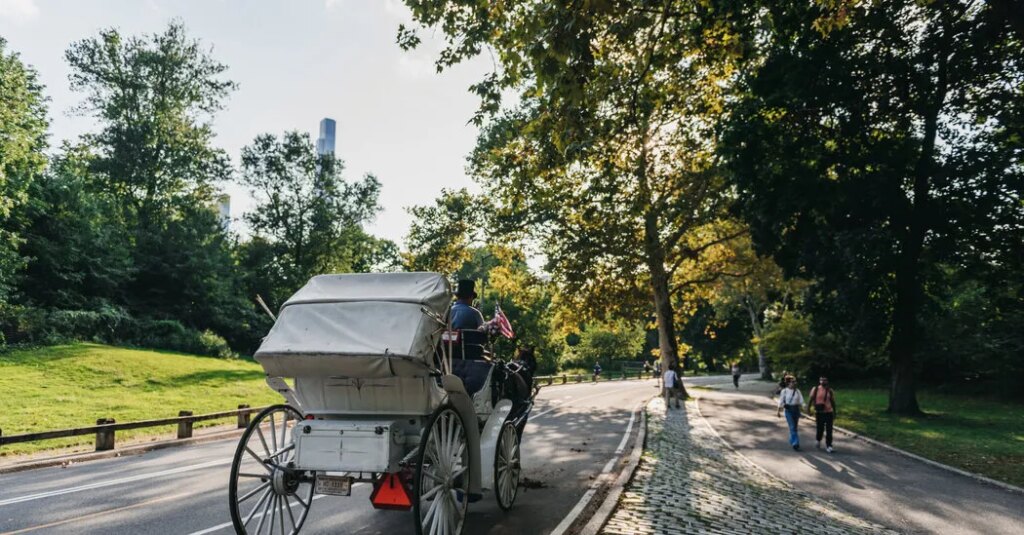
In an eerie preview of what the future may hold — a Central Park without its signature fleet of carriage horses — the south end of the park was practically horse-free on Thursday afternoon.
The carriage drivers were down at City Hall, protesting the vote that the City Council was taking to end their 160-year-old industry and affording their own preview of the long, messy process that lies ahead.
The Council’s bill to ban carriage horses, which passed 40 to 7, will be signed into law by Mayor Zohran Mamdani, the mayor’s office said. Animal rights activists triumphantly declared victory. But the carriage drivers do not plan to amble off peacefully into the sunset.
“We will see them in court,” Alexander Kemp, the administrative vice president of Transport Workers Union Local 100, said Thursday afternoon. “This bill is blatantly unconstitutional, providing nothing but a plan to draft a plan. There’s nothing concrete for hundreds of workers, carriage owners and family members who face total economic devastation.”
The Animal Legal Defense Fund took the opposite perspective, declaring, “Today is the start of a more humane and safe approach to New York tourism — for people and horses alike.”
The ban does not take effect until June 2028. Between now and then, according to the official summary of the bill, the city must find a way to humanely retire the horses without allowing their sale or transfer “for inhumane purposes, such as for slaughter or for use in another horse drawn cab business.” It directs the city to come up with an “industry transition plan” by next April for the benefit of horse owners, drivers and stable workers. Then there is the matter of the carriage medallions that the carriage owners had to buy from the city.
“I paid over $300,000, so who’s going to pay me that money then?” Onur Altintas, 41, a driver who owns four horses, said outside City Hall after the vote. “I invest my life to that business, my future. I invest my future to that business. Now they are taking my future away. My kids, my family, all my life, depends on it.”
Among the protesters was a woman who appeared to be a carriage driver and held a plastic bag of dung with a label indicating that it represented what she thought of the vote.
The vote capped a yearslong debate over whether the carriage-horse trade was a quaint throwback to a gentler time or a brutally abusive system of animal slavery. The industry’s demise was set into fast-forward motion in June when an 18-year-old tourist from India, Romanch Mahajan, died in a fall from a carriage.
A lawyer for Mr. Mahajan’s family, Sagar Chadha, said that the Council’s vote “achieved justice today, not just for Romanch but for the human beings and the horses that have been injured over the last four decades in this city.”
Nicole Gelinas, a senior fellow at the conservative think tank the Manhattan Institute and a supporter of the carriage-horse industry, called the vote a blatant act of socialist overreach. “It is the seizures and the extinguishing of private property and private property values without compensation and without regard to the facts,” she said.
At Central Park, a carriage horse driver who gave only his surname, Yilzin, for fear of harassment over his trade, called the ban blatantly unfair. “People think we abuse the horses,” Mr. Yilzin said. “What about chickens? Ducks? Cows? If they want to ban the horses, they should ban eating the animals.”
But late in the afternoon, as the carriage drivers returned to their posts in the park, the customers gathered, too.
A young man, Izzy Ramos, took a photo in front of a horse carriage. He had heard of the ban but didn’t know much about it. “I’m from Wisconsin,” he said as he got ready to climb in. “I am excited. I want to try everything.”
The post Drivers Are Livid and Activists Exult After Vote to Ban Horse Carriages appeared first on New York Times.