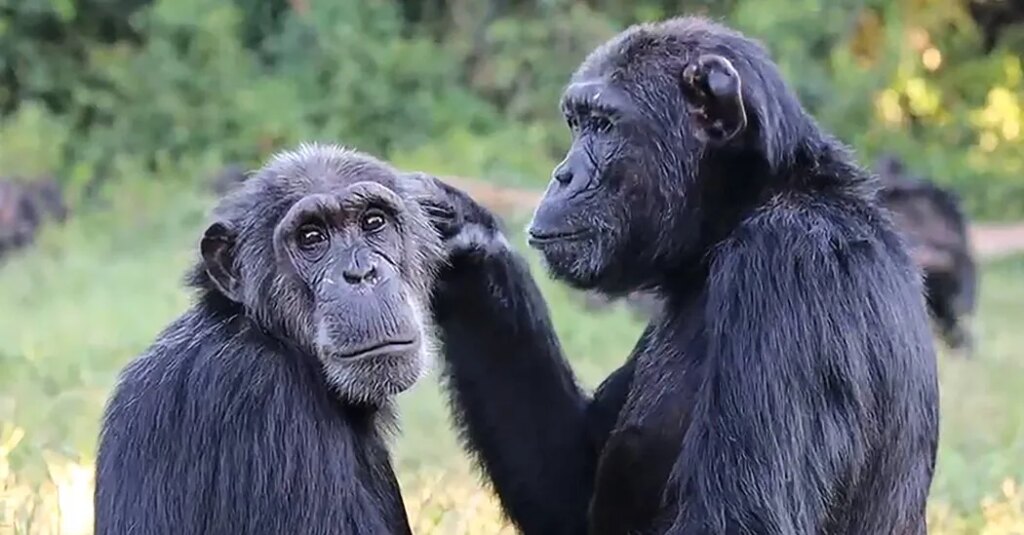
Pasa and Yoyo, two female chimpanzees, are best friends. They spend their afternoons lounging together in the warm grass of the Ngamba Island Chimpanzee Sanctuary in Uganda, grooming and sharing food. Sometimes they even try to escape the grounds together.
They are also less likely to steal food from each other, according to the results of a new experiment that pitted friendship against pineapple slices.
The new study is the first to find that primates can prioritize friendships over tasty treats, revealing an ability to squash selfish impulses previously undocumented in our hairy ape cousins. The discovery, which may hint at the roots of human norms around friendship, was published in the journal Evolution and Human Behavior.
“It wasn’t obvious to us that chimpanzees would steal less from their friends,” said Oded Ritov, a social psychologist at the University of California, Berkeley and lead author of the study. The discovery shows that chimps, like humans, have social expectations of each other, he added. “We think that these expectations might be a basic building block that later evolved into fairness and other types of morality we see in humans.”
Notions of “friendship” in nonhuman primates have a contentious history. Many researchers have claimed that attributing the term to relationships in primates like chimps and bonobos is a kind of anthropomorphism, imposing ideas familiar to us onto distantly related animals, where they don’t belong.
“For a long time, it was like this F-word,” said Laura Lewis, a biological anthropologist at the University of California, Santa Barbara and coauthor of the study. But over the past few decades, primatologists have uncovered increasing evidence of friendships in social primates, finding that they show more trust and support toward the peers they feel close to.
In the wild, chimpanzee friendships mostly develop between males, where they nurture bonds primarily to defend against alpha male tyrants or provide backup in fights against other troops. In bonobos, friendships are common among females, who must vie for power in the prevailing matriarchy. In captivity, for both species, friendships develop more broadly across a troop, with fewer sex differences.
“In captivity, you sort of have to deal with each other all the time,” said Zoë Goldsborough, a behavioral ecologist and primate expert at the Max Planck Institute for Animal Behavior, who was not involved with the research. Because captivity removes some of the normal constraints on a chimp’s life based around food, and conflict, you see many more relationships, including friendships, flourish.
Once established, friendships afford many privileges. Friends hang out, hold hands, nest together at night, protect each other in battles and console each other after fights or if an infant dies. Sometimes chimps even get jealous when they see a friend grooming another chimp, intervening to prevent them from bonding with someone else, said Dr. Goldsborough.
In the new study, the researchers wanted to see whether chimp friendships encouraged self-restraint regarding certain bad behaviors, in this case, stealing.
The team scrutinized 800 hours of video recordings of the Uganda sanctuary to figure out which chimps were friends. Then they set up trials in which the chimps were placed in pairs. One of the chimps in a pair had the option of being a thief who could steal fruit from a victim; the victim was either a friend or a neutral acquaintance. The chimps sat in adjacent rooms, one with metal trays stocked with pineapple slices and the other with ropes attached to the trays, which the theif could pull to steal the treats for itself.
“Sometimes the thieves would come in and they’d rip that tray,” said Dr. Lewis. But other times they came in, inspected the rope, then dropped it in an act of protest. When Yoyo was faced with the opportunity to steal from Pasa, she rejected the experiment altogether, turning her back to the ropes and refusing to enter the room at all.
Overall, the results revealed that friends were less likely to steal from one another, and pulled the pineapple trays away only 61 percent of the time, compared with 70 percent of the time with acquaintances.
When a chimp did steal from a friend, the result was chaos. The betrayal induced the victimized chimp to do things like pound its fists into the ground, screech loudly or scratch itself in a fit of anxiety, showing that it had expected more from its pal.
But after these betrayals, researchers found that the same chimps were quicker to forgive their friends, eventually acquiescing to such swindling in later trials. Nonfriends received no such grace, and were met with the same degree of anger throughout the experiment.
“The fact that they’re able to attenuate this behavior depending on their social relationships is incredibly important,” said Dr. Lewis, “and we think it’s critical for the maintenance of these social relationships over time.”
As humans, “we put a lot of weight not just on the nice things people do for us, but also the lack of mean things they do,” said Dr. Goldsborough. “This study shows very nicely that chimpanzees also do this.”
The post Chimps Steal Less Often From Their Friends, Even When Offered Pineapple appeared first on New York Times.