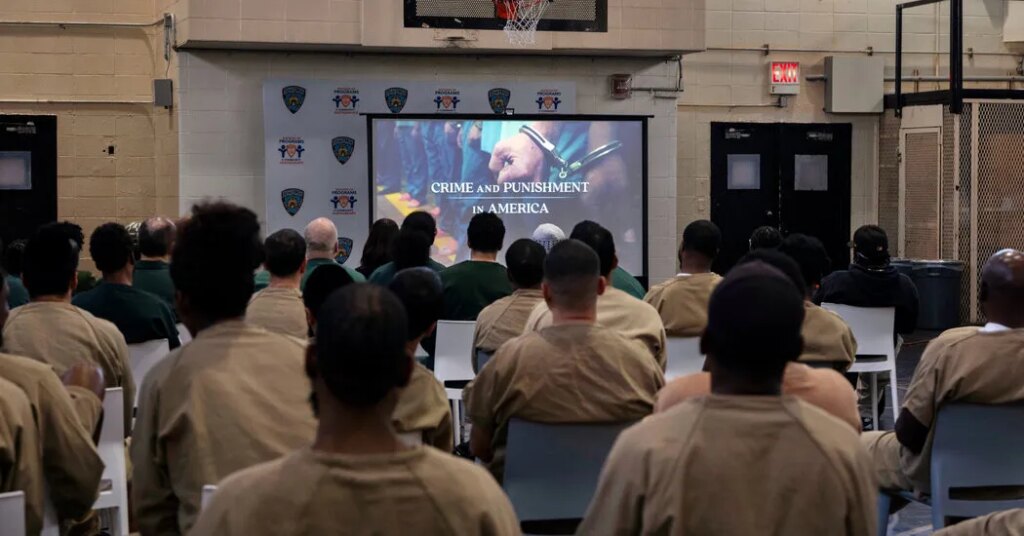
As inmates at the Rikers Island jail complex filed into a gymnasium for a documentary screening last week, some in the front rows were buzzing from a recent basketball league win. Others shuffled between plastic chairs in search of conversation.
Few seemed to anticipate that within the hour, the matinee showing would leave several of them fighting back tears.
The film, “Crime and Punishment in America,” is set to premiere on Nov. 16 on PBS. In four parts, and across eight hours, it chronicles the history of the criminal justice system in the United States, dating to the colonial era. Told chronologically through archival materials and interviews with experts and people who were once incarcerated, the docuseries is both macroscopic and meticulous in its examination of how the nation has constructed its laws and the penalties for those who break them.
The film discusses the American origins of the modern penitentiary system (“Incarceration as both punishment and rehabilitation was something no country had ever tried”) and the legacies of slavery (“Most prisons were modeled on the New York system of private contractors and forced labor”). It also looks at the proliferation of “tough on crime” approaches to criminal justice policy: “In 50 states, in 3,000 counties, a series of actors, most of them unknown to us, made small decisions in the direction of harshness.”
The seed for the film came more than a decade ago, when Lynn Novick, a seasoned documentarian known for her collaborations with Ken Burns, delivered a lecture to the Bard Prison Initiative. The program, run by Bard College, provides liberal arts educations to prison populations and was the subject of Novick’s 2019 docuseries, “College Behind Bars.”
“Throughout the course of that project, I just was constantly reminded of how little I knew — meaning nothing — about the history of the justice system, and why our prisons are the way they are,” Novick said. She was particularly interested in how the United States became one of the world’s leading incarcerators, invested in punishing criminals harshly and often inequitably. “We believe in redemption and forgiveness and mercy,” she said, “but not for everyone.”
In making “Crime and Punishment in America,” Novick added, she hoped to explore a fundamental question: “How did we get here?”
At Rikers, Novick couldn’t show the inmates all eight hours of her new film, so she screened a 48-minute clip reel instead. The beleaguered complex in the East River, with its history of violence and dysfunction, has been ordered to close by next August, though the city appears unlikely to meet that deadline. It ultimately plans to replace Rikers with four smaller borough-based jails.
Inmates watched the clips with rapt attention. In a discussion that followed, they were more open and emotional than Novick had expected.
They expressed weariness about inhumane conditions for inmates, frustration about apathy that sentencing judges can seem to show and sorrow about forces outside their control affecting their incarceration.
Joel Clapp, who had just recently been released from prison before being arrested again last month, spoke about his troubled upbringing, which he felt he could not overcome.
“Circumstances made us crash and burn,” Clapp said. “We didn’t know how to deal with it. We didn’t know how to reach out for help, because we continuously keep getting judged for our past over and over and over.”
Niko Willer agreed: “Once you come through, it becomes a revolving door,” he said. Willer, who in May was convicted of burglary, has been in and out of the carceral system since he was 9 years old.
Several inmates shook their heads during a portion of Novick’s film about three-strikes laws, which, despite being promoted by politicians as a way to stop violent, career criminals, heavily affected perpetrators of nonviolent crimes.
When Stanley Richards, the commissioner of the New York City Department of Correction, took the microphone, he encouraged the inmates to be wary of becoming stuck in their vexation.
“Don’t let that anger be an anchor around your ankles,” said Richards, who is the first formerly incarcerated person to be the department’s commissioner. Having “hard conversations” about such feelings, he added, can become “a springboard of hope.”
Numerous inmates said they felt empowered both by the event, which they characterized as part of the rehabilitation support that had not always been available to those in jail, and by the fact that Richards himself had once been imprisoned. “Things have really got better,” said one inmate, Rohan Brown.
Rahsaan Thomas was held at Rikers several times in the late ’80s and early ’90s, at the same time that his mother and stepfather worked at the facility. He told the crowd that while serving a stint at the San Quentin prison complex in California, he became a writer, podcaster and filmmaker. (Thomas had been sentenced to 55 years and six months to life for a second-degree murder conviction and related charges, but California’s governor, Gavin Newsom, commuted that sentence.)
Thomas is now a consulting producer on Novick’s film, and appears in it. Some inmates recognized him onscreen.
“I was supposed to never come home,” he said.
The post At Rikers, Inmates See Themselves in a Film About America’s Jails appeared first on New York Times.