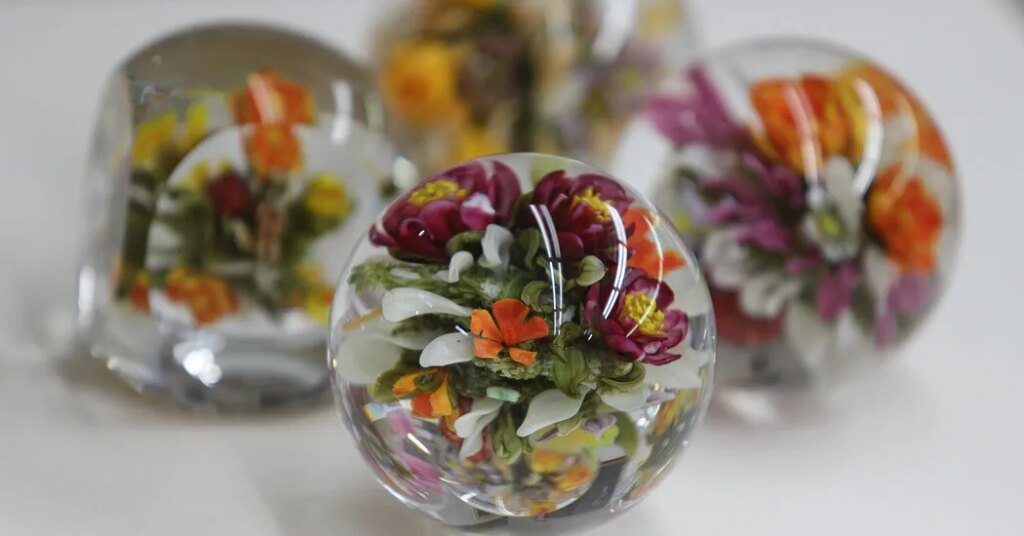
Paul Stankard, whose decades-long obsession with replicating the natural world in glass transformed the American paperweight from tchotchke to fine art, died on Oct. 6. He was 83.
The cause of death was cancer, said his daughter, Christine Kressley.
In 1972, with three young children and a newborn at home, Mr. Stankard skipped out on a steady job blowing glass for chemical laboratories. He was in love — with paperweights. The form’s pioneers had filled their weights with stylized glass garlands, pansies and primroses. Not Mr. Stankard, a sprightly, self-taught naturalist. He set out, he told a film crew in 2024, “to invent a new language to interpret native flowers in glass.”
For the next 54 years, over a nearly 5,000-degree gas flame, he melted and joined canes of colored glass into hyper-realistic buttercups and spiderwort. Within three-inch hemispheres, he created spectacular, increasingly intricate natural worlds from glass: root systems, worms, moths and honeybees in flight; kaleidoscopically colored bouquets crammed with foxglove, moss, blueberries and sprites.
Mr. Stankard meant his pieces, which commanded prices in the high five figures and landed in the permanent collections of the Victoria and Albert Museum in London and the Metropolitan Museum of Art in New York, to astound and delight. Could those stamens, lilacs or veined and dappled leaves really be made of glass? The technical precision his illusions demanded in turn drove and delighted Mr. Stankard, who was fanatically serious about his craft.
“Paul just loved glass,” David Graeber, his longtime studio assistant, said in an interview. “He lived it, breathed it, ate it.”
Paul Joseph Stankard was born in North Attleboro, Mass., on April 7, 1943, to Martin Stankard, a chemist, and Mary Florence Stankard.
School was torture. As an adult, Mr. Stankard discovered that he was dyslexic. But his childhood home opened onto woods where the swamps, ponds and hills teemed with mountain laurel and touch-me-nots. Roaming free there, Mr. Stankard remembered in 2024, “you felt like a pioneer.”
Impressed by a trade school brochure his son brought home, Martin Stankard coaxed Paul into a program for scientific glassblowing. Afterward, Mr. Stankard spent his workdays blowing apparatuses for chemists. On weekends, he took his torch and tool kit home.
‘Paul just loved glass. He lived it, breathed it, ate it.’
He blew glasses in his utility room and sold glass animals at craft fairs for a quarter. But nothing enchanted him like paperweights. Magnified by a clear crystal dome, imperfections were impossible to hide — a challenge to which Mr. Stankard thrilled. Paperweights, he told The Palm Beach Post in 1996, “embody my attitudes about Mother Earth and nature. The spherical shape gives me a parameter, and within that, I’m able to create.”
For $10, he sold his first paperweight to an antiques dealer at an Atlantic City craft fair in 1971. By 1975, his weights fetched between $250 and $400, said Alan Kaplan, an antiques dealer who began working with Mr. Stankard that year. In 1989, Mr. Stankard had begun stretching his orbs into prisms that sold for nearly $10,000. That year, he hired David Graeber. The men met through Mr. Graeber’s uncle, the owner of a Mobil station where Mr. Stankard settled his account in paperweights.
“Paul was the almighty barterer,” Mr. Graeber said. “Paperweights for service — with the butcher, with the dentist, with the lawyer.” The weights could buy a lot of steak.
As he aged, Mr. Stankard pushed himself toward increasingly ambitious designs. In his Mantua, N.J., studio, experiments with roots turned into knobby spirits that danced at the bottom of his weights. He played with reflection, refraction, plants’ life cycles and microscopic words. He made glass resemble sand. Within poured orbs and blocks of optical glass, he squeezed whole bouquets. Could he fit three? Five? He could.
Mind-bogglingly, taxonomically true to nature, his pieces turned the paperweight world on its head. “A paperweight had been an attractive object,” Douglas Heller, a glass dealer who sold Mr. Stankard’s work in his New York City gallery from 1980 onward, said in an interview. “But looking at Paul’s was like looking through a window to another world. He took it to unprecedented heights.”
Mr. Stankard showed his work in New York at the Museum of Modern Art in 1998 and the Museum of Arts and Design in 2004.
As his star rose, so did the paperweight’s. “There’s a Before Stankard and After Stankard,” Mr. Heller said. Mr. Stankard’s creations convinced a generation of American craftsmen of the object’s creative potential. In 1994, The Chicago Tribune named the paperweight the year’s hottest collectible.
Which is not to say that Mr. Stankard’s work conquered all. A critic in The New York Times wondered aloud in 1989 whether Mr. Stankard packed his paperweights with such imagination out of fear “that he might be viewed merely as a craftsman rather than a true artist.” In a 1993 cover story — “Revenge of the Philistines” was the headline — Forbes lumped a Stankard piece in with “junk collectibles.”
If he heard the sneering, Mr. Stankard did not seem to care. A devout Catholic, he saw melting his woodland worlds into miniature as a higher calling. Wearing purple didymium lenses to protect his eyes from the sodium flare heated glass emits, Mr. Stankard worked beneath a Benedictine motto: Laborare est orare, Latin for “to work is to pray.” He strove for excellence. It was “to respect God’s beautiful creations,” he said in a documentary.
“When I look at a flower, I don’t think that God, after creating man, took a rest and then went around creating the plants,” he said. “I think that he worked just as hard on the flower.”
Mr. Stankard is survived by six siblings; his wife, Patricia Stankard,; five children and six grandchildren.
The post Paul Stankard Has Died. Behold What He Did With Paperweights. appeared first on New York Times.