Reuel Marc Gerecht is a resident scholar at the Foundation for Defense of Democracies. Ray Takeyh is a senior fellow at the Council on Foreign Relations.
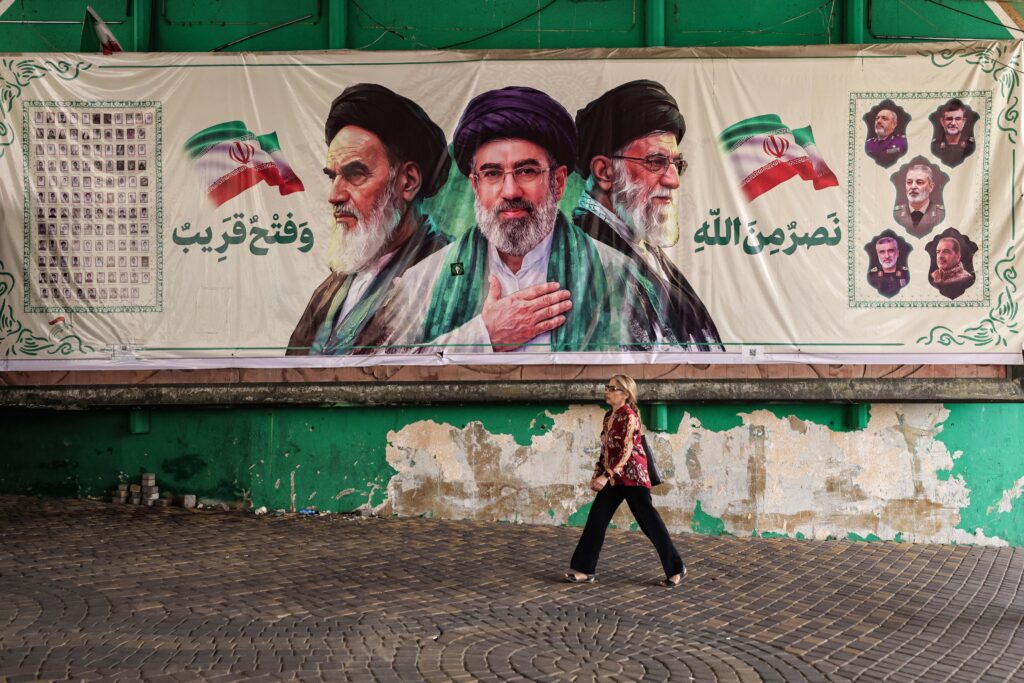
Locked in a war of attrition with the United States, the Islamic republic has clear objectives. President Donald Trump’s recent decision to send another aircraft carrier to the region and threaten the resumption of a significant bombing campaign after the midterms won’t alter these aims. The ruling clerics and the commanders of the Islamic Revolutionary Guard Corps seek to create a new tributary order, imposing tolls on ships traversing the Strait of Hormuz and severing security ties between the United States and the Arab Gulf states.
The regime also wants to find a means to deter Washington and Jerusalem from attacking. Until Tehran can revive its nuclear weapons program, domination of the Persian Gulf — having the capacity to control or destroy its hydrocarbons — is the only way to possibly checkmate the country’s primary foes. Any diplomatic compact that ends this war — and despite Iran’s awful economic state, Tehran seems in no rush to find a diplomatic solution — must, from Tehran’s perspective, bring about American capitulation. Indeed, this is how the Iranian regime saw the Islamabad Memorandum of Understanding — the interim peace agreement signed on June 17.
The Iranians have given up on neither their proxies nor their atomic aspirations. We can’t gauge how serious the regime’s current nuclear efforts are, but it is engaged in “high levels of activity” at important bombed sites, according to the Institute for Science and International Security. The IRGC’s arguments for nukes as the ultimate deterrent are no less convincing just because alternative strategies — pressure on Hormuz and attacks by its proxies — have proved so useful against enemies.
With its proxies, Tehran has reshuffled its priorities to focus more on Saudi Arabia. Iran’s Yemeni Shiite allies, the Houthis, have become its most effective foreign asset. Their clarion call — “God is the Greatest, Death to America, Death to Israel, Curse Be upon the Jews, Victory to Islam” — shows a movement deeply imbued with Tehran’s spirit. As important, the Houthis have successfully deployed Iranian-designed and -manufactured missiles and drones to bedevil Saudi oil shipments and spread terror in Saudi cities.
Iran’s Islamists have long had contempt for the Sunni Gulf Arab dynasties that have been too close to America. And Saudi actions and propaganda over the years may have galled Tehran the most. The common thread in Saudi Arabia’s evolution — from a Wahhabi fundamentalist state to an Arab nationalist, modernizing autocracy — has been its hostility to the Islamic republic.
Saudi ineffectiveness against the Houthis unquestionably whets Iran’s appetite to further humiliate Saudi Crown Prince Mohammed bin Salman, the de facto ruler who was once the most ardent Sunni opponent of the Iranian regime. The Islamic republic’s rulers have always wanted to believe that the kingdom is fragile, built on religious hypocrisy and decadent princes. Given the crown prince’s faltering grandiose “2030” ambitions, the shocking weakness of Saudi armed forces against its Yemeni enemy, and the failure of Washington to protect the kingdom, Tehran’s anti-Saudi dreams now seem more within reach.
For Tehran, the wild card remains Donald Trump. He still can instill fear. Despite decades of U.S. sanctions and Iranian sanctions evasion, the American blockade and Treasury Secretary Scott Bessent’s campaign to put economic warfare on steroids clearly worry the regime. The economy is in free fall. According to the Iranian government, gross domestic product has declined by 10 percent year on year between March and June and inflation hovers between 70 and 80 percent. A polling outfit close to President Masoud Pezeshkian reported that only 9 percent of the public supports the status quo.
Too often, Westerners assume that such distress is bound to produce rulers seeking compromise. The war has injected a measure of pragmatism into the Islamic republic’s dealings — with its own people, not foreigners. The regime has all but abandoned the enforcement of the hijab. Gholam-Ali Haddad-Adel, former speaker of the parliament whose daughter was married to Supreme Leader Mojtaba Khamenei before she died in an Israeli airstrike, confessed, “Due to the war conditions, we are currently unable to enter the [hijab] front as we should.”
This is balanced, of course, by displaying more muscle. Hossein Taeb, the head of the Basij paramilitary shock troops that attack protesters, announced a significant increase in his forces in anticipation of deterring and suppressing another insurrection. The recently launched “Sacrifice for Iran” campaign openly hypes the use of militarized female units. This is surely intended to counter, at least rhetorically, the nationwide regime-shaking Woman, Life, Freedom movement, which erupted after a young Kurdish Iranian woman was murdered for “bad hijab” in 2022. The Islamic republic may be experimenting with a new version of its autocracy, one that’s less rigid about certain cultural issues but more brutal about internal challenges.
And it’s Iran’s internal problems, even more than Trump’s economic coercion, that most concern the Islamic republic. The theocracy’s priorities — proxies, missiles, drones and nuclear weapons — reflect this internal weakness: The regime can no longer stir a faithful nation to spread the revolution. Militant foreigners and technology have to save the regime’s sense of purpose.
The Islamic republic’s aspirations have always revolved around the challenge of how to do more with less. If the regime can survive Trump’s attempt to strangle it and provoke an uprising, the theocrats and guardsmen just might figure it out.
The post Iran is not bowing to pressure appeared first on Washington Post.