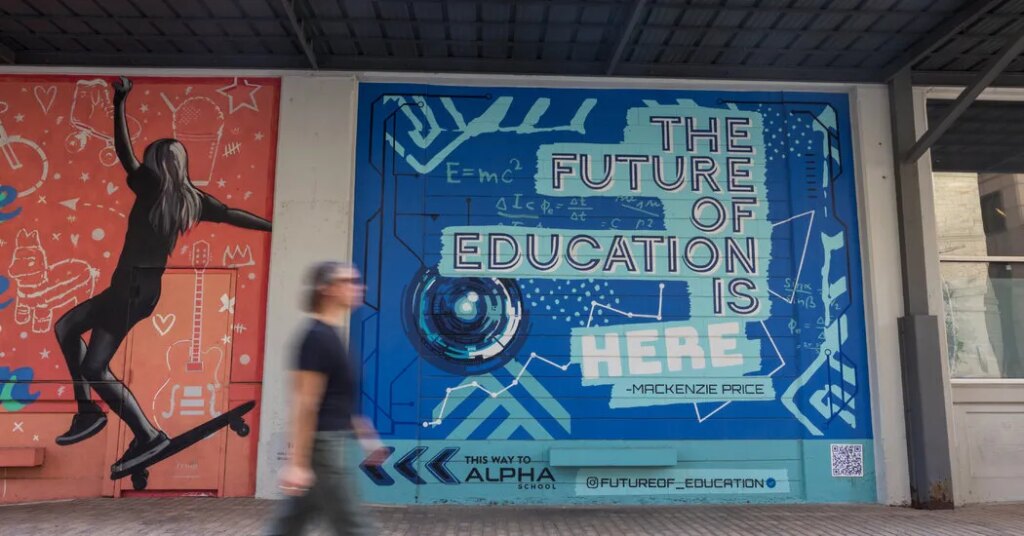
Alpha School, a fast-growing network of expensive private schools, promises to use A.I. to teach kids twice as much as they would learn in a traditional classroom in half the time. Academics take just two to three morning hours on a computer, freeing up the afternoons for workshops on vibe-coding, public speaking and sports.
The Trump administration has promoted Alpha as a model for “harnessing A.I.” to prepare tomorrow’s work force. Business leaders are talking it up on social media and podcasts, and some have signed up their own children.
For now, Alpha is a small, for-profit network, with lots of buzz and powerful backers, including the software billionaire Joe Liemandt. Its private schools serve about 1,500 students across 50 campuses.
But Alpha has huge ambitions to reach one billion students worldwide through its proprietary “A.I tutor.”
The plan depends partly on extending its reach into public schools. Already, the Alpha software platform has been quietly adopted by several school districts in Texas and South Carolina, according to a company document reviewed by The New York Times. About 2,600 public school students are now using the software.
To reach more, Alpha needs to prove that its technology works for a broader range of children, beyond its core customer base of affluent, tech-enthusiast families. But as Alpha markets itself to districts and states, a growing number of educators, and former Alpha parents and employees, are questioning the effectiveness of the network’s high-tech, low-book model.
Most of the students enrolled at Alpha private schools, which charge as much as $75,000 per year, earn high test scores compared with peers in more typical schooling environments. Some parents say their children are thriving. Still, many Alpha private school students are not meeting the targets at the center of the company’s marketing.
About half of K-8 students enrolled in Alpha private schools last year did not meet the promise that they would learn math twice as fast, according to Alpha data reviewed by The New York Times. About a fifth of students, out of about 400 total, missed the goal in reading.
Less than half of students were able to double their rate of learning in both subjects, according to the data, which spans fall 2025 to early 2026.
Alpha students are participating, essentially, in an experiment. At Alpha, there are no traditional teachers, few books and little paper. All of the academic lessons are delivered via apps, and students can earn lavish prizes for completing their work. Adults are present, but only as motivational guides: Students stuck on a concept can do video calls with tutors abroad. Some children who struggle leave or have been pushed out, according to documents and several former private school parents and employees.
Pushing out students is not uncommon in private schools, but public education presents a new test for Alpha. Many of the public school students now using the company’s software are considered at risk academically. Their schools cannot remove them. And public schools will not have access to the same perks Alpha offers its private school students as incentives to work hard.
This article is based on a review of Alpha documents and statements made by its executives, along with interviews with nine current and former Alpha parents and employees across the country. Some parents asked to remain anonymous to protect their children’s privacy. The employees requested anonymity because they did not want to risk their ability to work in the field.
The documents obtained by The Times show for the first time how Alpha student performance — based on its internal data and metrics — measures up to Alpha’s promises to families, and the full extent of the network’s reach into public education.
A spokeswoman for Alpha School, Anna Davlantes, said the company would not respond to written questions or requests for on-the-record interviews. This week, a consultant working with Alpha shared a blog post saying the network was developing new software and bringing books into the curriculum.
Alpha is riding a wave of fascination — and anxiety — with how artificial intelligence might transform learning. But its app-driven instruction cuts against the grain of a growing parent movement demanding fewer screens in classrooms. Research points to direct adult instruction, books and tactile materials as critical to effective learning.
In the Houston Independent School District, where two public schools are piloting the model, the superintendent, Mike Miles, said in the early weeks students spent longer than expected on the Alpha apps, eating into the time that was supposed to be spent on afternoon enrichment.
Still, Mr. Miles has rejected the idea of banning A.I. or screens entirely from schools. “We’re way behind on what kids need to know and be able to do to be successful in a different world and workplace,” he said.
But, he added, “I am a little skeptical for kids who struggle.”
A Promise to ‘Crush Academics’ in Two Hours
MacKenzie Price, an Alpha founder, has said she was inspired to start the network in Austin, Texas, in 2014, after her own daughter complained she was bored at school. The program met in a private home, with a small group of students using mainstream learning apps.
But around 2022, when generative artificial intelligence broke out, Alpha changed focus. That is when Mr. Liemandt, whose children attended Alpha, began investing heavily in the school and its technology, with a goal of transforming education “for everybody in the world.”
Mr. Liemandt now holds the title of principal of Alpha School, and serves as the network’s de facto chief executive.
Ms. Price, meanwhile, became an influencer in tech and education as she talked about regular schools “doing it all wrong.” Her ideas attracted supporters like Linda McMahon, the education secretary, and Bill Ackman, the hedge fund manager.
Even Elizabeth Holmes, the imprisoned Theranos founder, has boosted the network, calling Ms. Price “a visionary.”
The vision is that students will “love school” and “crush academics,” learning “2x in two hours” online.
The product at the center of the model is TimeBack, Alpha’s software platform. Over 7,000 students in total are using TimeBack, according to an Alpha document. In addition to Alpha private school students and several thousand public school students, the platform delivers academics to home-schooled students, to students in Poland and Malawi, and to students whose tuition costs are paid for by the state of Texas through its new voucher program.
On the TimeBack platform, students are directed to lessons in core subjects, including English, math and science. Alpha markets the app as an innovative “A.I. tutor.” But it does not contain a chatbot.
A.I. appears mainly to work behind the scenes, analyzing student progress in a number of learning apps, some proprietary and some popular in traditional schools, according to a Times review of the software and interviews with parents.
The apps contain reading passages, comprehension questions and math problems, targeted to a student’s level.
Public schools everywhere have long used learning apps, usually for practice. But in the Alpha model, the apps are the delivery system for new material.
Alpha private schools employ classroom “guides,” whose job is to motivate students, not deliver lessons, according to job listings and current and former employees. Students stuck in the apps on a tricky concept — what Alpha leaders refer to as the “doom loop” — can book time with tutors. But as the network expands rapidly, they must sometimes wait several days to get help, people affiliated with Alpha said.
Students read some literary and primary source documents in the app, but A.I. also generates articles for students to read and writing exercises tailored to children’s interests — gymnastics, Harry Potter — and offers feedback on student prose.
Like many other learning apps, TimeBack makes academics feel like a game. It awards points, known as XP, when children complete certain goals, and ranks students by name on a digital leaderboard. Parents can track their children’s progress on an online dashboard.
But the Alpha experience, at least on its private campuses, is not limited to the software.
Alpha bills its technology as a timesaver, and students are supposed to use their afternoons for “life skills.” At the private campuses, that could mean lessons in stand-up comedy or starting small businesses, bespoke experiences that are not available to others using TimeBack.
Alpha also has a unique incentive system. At the private schools, students who finish their app sessions can sit next to friends or win stuffed toys and electronics. For longer-term goals, there are bigger rewards, like cross-country field trips. Students can also earn cash — up to $1,000 for high test scores, according to an Alpha document.
Sarah Cone, whose 8-year-old daughter is in her second year at Alpha’s site in Lower Manhattan, said her daughter mastered two years of academics in about one year.
Ms. Cone, who founded a venture capital firm, moved her child from an elite traditional private school to Alpha. She praised the way the program encouraged her daughter to follow her interests: joining a book club and working with peers to create a baking business. African drumming and robot-building workshops have been highlights. The school has a library, she added.
Unlike at other Alpha campuses, Manhattan students are registered with the city as home-schooled students, because the state’s Education Department declined to incorporate Alpha as a private school. At least six other states have rejected Alpha’s bids to open public charter schools, often raising questions about its lack of traditional teachers.
Ms. Cone said she was unbothered.
“She is extremely happy at Alpha and really learning,” she said of her daughter.
Edward Nevraumont relocated to Austin so his four children could attend an Alpha private school. He likes that he can track online how his children are doing and that they can accelerate beyond grade level. His daughter Everest was Melania Trump’s State of the Union guest.
Mr. Nevraumont said the curriculum could be thin but praised Alpha for being responsive to parent feedback. The biggest gap is depth in the humanities, he added: “Things like literature, history, geography, fine art, music.”
Achievement vs. Growth
Most Alpha private school students are high performers. The median K-8 student scored at the 87th percentile nationally in math last winter on a widely used assessment, the MAP, and at the 89th percentile in reading.
Alpha’s academic commitment to parents is based on growth, however.
Between last fall and winter, a majority of students — 75 percent — advanced at least as fast as projected by national averages. But only 42 percent progressed twice as fast in both math and reading, meeting the “2x” growth standard featured in the company’s marketing.
Alpha had an especially difficult time meeting that mark for its lower-performing math students. About a fifth of Alpha’s private school students scored at or below the 50th percentile nationally in math last fall, and only 37 percent of that group met the network’s promised 2x growth by winter.
Alpha highlights network-wide averages, rather than student-level results. A curriculum consultant working with Alpha, Karen Vaites, wrote in a blog post Thursday that the network’s earlier results “are based on a set of products that aren’t half as good as what we’re creating now.”
Experts caution that public school students using Alpha’s model may not perform as well as affluent private school students. Home environment heavily influences learning outcomes, and public school students will not have access to the same rewards system Alpha uses to motivate performance.
David Slifka said those incentives had worked for his 14-year-old twins, who are thriving at Alpha in New York after struggling to focus in traditional classrooms.
“It’s so hard to know what education should be like with the rise of A.I.,” Mr. Slifka said. “I don’t know that anybody has it figured out, including Alpha. But at least they’re working hard to try.”
Growing Concerns
Some Alpha families have left voluntarily, while others were pushed out after their children struggled socially or did not achieve certain academic growth metrics, according to documents and several former parents and employees.
Parents at the Alpha campus in Brownsville, Texas, have also reported high rates of student turnover, according to Wired.
A former employee who spent time on several campuses said Alpha staff had talked about how to balance a push to increase enrollment while also counseling out children who struggled.
Alpha does not publish student attrition data, but Tasha Arnold, an Alpha official, told the Boston School Committee in April that the network had 6 percent turnover.
In a video explaining Alpha’s learning model, Ms. Price, the network’s founder, emphasized that it works for most students, but not all.
“We believe that ed tech is only 10 percent of the solution, while 90 percent is having a motivated student,” she said. “It is a messy process. We tell parents to expect results, not polish.”
The paucity of physical books, paper and pencils stood out to Savannah Ngo, a reading specialist who visited one of Alpha’s California campuses last spring when she was interviewing for a job with the network — part of a new push by Alpha to hire educators with expertise in early literacy.
“It was unsettling,” she said of the experience.
During her visit, Ms. Ngo saw that students had been given bound volumes of stories they had composed. One child told Ms. Ngo he had prompted an A.I. chatbot to write the text. Chatbots can be used in afternoon workshops, though they are not part of the morning app-based curriculum.
Ms. Ngo was offered the job but turned it down, despite feeling that many of the staff she met were warm and committed.
Laura Tortorelli is a reading researcher at Michigan State University who is developing an A.I. reading app. She said that while technology can provide personalized practice, it cannot replace human teaching.
Research shows students comprehend more of what they read in print than on screens, she noted.
“I love ed tech,” she said. “I’m interested in its potential for helping teachers do their job better. Not replacing teachers.”
A former Alpha employee said classroom guides were energetic but often lacked formal education training. The employee saw students as young as 5 sitting alone as they struggled with tasks like forming letters. Children were sometimes directed to YouTube videos for help.
There is also new scrutiny on the student culture at Alpha.
Wayne Vaughan, a former Alpha parent, wrote this fall on social media that his son attended Alpha’s flagship elementary school in Austin for five years, where fellow parents reported “negative self talk” among their children because of the pressure created by being ranked against peers by name.
Private high school students across several Alpha campuses recently participated in an eight-week freshman “boot camp,” meant to build traits like grit and entrepreneurship. Among other tasks, they were asked to clean public bathrooms or perform other “dirty jobs.”
Some students were hooked up to heart-rate monitors while they watched videos of their parents critiquing them, in front of their peers.
“We do not think the existence of discomfort means the exercise has failed,” says an Alpha website describing the boot camp. “In fact, in many ways, it illustrates why this skill needs to be taught.”
Some boot camp students posted about the experience with enthusiasm, although at least one expressed apprehension.
The existence of the boot camp was revealed by Benjamin Riley, a longtime education policy expert who has become a vocal opponent of A.I. in schools.
Expanding Into Public Schools
The children of tech and finance executives are not the only ones learning with Alpha.
The network also includes Unbound Academy, a virtual public charter school in Arizona. The school has posted underwhelming academic results, according to program data.
And Alpha leaders are marketing TimeBack under the brand name Studient to traditional public schools, promising that districts will pay only for students who meet learning goals. One Alpha document shows nearly 2,000 students in South Carolina are using the software, in the Jasper County School District and Allendale County Schools. Officials in those districts did not respond to questions.
In Fort Davis, a rural Texas district, and the Aldine Independent School District, in Houston, subsets of students use TimeBack to supplement traditional instruction for fewer than two hours a day, according to district staff. Texas school districts using TimeBack said they were not paying for it.
A spokeswoman for the Aldine schools said successful students could choose prizes from a catalog, ranging from small toys to a bike.
Michelle Hartmann, the chief innovation officer in Fort Davis, wrote in an email, “It is an exciting time in Texas education when what used to be a Hard No becomes a Hell Yea!”
Texas state education officials facilitated discussions between school districts and Alpha, according to The Texas Tribune and ProPublica.
The public schools using TimeBack are predominantly Black, Hispanic and low-income.
In the Houston Independent School District, about 100 children were selected to pilot TimeBack for math and reading because they were performing above the 60th percentile. The program was supposed to free up time in the afternoon for field trips and other hands-on learning.
But according to Mr. Miles, the Houston superintendent, in the first five weeks, many students spent afternoons on catch-up.
In Alpha’s private schools, some students also spend far longer than two hours per day on TimeBack, and some families hire tutors, according to parents and employees.
Mr. Miles said families could exit the program, and the district would pull children who do not make sufficient progress.
Daniel Willingham, a cognitive psychologist at the University of Virginia, said he had serious concerns about Alpha’s methods. Compressing academics into two hours per day suggests a lack of breadth and depth, he said.
“They think the way you toughen kids up is to get them to clean a bathroom, and the way you get them to learn is to power through it as quickly as possible,” Professor Willingham said, adding, “These are naïve theories of psychology.”
Alex Klavens contributed reporting. Georgia Gee and Sheelagh McNeill contributed research.
The post An A.I. School Claims to Teach Kids Twice as Fast. Many Don’t Make It. appeared first on New York Times.